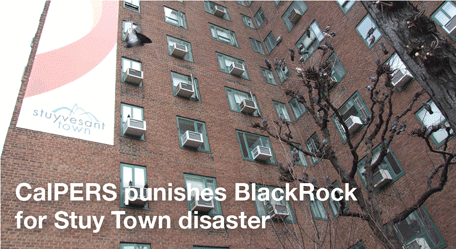
CalPERS punishes BlackRock for Stuy Town disaster

Another page has turned in the history of the Stuyvesant Town – Peter Cooper Village apartment buildings in New York, as iconic as they have been controversial since their initial construction in the 1940s. CalPERS, America’s largest pension fund, has terminated BlackRock, one of its property managers which led a 2006 purchase of the 80-acre site, after a 12-year relationship.

CalPERS wrote off US$500 million of its apartment portfolio after real estate manager Tishman Speyer Properties, which together with BlackRock and investors paid $5.4 billion for what the residents call “Stuy Town”, had given up control of the properties to avoid bankruptcy in January this year.

This week CalPERS terminated a $1 billion apartment management mandate with BlackRock, which had dated back to 1998. The fund has consolidated this with another long-time manager, the privately owned GID Investment Advisers.

The Stuy Town development marked the first major clearing of slum dwellings in New York, starting in 1943, financed largely by the insurer MetLife, which was awarded tax breaks and other government assistance.

It has been the subject of many court actions over the years, some on the basis of race. Courts ruled that the managers did not have to adhere to race discrimination laws applicable for public landlords, despite the government assistance in the development, and almost all the early tenants in the rent-controlled apartments were white.

CalPERS reported a loss of 37 per cent in its total real estate portfolio in the year to June. The fund is anticipating reduced costs and improved efficiency from consolidating its mandates under one partner/manager.


Sponsored Content

Leave a Comment

Sort content by

A Simple Theory of the Financial Crisis; or, Why Fischer Black Still Matters

In this month’s Financial Analysts Journal, Tyler Cowen professor of economics at George Mason University, Virginia makes sense of the current financial crisis by drawing on some of Fischer Black’s ideas. mrec4inarticleinline Sponsored Content scnative1 scnative2 scnative3

Arizona expands allocation ranges, freezes private investments

The $27 billion Arizona State Retirement System has extended its asset allocation ranges and postponed the approval of new commitments to private market investments until the end of June, unless an overriding investment opportunity exception exists. mrec4inarticleinline Sponsored Content scnative1 scnative2 scnative3

Bps speak: the real value in internal management

A 10 per cent increase in internal investment management results in a 4.2 basis points increase in net value added to a pension fund’s bottom line, according to analysis of the CEM Benchmarking database, which has data on more than 380 global pension funds from 1991 to 2007. mrec4inarticleinline Sponsored Content scnative1 scnative2 scnative3

Where the growth is: mandate trends in 2009

As a recent survey by US management consultant Casey Quirk showed, for investment management, 2009 is all about beta. Director of research, Ben Phillips, spoke to Kristen Paech about mandates that pension funds are investigating, and the role alpha may play. mrec4inarticleinline Sponsored Content scnative1 scnative2 scnative3

That market’s got style: investing through cycles

Style investing remains a powerful tool in periods of market volatility and, in particular, style analysis reminds investors to be aware of the distinction between overall market risk and stock specific risk. Amanda White spoke with director of Style Research, Robert Schwob. mrec4inarticleinline Sponsored Content scnative1 scnative2 scnative3

Risk reduction pays off for ABP

The giant Dutch pension fund ABP’s plan to reduce investment risk as a means of recovery from an underfunded position is paying dividends, with the coverage ratio increasing from 86 to 91 per cent from March to April. mrec4inarticleinline Sponsored Content scnative1 scnative2 scnative3

Previous



