


The UK’s Universities Superannuation Scheme has produced new climate scenarios that are more informative for investors by focusing on shorter-term scenarios and switching the focus from temperature pathways to the complex interplay of physical and human factors.
The £75.5 billion fund aims to develop a long-term investment outlook informed by the scenarios and draw out investment implications for capital markets expectations, top-down portfolio construction, and country/sector preferences.
USS commissioned the University of Exeter earlier this year to apply a new approach to scenarios to support its investment and risk management decision making. The result of that collaboration is a report released today No Time To Lose – New Scenario Narratives for Action on Climate Change, which introduces four new climate scenarios that look at shorter-term and more realistic time horizons to inform investment decision making.
The new scenarios are more meaningful for investors because they switch the focus away from global average temperature pathways and towards the complex interplay between physical factors such as extreme weather events and human factors such as disruptions in geopolitics, economics, financial markets, and technology.
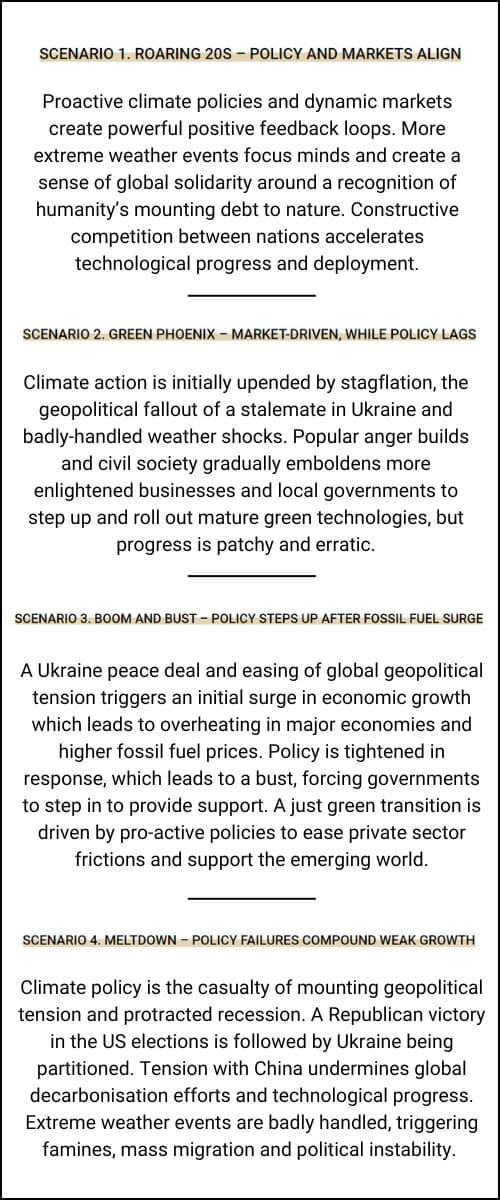 The focus is on operationalising net zero commitments and the need to have shorter term and bespoke scenarios to achieve that.
“This paradigm shift towards shorter horizons and business applications requires scenarios that focus less on the climate itself and more on the vicissitudes of politics, markets and extreme weather events. Global warming is not a major uncertainty over the next few years, but extreme weather events are rising rapidly, even if location and timing are uncertain,” the report says.
The report highlights that existing scenarios understate both the economic damage of climate change and the potential benefits of action, failing to capture key aspects of the real world, and so restrict their usefulness for investment decision-making. It also recognises that the mainstream economic models being used for climate risk scenarios are not up to this task.
Mirko Cardinale, head of investment strategy and advice at USS Investment Management, says the fund wants to lead in the development of this new approach that is focused on understanding how real-world dynamics could play out.
“The work with the University of Exeter has been extremely valuable in representing an important milestone for the development of a new approach to climate scenario analysis,” he says.
“We aim to lead in the development of this new approach that is less focused on precise estimation and more on understanding how real-world dynamics could play out in a complex world where climate risks cannot be looked at in isolation from political, economic, and technological factors. Moving forward, we intend to develop a long-term investment outlook informed by the scenarios and draw out investment implications for capital markets expectations, top-down portfolio construction, and country/sector preferences.”
USS’s Mirko Cardindale and University of Exeter Visiting Fellow Mike Clark will speak at the Sustainability in Practice event at Oxford University from November 6-8. For the program and more information click here.








Leave a Comment
You must be logged in to post a comment.
Login