


The $31.3 billion South Carolina Retirement System Investment Commission, RSIC, has launched a co-investment private equity program in a bid to reduce risk and enhance returns. Partnering with Chicago-headquartered GCM Grosvenor, RSIC will tap Grosvenor’s own private equity deal flow, as well as introductions to the manager’s GP network. The relationship will ultimately account for around 30-40 per cent of RSIC’s 9 per cent private equity allocation, and will also see Grosvenor help underwrite, review and ultimately speed-up RSIC’s investment with new GPs. The move underscores a wider trend among LPs, most notably CalPERS which is poised to restart a co-investment program for its $27.2 billion private equity portfolio, to invest more alongside GP partners.
“If we are looking at investing with a firm that is somewhat new to us, we will lean on Grosvenor and enlist their support in underwriting and reviewing the transaction. They will ultimately advise us on what we should do,” explains RSIC CIO, Geoffrey Berg. “Aside from this, we will also benefit from having a partner that has their own deal flow, that we would not otherwise have access to. It will allow us to cast a wider net for future fund investments and get to know new GPs through the relationship they already have with Grosvenor.”
Within this pillar of the relationship RSIC is particularly hunting introductions to new GP names in the middle to smaller end of the market where the LP sees less flow. Only two months into the partnership Michael Hitchcock, RSIC’s chief executive, is already impressed with the quality of new introductions. “It’s not a story about what gets done in the first few months, but several co-investments are live right now and we are impressed with the GP interest in our platform,” he says.
The relationship means RSIC can respond swiftly to GP enquiries in the first come first served, competitive world of private equity. Grosvenor’s expertise and infrastructure allows RSIC to assess the quality of deals, conduct due diligence, build conviction and react to new GP enquiries much faster than what the fund’s small Columbia-based team can manage, says Hitchcock.
“We have our own lengthy due diligence that involves a deep quantitative analysis to understand how a potential GP adds value. As a result, we are able to react quickly when shown a co-investment by a GP we already know,” says Hitchcock. “However, for GPs that we may not already have a relationship with, the Grosvenor platform provides a way for us to respond with speed without sacrificing the quality of our due diligence, because Grosvenor can bring more resources to bear in a shorter period of time than we can.”
Risk
Another benefit is enhanced returns but without any additional risk to the private equity fund investment RSIC is co-investing alongside.
“Co-investments have no fee and no carry, or a greatly reduced fee and carry, and you can therefore increase your return by capturing the gross-net spread. When done in scale, it greatly reduces the cost of our overall private equity program,” says Hitchcock.
Indeed, the benefits of co-investment over fund investment was proven time and again in RSCI’s two-year analysis of thousands of transactions prior to the co-investment program’s June launch.
“We were trying to figure out reasons why co-investment might not be the right thing, but we found the case for co-investment far outweighed any other issues,” explains Berg. “We wanted to see if private equity co-investment returns are lower than the overall fund investments for a given GP. While we did encounter pockets of poor co-investment performance, it appeared to be GP-specific rather than a broader outcome.”
The co-investment program is also tailored to cap risk by limiting the bitesize of any individual investment to around $30 million.
“We could do more than $30 million, but that would be an exception to the rule. We want to avoid the big, idiosyncratic risk that comes from outsize exposure to a single transaction. Rather, we want a large number of transactions that allow us to tap into the gross net spread of the private equity beta. This programme isn’t about trying to hit home runs with any individual transaction,” says Berg.
Marriage not dates
Co-investment also sits comfortably with the kind of manager relationships RSIC’s seeks, where the mantra is long-term and creative.
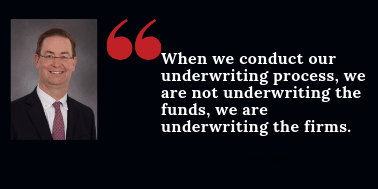
“We look for marriage, not dates,” says Berg. “For us, it’s not just about a single fund investment. We are looking for a partner than can manage our money over multiple funds. When we conduct our underwriting process, we are not underwriting the funds, we are underwriting the firms.”
RSIC has 100-plus relationships and all strategy apart from cash and short duration is outsourced.
 As the new program gathers steam, Hitchcock and Berg are turning their focus to other areas of the fund. This includes working with consultant Meketa Investment Group to explore the benefits, and possibility, of simplifying the asset allocation.
The fund currently has 17 asset classes with 22 benchmarks and the idea is to replace the top down structure with a more granular approach. For example, individual allocations to high yield, banks loans and emerging market local and hard currency debt, could be rolled into a simple fixed income or bond bucket. It’s a process that could lead to a change in the number of asset classes, says Hitchcock.
“We wouldn’t lose the ability to have exposure to the number of asset classes that we currently do, however, adding complexity to the portfolio would require conviction that it would add value over a more simplified approach.”
RSIC is also adjusting for the possibility of lower returns in a variety of ways. The equity allocation which was increased by 13 per cent in 2016 has now been tapered back again. After a “phenomenal track record” in real estate, RSIC is now putting more emphasis on core; similarly, in private debt the shift is away from more aggressive sub strategies like distress, junior lending and subordinated strategies, to secure direct lending.
The latest changes and innovation at the fund come against the backdrop of RSIC’s improved funded status. The two biggest pension plans are now 55 per cent and 63 per cent funded on an actuarial basis giving the plan a 63 per cent funded status overall. 2017 legislative changes which increased employer contributions, two good years of investment returns and a more realistic 7.25 per cent target return, likely be lowered to 7 per cent in 2020, have all helped, says Hitchcock.
“It’s challenging,” he admits. “But we are on the road to improvement.”








Leave a Comment
You must be logged in to post a comment.
Login