
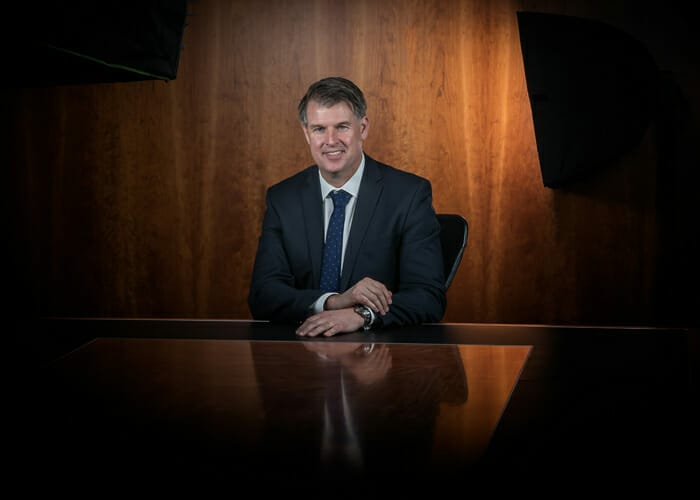

When the IOOF board named Daniel ‘Dan’ Farmer the firm’s incoming chief investment officer earlier this year, ahead of the retirement of long-time CIO Steve Merlicek, it allowed plenty of time to plan for a smooth transition.
So, when Farmer officially stepped up to the role on July 1, 2017, to manage a portfolio of A$20.6 billion ($16 billion), he knew what his immediate priorities were: solidify the investment team, appoint a new asset consultant, and progress a technology project to support a whole-of-portfolio approach to risk. Not to mention the all-important day job of overseeing the portfolio.
“Team is everything, so having the right people around me was the critical starting point,” he says.
One of the first things he did was argue for the promotion of strategist and international equities manager Stanley Yeo to the newly created role of deputy CIO. This also took effect on July 1. Yeo’s new title represents a “subtle but important” restructure within the team, the CIO says.
“That strategy role is really important because it touches all the different asset classes,” Farmer says. “To my mind, it was important to reflect Stan’s seniority in the team, and I guess make sure he gets buy-in from all the portfolio managers.”
Meanwhile, Farmer’s promotion had created a vacancy in the role of portfolio manager, Australian equities. In August, that was filled by Paul Crisci, who joined the team from Funds SA, where he managed an $11 billion portfolio of domestic and international equities for the South Australian public-sector superannuation fund.
“Paul had the right heritage…We really wanted a hands-on person with experience in the day-to-day realities of running a multi-manager fund,” Farmer says.
New consultant
A recommendation from Yeo helped Crisci nab the job. A few years back, when Yeo was a consultant with Russell Investments, he advised Crisci at Funds SA. In that consultant role, Yeo also advised IOOF, before coming in-house in 2010.
With Russell exiting the asset consulting market in Australia this year, IOOF needed to run a tender to appoint a new consultant. Farmer and Yeo worked closely together on this project in the months leading up to officially commencing their new roles. Mercer took over as IOOF’s new asset consultant from the start of the 2017-18 financial year.
The firm won the tender thanks to its “strong cultural fit with the team” and “the strength and broad sweep of their research”, Farmer says. Melbourne-based David Stuart is now the lead Mercer consultant working with IOOF.
“Advice on dynamic asset allocation and tilting is really the key component of the service we look for from Mercer,” Farmer says.
Stuart and his team at Mercer report directly to Farmer, rather than to the IOOF investment committee. Unlike at many Australian superannuation funds, the board designates significant responsibility to the CIO.
Farmer’s predecessor, Merlicek, who remains on the IOOF investment committee, is well-known in the industry for his successful track record built on excellence in asset allocation. Farmer has worked closely with Merlicek for the last 20 years, first at Telstra Super before both moved to IOOF, and is well-positioned to carry the torch.
“Steve and I worked together for 20 years. Back in the ’90s at Telstra Super we were one of the first Aussie super funds to go active [with dynamic asset allocation and tilting],” Farmer recalls. “Then we implemented a similar strategy here at IOOF…So I really have been on the journey with him and feel very comfortable in the transition.”
A dynamic approach
Central to the portfolio management philosophy is that it is the internal investment team’s job to “get those big sweeping moves right” and let the external managers trade and make money off the small moves.
“The view I take, and it’s followed on from the view established with Steve, is it’s really when you see markets at pretty big extremes that you take significant moves,” Farmer says. “For a multimanager like us at least…it’s really about trying to capture those big market risks or opportunities, not day-to-day trading off small moves.”
Figuring out what the next big moves in markets will be is tricky.
“It’s somewhat challenging at the moment, as we don’t see any of the major markets as extremely attractive. It’s really a case of trying to find those niche ideas and being active to generate an attractive return,” Farmer says. “We’re not overly negative but the outlook is not as strong as it has been.”
IOOF’s current asset allocation is fairly close to its benchmarks on most major asset classes.
“We’re a little bit underweight at Aussie equities in favour of international equities, which has performed very well for us over the last few years,” Farmer says. “We continue to hold that tilt, although I’m reviewing whether we begin closing that up.”
Within the equity portfolio, more money is due to flow into emerging-market strategies.
In the fixed income portfolio, IOOF has been short on duration for the last few years, another play that has performed well.
“We see inflation sort of picking up but only very moderately; it is very hard to see a sharp spike in inflation from here,” Farmer says. “So we’re beginning to add a little bit of duration back into our portfolios, opportunistically via a futures overlay.”
Upping alternatives
The most significant change he expects to make to the portfolio through the back half of 2017 is increasing the allocation to alternatives. As at June 30, the alternatives portfolio – which includes hedge funds, liquid alternatives, private equity and private credit – represented about 8 per cent of IOOF’s total $147.2 billion in funds under management, advice and supervision (FUMAS).
“We’ve actually been reducing our traditional macro strategy hedge funds in favour of more systematic multi-strategy funds,” Farmer says. “We see that more systematic multi-strategy approach as giving us a more predictable return outcome.”
In building out the alternatives portfolio, Farmer is hunting for new sources of return that are not overtly driven by the direction of equity or bond markets.
“It’s going to be really opportunity based…The private debt space is interesting at the moment, with the banks pulling back, so opportunities will probably exist there,” he says. “One of the other areas we are looking to see if we can build is co-investments.”
Opportunities to buy into good global private-equity funds at a discount on the secondary market are also being looked at with keen interest.
“We’ve also looked at some other niche areas such as agriculture, but are a little bit worried about valuations at the moment,” Farmer says. “Likewise, we’ve looked at, but backed away from, increasing our allocation to infrastructure due to stretched valuations.”
Much of this is being led by IOOF’s Melbourne-based head of alternatives Ray King, while the fund’s Sydney-based property portfolio manager Simon Gross is also working on closing more direct commercial Australian property deals in the $20 million to $50 million range.
“The direct property fund we run out of Sydney is a niche strategy, but they’re generating strong yields off those properties and for quite low risk with minimal gearing,” Farmer says. “We don’t need capped rates to fall further, we don’t need valuations to lift, for that to stack up. The running yield of those properties is attractive to us at the moment and we think that’s a relatively conservative and safe place to generate a reasonable return.”
A view to risk
As IOOF diversifies and expands it alternatives holdings, it will become more important than ever for the CIO to have a clear view of risk across the total portfolio.
That is why Farmer is focused on completing the rollout of a universal portfolio management software system across the whole fund.
“We’ve been running it across Aussie equities and international equities on a standalone basis for quite a long time, and I’ve found it very useful for managing my own portfolio and also for feeding into discussions about asset allocation,” Farmer says.
In recent months, the fixed income portfolios have been loaded into the system. Next up will be the more challenging task of incorporating alternatives.
Farmer says it is “obviously a challenge” to get all the data required to record some of the fund’s more idiosyncratic alternative assets in the centralised portfolio management system.
“But it is a priority for me as CIO,” he says. “It really helps provide a clear view on risk. For instance, having now entered the fixed interest portfolio, we have a much fuller picture of what our currency risks are.”
The technology and systems project will also make compliance with the Australian Securities and Investments Commission’s Regulatory Guide 97 (RG 97) easier.
Of course, given that most of IOOF’s business comes via advisers and platforms, the asset allocation of individual clients’ portfolios can vary greatly. The $3.3 billion ASX-listed wealth-management firm runs four main investment products: IOOF MultiSeries, IOOF MultiMix, IOOF WealthBuilder and Shadforth products.
But the business is set to swell dramatically.
In October, IOOF announced it had entered into an agreement with ANZ Banking Group to acquire its OnePath pensions and investments business, and aligned dealer groups, for a cash consideration of $975 million.
The plan is to complete the deal within 12 months.








Leave a Comment
You must be logged in to post a comment.
Login