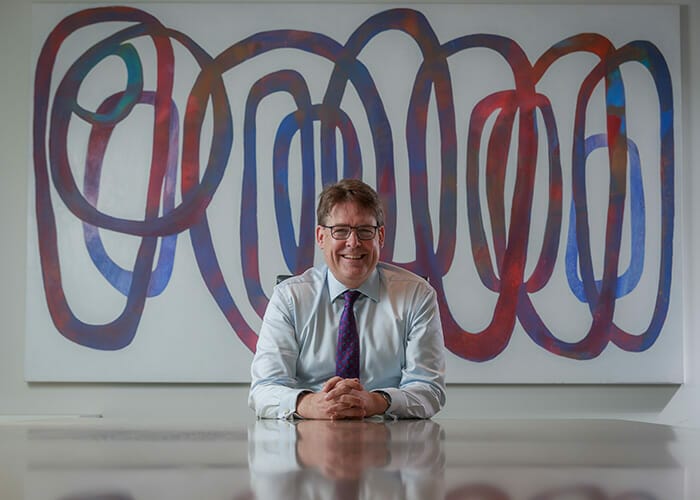

AustralianSuper on shaping ownership

Jim Craig has been the chair of the A$103 billion AustralianSuper investment committee since April 2017. He has been an independent member of the board since 2016 and brings a wealth of financial services knowledge from his many years at Macquarie Group. He talks to Amanda White about principles and strategy for Australia’s largest superannuation fund.

Amanda White: Let’s start by looking at the AustralianSuper investment committee and its structure and decision-making. Can you tell us a bit about how you make decisions, and how you delegate decisions to the investment team?

Jim Craig: AustralianSuper’s investment governance framework provides a clear set of delegations, from the board to the investment committee, and down to [chief investment officer] Mark Delaney and members of the investment team.

The delegations were restructured in 2017 into the form of mandates, both for each investment option the members invest in and each asset class. These are formal mandates and look like they would for an external provider.

Under this structure, the investment committee retains oversight of key investment decisions, such as key strategies in the portfolio, key parameters such as investment return objectives, risk appetite, liquidity limits and large strategic investments.

This is an evolution in our governance to be as clear as possible, which is appropriate, given our size.

Sponsored Content

Given the continued low-yield and low-return environment, are you looking at your strategic asset allocation in a different way and making any changes?

During 2017, the fund did a number of things. We reduced the portfolio’s exposure to unlisted assets – particularly property and credit – given valuations. We were close to our limit in unlisted, at about 33 per cent of our asset allocation. We are now at about 25 per cent.

The fund rotated these proceeds to equities, to take advantage of the improved earnings outlook and improvement in global growth. We also increased our exposure to cash to maintain flexibility.

Looking forward, our asset allocation is driven by our view on economic growth,
which we see as slightly positive, the impact of risk factors such as rising interest rates, and the valuations and return outlook.

It is now a well-versed story that your fund is aiming to have about 50 per cent of equities managed internally by 2021. What is the role of the investment committee in holding those internal teams to account and how are you doing that in practice?

The investment committee has a key role in ensuring that the performance is as good, or preferably better, than using external managers for the same strategy. Pleasingly, although it’s early days, to date this has largely been the case.

The investment committee is responsible for reviewing and approving any new internal strategies, and in initial phases we had a subcommittee providing greater oversight and advice on the establishment of the program.

For example, for the last two years, we have been looking at an internal quant strategy. The strategy was reviewed by the sub-committee, and they had two or three meetings looking at it. Once they were comfortable, it went to the investment committee for approval, before we allocated a small portion to it. It then went back to the subcommittee to review and monitor, to make sure it was doing what we wanted. Then we made a larger allocation.

Can you tell us a bit about what is strategically important to the investment committee at the moment and what in particular you are spending time on?

At the moment, our focus is around key medium-term strategic issues, the oversight of the investment program and the internal management program. For example, we are putting a lot of work into a set of ownership principles that clarify our approach to governance of assets.

These will be AustralianSuper specific, and will guide us and the investment team in our governance of the investments we make.

We have a separate set of investment beliefs, but the ownership principles will deal specifically with being an owner of assets.

So let’s explore that a bit more, can you tell us about how you conduct your engagement, what processes and practices you have put in place to monitor listed companies, how you effect change and what impact that is having?

AustralianSuper uses an extensive engagement program that works on two levels. The fund’s equity team meets with the management and directors of a range of the companies in which we invest. This is often either part of an ongoing dialogue about future strategy, or we meet to discuss specific issues that might arise from time to time.

The other level of engagement is through the investment governance team that manages our active owner program. Last financial year, the team attended or supported 272 meetings with ASX-listed companies, on material ESG issues, directly or via our engagement partner, the Australian Council of Superannuation Investors (ACSI).

In relation to directors of listed companies, we maintain a database of each director of ASX 300 companies, evaluated against shareholder returns and our assessment of ESG performance.

In the Australian market, your largest positions are with the big four banks, BHP, Telstra and Wesfarmers – with the largest position being Commonwealth Bank. How are you reacting to the royal commission and are you making any changes to your holdings, given what is coming out of it?

I can’t comment on individual stocks, but in broad terms, AustralianSuper is a long-term shareholder and wants to see boards act in the best interests of staff, customers and shareholders, as this is the only way to build long-term value. For too long, boards have put short-term targets above other key strategic interests.

AustralianSuper is the largest, and fastest-growing, fund in Australia. Clearly that size can be an advantage, but it can also be a disadvantage. Can you talk a little bit about how you are overcoming those obstacles?

Our growth has been carefully managed over the last few years. A key factor is that we have an ethos of wanting to be bigger to be better, we are not interested in growth for its own sake. Another key is the fund’s culture. Every decision and action we take is through the prism of whether it is in members’ best interests.

For example, we had a debate for years about divestment from tobacco. The whole discussion was about what was the right thing to do for the members.

Can you talk a bit about how you are working with external managers and how you will work with them? What you expect from them and how you negotiate fees and alignment of interests?

Our medium-term goal is to move towards having 40-50 per cent of members’ assets managed internally.

Given this is only half of members’ assets, external managers will continue to play an important role in the remainder of the portfolio, particularly in the context of a global portfolio. However, what external managers do for us will continue to evolve.

Our position on fees is largely unchanged as we grow. We want to see value for money in the net returns our members get from fees spent. Further alignment of key investment decision-makers within external managers is critical.

What is your advice for how to chair an effective investment committee meeting?

It is important that the committee respects a diversity of views from the internal team, external advisers, sponsors and independent committee members.

Good governance is achieved only by debating genuinely diverse opinions with respect.
Who are your most important mentors? who do you turn to for advice now?

I have been lucky enough to have worked with many great investors and inspiring business people. It wouldn’t be appropriate to pick one or two, as it is a network of mentors that has guided me.

Asset Owner:AustralianSuper

Leave a Comment

Nest favours institutional-first managers as retail exodus pressures private credit

Nest favours institutional-first managers as retail exodus pressures private credit

Nest, the largest workplace pension in the UK, says that private credit managers who prioritise institutional clients will be more favourably viewed. The £61 billion ($82 billion) fund has awarded a £450 million ($605 million) US direct lending mandate to Crescent Capital this month, citing the manager's institutional-client-first approach as a key attraction.

Sort content by

HOOPP: Light covenants in private credit are a growing source of concern

The boom in private credit has been accompanied by a spike in lighter covenants, reducing protection and guardrails for lenders says Jennifer Shum, senior managing director, structured and private credit at HOOPP, and warns of mounting risks in private credit.

Oregon’s private equity future

Oregon State Treasury is one of the longest-standing investors in private equity but as allocations pushed beyond the outer policy limit and a maturing asset class puts pressure on returns, a recalibration was necessary. Amanda White spoke to Oregon State Treasurer, Elizabeth Steiner, about the future of private equity.

Dutch pension funds face tech reckoning, warns central bank

The Netherlands' Central Bank has warned the country's pension funds that their €150 billion ($177 billion) investments in tech companies, representing almost 43 per cent of their listed equities portfolios and 8 per cent of their total balance sheet, is at risk from a potential AI bubble.

Private equity: Arizona’s ASRS argues the case for secondaries

The $50 billion Arizona State Retirement System is pushing into private equity secondaries, actively looking to invest in stakes being overloaded by other LPs, in a strategy that will complement its co-investments program and SMA investments with external managers. It’s looking for opportunities across the US and Europe.

APG’s answer to aligning government and investment goals in infrastructure

An increasing push to invest in home markets means asset owners need better frameworks for aligning government expectations with investment goals. APG’s three-pronged approach for public infrastructure investments could act as a guide for other investors looking to balance fiduciary duty with political demands.

CalPERS touts fixed income wins, gears up for TPA

At the annual review of its fixed income portfolio, CalPERS staff explain how active management, value-add strategies and the hunt for alpha are paying off, with ESG integration giving it a valuable edge and informing it to invest in companies under pressure like Boeing at the right time.



