
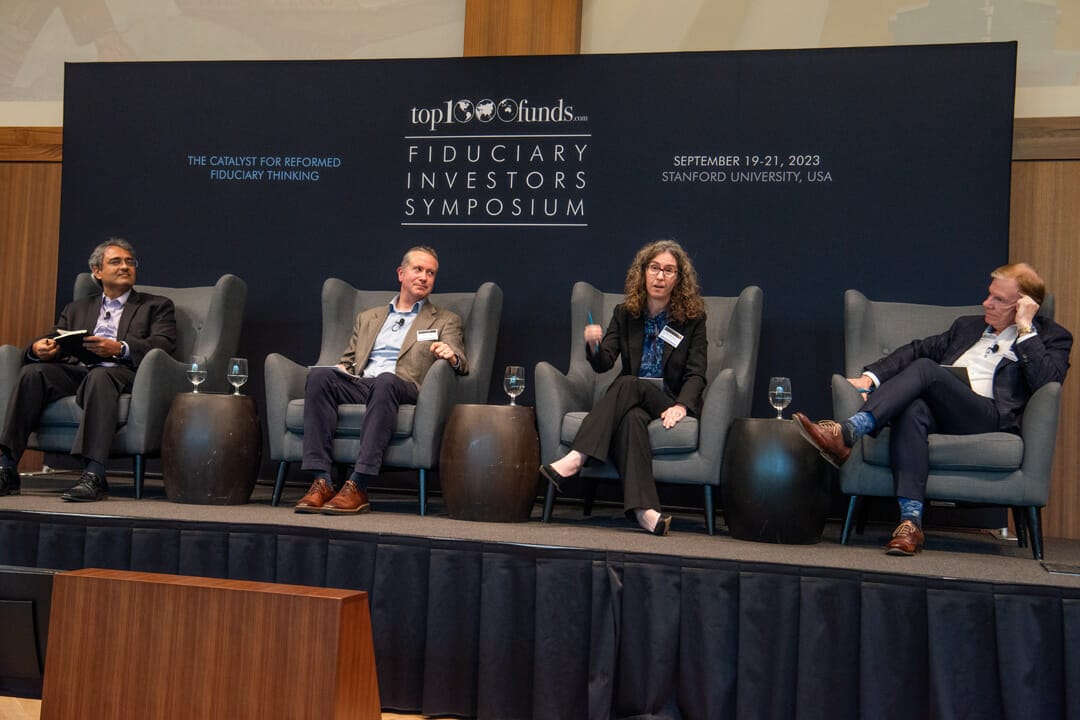

The chief investment officers of three global pension schemes have told the 2023 Fiduciary Investors Symposium at Stanford University they are re-evaluating or reducing their exposure to the world’s second largest economy as tensions between the US and China escalate. But they are resisting total divestment to a country that still dominates emerging markets benchmarks.
The chief investment officers of three global pension schemes say they are re-evaluating or reducing their exposure to China as tensions between the world’s largest and second-largest economies escalates.
Alison Romano, CEO and CIO of the San Francisco Employees’ Retirement System, told the Fiduciary Investors Symposium at Stanford University on Tuesday that exposure to the Chinese market had been a meaningful contributor to performance over recent years.
“When I joined [SFERS in June last year] the performance was very strong, based on a number of strategic bets,” she told the symposium, hosted by Top1000funds.com.
“We leaned into growth, we leaned into innovation, we leaned into China.”
But she said increased geopolitical risk attached to the market meant she is now re-assessing that portfolio exposure, which she described as overweight.
“Let me be very clear – we’re not throwing in the towel. But we are evaluating our risk-reward basis, there is increased risk,” Romano said. “We want to be very careful who they partner with to invest there, that they have on the ground knowledge or connections.”
She said analysts, experts and industry peers held a wide range of views on China, which made it difficult to come to a position on the appropriateness of its inclusion and weight in a well diversified portfolio.
The comments come amid heightened tensions between Washington and Beijing, with reports of diplomatic communications having faltered between the two world powers and conflict over maritime disputes and alleged espionage, most notably the incident of a suspected Chinese spy balloon over US territory earlier this year.
Mark Walker, CIO of the UK’s Coal Pension Trustees, told the symposium the fund had reduced its Chinese exposure from 15 per cent to 10 per cent of its public equities portfolio, under “pressure” from trustees and concerns about geopolitical risk. He said it would likely also reduce its private equity exposure to China going forward, but added that the country was too big to ignore or divest entirely.
He said he and his team were considering how to remain a neutral position in the escalating US-China tension, while also looking to burgeoning Southeast Asian economies that have large or growing populations and can provide alternative emerging markets exposure.
“We’ve absolutely not eliminated it, but we have downplayed,” said Walker, whose fund represents UK-based mining sector workers.
James Davis, CIO of $25 billion Canadian fund OPTrust, said the China challenge was symptomatic of a broader concern around pricing geopolitical risk, especially in developing economies.
“I am not sure I am being adequately rewarded for being exposed to China,” Davis said. But he said he had resisted eliminating the fund’s exposure to China because it still accounts for at least a third of most emerging market benchmarks.
He said divesting China would be difficult for that reason, arguing the case showed some of the flaws of an index-hugging approach to emerging markets investment. “Benchmarks are constraining; I personally don’t like them,” he said. “We follow the total portfolio approach, so we try to avoid getting caught in the benchmark trap.”
Table discussions of delegates to the symposium centred on geopolitical risk, with some attendees questioning whether China should be split out from other emerging markets when making asset allocation decisions.








Leave a Comment
You must be logged in to post a comment.
Login