
Why allocators need a ‘continuous exploration’ mindset for AI adoption

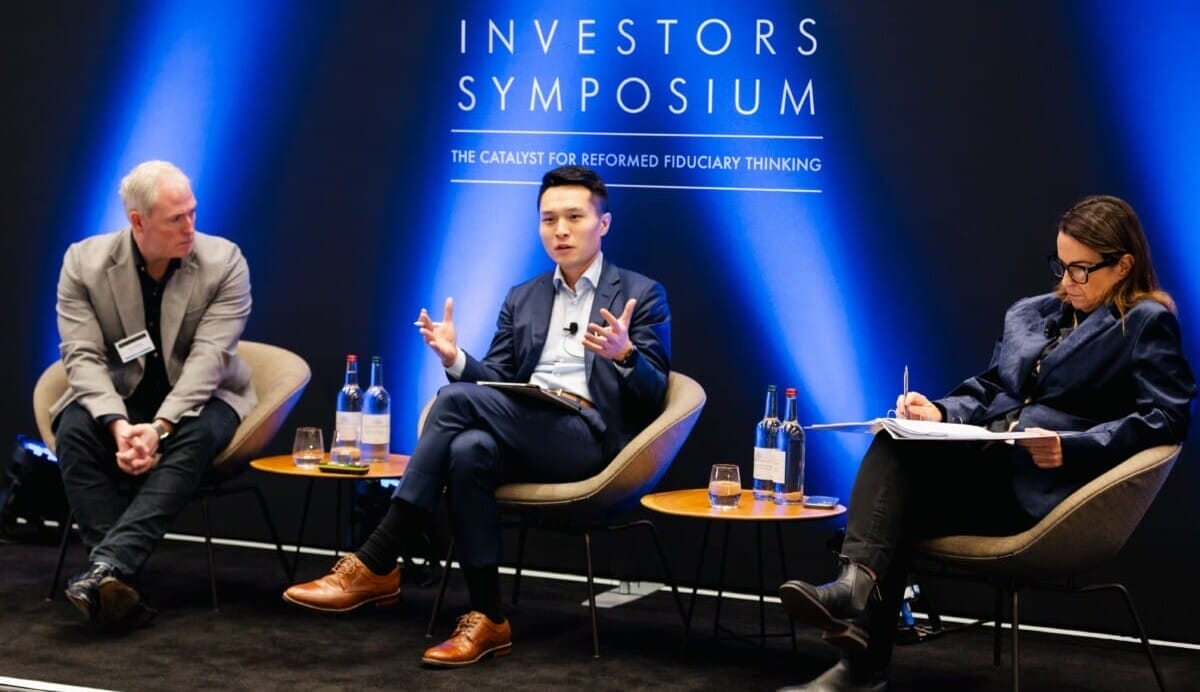
Jon Webster (left), Jacky Chen and Amanda White (Conexus Financial). Photo: Jack Smith

Asset owners are witnessing a sea-change in data management and analytics as artificial intelligence opens doors to more efficient processing of investment information. But despite the promise, some may be wary of experimenting with the new technology due to the potentially negative consequences of failures on budget and culture.  

This tension was recently explored at the Top1000funds.com Fiduciary Investors Symposium. Jon Webster, senior managing director and chief operating officer at the C$777 billion ($554 billion) CPP Investments encouraged his allocator peers to first shift their mindset to one of “continuous exploration” when it comes to AI.  

He challenged the view that AI experimentation is inherently expensive to implement, at least for an organisation of the size of CPP Investments. It subscribes to the enterprise version of ChatGPT and uses DealCloud as its CRM software, whose combined fee is less than C$5 million a year against a C$2 billion annual operating budget and a C$10.5 billion investment budget.  

“I don’t think you should be afraid of the cost aspect of it. In fact, I’d lean very heavily into that,” Webster told the Fiduciary Investors Symposium at Oxford University.  

“To the experimentation point, it’s not that you should experiment. You literally have no choice but to experiment, because what the models can do tomorrow is just not the same as they were able to do yesterday.” 

To understand what AI can do for a fund, one needs to first understand what constraints it will remove, Webster said. He proposes that an organisation which is formed around investing is essentially “an information-processing supply chain” – it takes structured and unstructured data and turns them into investing ideas. 

Sponsored Content

The limitations, in turn, are “scarcity of expertise”, “high degrees of specialisation”, and “limited information processing capacity”, which is an intrinsic part of being a human.  

“Lots of those constraints are about what we prize deeply, as in ourselves, our own intelligence,” he said. 

“The thing we’re looking at inside CPP Investments is, how will our organisation get changed by this [technology]? How will work legitimately get redesigned? And are the constraints around which our organisational structure was formed, as valid as they were?” 

The C$26 billion ($18.5 billion) OPTrust has also been on a journey in the past six years to more comprehensively implement AI in its investment process. It started with using AI to determine risk on/off positions but now has a regime model of four macro quadrants upon which it makes asset rotation decisions, thanks to more accuracy in risk factor predictions enabled by large language models.  

“I don’t think we think about it from a perspective of, because this is a new technology, we have to chase it,” said Jacky Chen, managing director of completion portfolio strategies, total portfolio management at OPTrust.  

“It’s a very natural progression that as we think about our investment approach, we naturally gravitate ourselves towards that kind of decision making.” 

The most important principle of AI implementation at OPTrust is that a “human is always in the loop”, Chen said, but he acknowledged that the technology becoming a more prominent part of the investment process means portfolio managers also need to change their old behaviours.  

“As an example, when AI doesn’t know what to do when you ask it to build a risk indicator, it will immediately assume that risk equals to 0.5 times the fear index plus 0.5 times maybe the gold price. And they draw this beautiful chart,” Chen said. 

“[But] would you be able to make decisions on that? I think the traditional, more fundamental managers need to start understanding how to vet that and look into that [underlying model].” 

Conversely, quant portfolio managers need to be more market-driven, instead of treating market events as “noise” and focusing purely on their data sets as they traditionally have been.  

“The cycle is moving way faster now. If you don’t do that, you’re not able to very effectively manage your model,” Chen said. 

CPP Investments’ Webster said for asset owners, using AI is not about making faster but better investment decisions, “unless fast is your competitive edge”. 

“For many of us, it isn’t,” he said. 

“You’ve got to do something different with the technology, otherwise, it’s all a bit pointless.” 

Leave a Comment

Same attacks, more pain: Cyber security face up to exponential threats

Same attacks, more pain: Cyber security face up to exponential threats

Despite headlines about exponential escalation in the cyber attacks on governments and corporation, an expert says the core threats have remained largely unchanged in the past decade. What’s different now is the attackers’ ability to inflict pain on their targets.

Sort content by

Opportunities and pitfalls for LPs using AI in private markets

Asset owners have a wide selection of artificial intelligence tools that product providers tout as enhancements to their unlisted investment process, but leading private markets academic Ludovic Phalippou said the reality is not that simple. Not only can AI make mistakes, it can also be tricked.

How investors are balancing the risks of investing in defence

As European countries increase defence spending, allocators are weighing up the risk and opportunity of allocating more to the sector. For some, investing in defence sits relatively comfortably with stakeholders but for others, investing "in things that kill people" remains a highly controversial conversation. 

Timothy Garton Ash: Reflections on the future of Europe

Celebrated academic Timothy Garton Ash reflects on the vital changes that Europe needs to achieve to thrive in its next evolution: success in Ukraine, its own defence industry, implementation of Draghi's recommendations, and a resolution to the cultural and social tensions gripping the continent – to name a few.

IMCO, USS and NBIM mull the risks of non-US dominant portfolios

The US has driven portfolio returns for decades, but investors are increasingly concerned that US-dominant portfolios are jeopardising precious diversification. USS, NBIM and IMCO share strategies to foster diversification including different currency exposures and investing in emerging markets.

FIS Oxford 2025: Photo gallery

mrec4inarticleinline Sponsored Content scnative1 scnative2 scnative3

The role of insurers helping create sustainable pension systems

Ensuring a sustainable income in retirement is an enduringly knotty problem and one that continues to preoccupy countries' pension systems and their asset manager partners. NEST, Sweden's Fund Selection Agency and US asset manager Apollo reflect on the future of retirement.



