
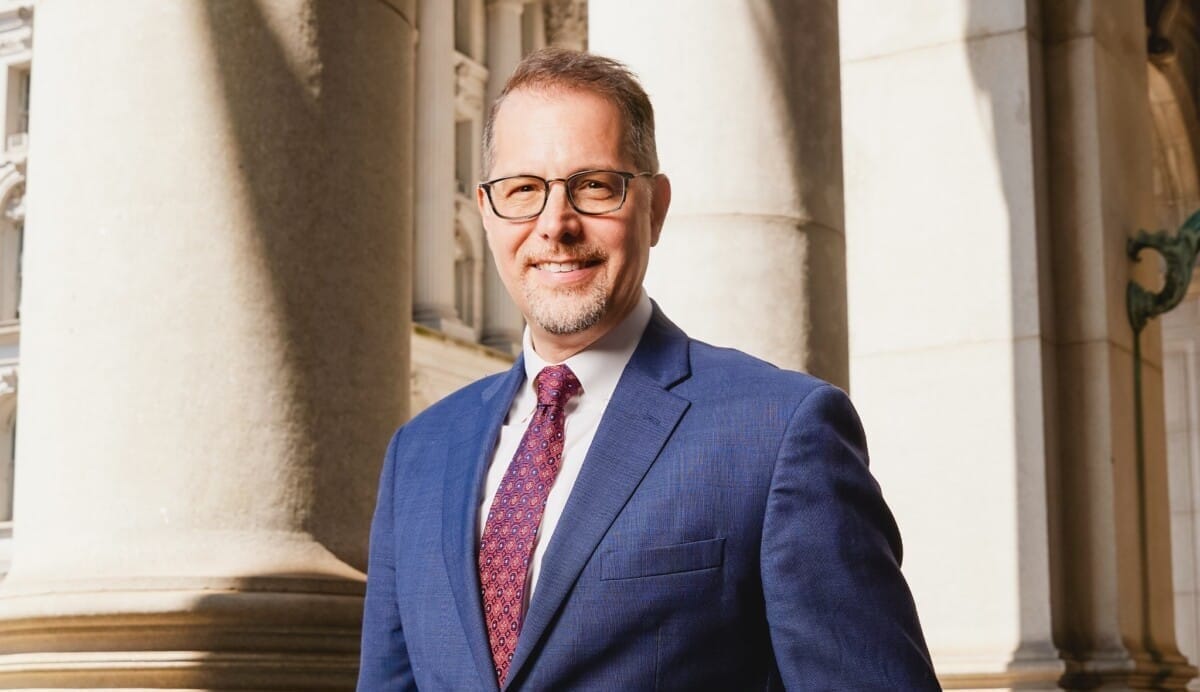

New York City Comptroller Mark Levine, who oversees the city’s balance sheet and the NYC Bureau of Asset Management (BAM), says he will leverage the city’s $310 billion pension assets and link arms with other state Treasurers to apply pressure on US corporates.
This means both direct engagement and via external managers on issues including climate and human rights, he tells Top1000funds.com in an interview. The NYC Bureau of Asset Management invests on behalf of five public pension funds in the city, with the largest one being the $120 billion Teachers’ Retirement System of the City of New York (TRS).
Earlier this month, Levine pushed for AI company Palantir to conduct an independent human rights inquiry over the company’s contract with the Department of Homeland Security and US Immigration and Customs Enforcement (ICE).
Levine says the request to audit the reputational, legal and financial risks associated with ICE and its potential violation of human rights is the kind of activism crucial to the fund. NYC BAM has $457 million invested in the company across the five pension funds as of December 2025, all via passive US equity managers.
“It’s consistent with our values, and it’s one I think that’s called for in this difficult moment,” Levine says.
“I expect us to continue to exert our influence as one of the largest institutional investment funds in America, and we own a stake in almost every company in the country, and most publicly traded companies globally for that matter. That gives us influence.”
The boards of Home Depot and Lowe’s also received letters requesting human rights risk assessments this month, where Levine asked for a review of the companies’ collection, use, and sharing of license plate and other location-based data. This stems from media reports that parking lots of the two home improvement stores have become prime spots for ICE raids, as car plates are reportedly being recorded by their surveillance system and shared with law enforcement.
Levine is part of the For the Long Term – a network of blue state Comptrollers and Treasurers who collectively oversee $2.5 trillion in pension assets – and says the alliance will push back together should US companies retreat on issues like diversity commitments or corporate transparency.
On climate issues, Levine is expected to continue his predecessor Brad Lander’s hard-line approach. Last November, Lander called on the TRS, New York City Employees’ Retirement System (NYCERS), and NYC Board of Education Retirement System (BERS) – the three pension funds that have committed to a net zero by 2040 goal – to axe a $42 billion passive mandate with BlackRock due to the manager’s pull-back from green commitments. Mandates with Fidelity and PanAgora also went under review.
BlackRock hit back on Lander at the time, accusing the former Comptroller of politicising public pension assets.
Levine says he has engaged with the managers at a senior level, as well as meeting other stakeholders including climate activists.
“It’s early but we’re determined to get a good outcome,” he says.
“[The net zero commitments] have really three major components. It means that we are pushing our company investments that we own directly to put forward a plan to move to carbon neutrality; it means that we ask the investment managers managing on our behalf to be on the same page; and it also means that we proactively look for investments in the green economy to move us towards a renewable energy infrastructure.”
Return to Israeli bonds
With that said, Levine was in the headlines recently for comments about opening the NYC pension funds to investing in Israeli bonds again, which drew the ire of the human rights group Dawn. It also puts Levine at odds with the position of NYC mayor Zohran Mamdani, who has opposed the reinvestment plan. The mayor has one or multiple nominees to each of the five pension funds’ boards.
NYC BAM’s current exposure to Israeli bonds is “effectively zero” after Lander allowed for all holdings to mature without reinvestments in 2023, but there is about $300 million invested in Israeli equities and “a slight amount” of real estate investments, says Levine.
“We would have to make an affirmative decision to purchase Israeli bonds, and we are exploring the mechanics of that, in discussions with stakeholders on all sides,” he says.
“I have political pressure on both sides of this issue, as I do on many issues, but I’m trying to stick to the financial fundamentals.”
Last August, Norges Bank Investment Management removed five Israeli banks from its equity portfolio due to their potential contribution to human rights violations in the Palestinian territories. But Levine did not respond directly when asked if reinvesting in Israeli bonds raises any red flags from a responsible investment perspective.
“I have strong political opinions on many issues, and I have a fiduciary responsibility, and I try to keep them separate,” he says.
“If you look at our work on climate, [we think] that over time fossil fuel extraction is not a winning investment from a strictly financial perspective. So I’m very comfortable with our shift to green energy for that reason.
“I look at Israel investments the same way,” Levine says, explaining that NYC BAM runs a globally diversified portfolio which means it has exposures to most of the major economies.
“Historically, Israeli bonds have never missed a payment in something like 70 years. They pay strong interest, so for that reason, they have been part of our portfolio for half a century or more. But I am making this [reinvestment] evaluation with my fiduciary responsibility in mind.”
NYC BAM is on the hunt for a permanent chief investment officer nationally – with the hope of finding one by spring, Levine says – and has appointed US pension investment veteran Monte Tarbox in an interim capacity.
The ideal candidate will have experience managing assets at scale in a public context, where political considerations are an essential part of the job; sufficient people management experience to lead a 150-person investment team; and of course, a residency in New York’s five boroughs at the time of employment.
Whoever takes the job will need to face up to the challenge of reporting to five separate boards, each with a dozen trustees representing various unions and employers and on which Levine also sits.
“Having such deep involvement from municipal labour is a benefit. And after all, our obligation is to manage the money of public sector workers and retirees, so I do think it’s great that they have a voice in the governance of these funds,” he says.
“There’s also potentially an upside in that the funds can pursue slightly different strategies, and they have, and so it does give us a chance to try things out,” he says, citing the fact that only three out of the five funds committed to a net-zero-by-2040 goal.
“We’ve been talking to good people so far, and I’m really confident we’re going to have a star in this [CIO] role once we make the final hire.”








Leave a Comment
You must be logged in to post a comment.
Login