
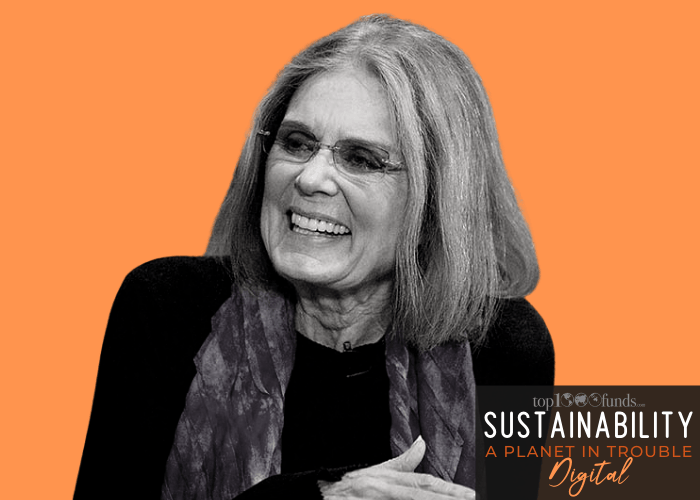

Gloria Steinem tells institutional investors it is time to ditch the labels that describe our gender, class or ethnicity and urged the investment community to look at investments through the lens of gender, class and racial equality.
“We need to become individuals without adjectives that describe our gender or class,” says celebrated feminist and social political activist Gloria Steinem.
Speaking at “Sustainability Digital: A Planet in Trouble,” 86-year-old Steinem stressed the importance of understanding that each human being is unique.
“Humanity is the point,” she said, urging delegates to see the individual behind the label – to look at our substance and content.
The ‘unfinished business’ and ‘human rights challenge’ of gender equality is rooted in long held racial and gender divisions viewed as desirable.
“It’s taken us a long time to realise that money is just one form of value,” said Steinem who said the tide began to shift with social justice movements that saw the quality of life not just measured on a financial scale.
She noted a new energy to gender equality under the Biden administration. She also drew delegates attention to the sweeping transition underway in the US population from “majority white” to “majority people of colour.”
She said that among a percentage of the population, this transition was sparking insecurity and rebellion, witnessed on the 6th of January storming of the Capitol by a white minority.
“Trump wasn’t elected by a majority but by a fluke of the electoral college,” she said.
Steinem played down polarisation in the US, arguing that resistance to multiculturalism only comes from a minority. She said that Trump represented that minority (white and male) that is resisting the fact the US is about to become a non-white country – alongside other changes.
“We are now back to majority democratic rule,” she said.
As to how diversity sits within the broader sustainability debate, she said it comes down to “the common sense” principle of the importance of releasing all talents, not just the talents of some people.
She said inequality has its roots in colonialism, hierarchy and European religions and values. Besides, the original inhabitants in the US lived by a circular model “before Europeans came along.” Adding: “In a sense we are trying to get back to this.”
It led her to reflect on the fact women are less hierarchical in leadership roles stemming from models of behaviour and leadership rooted in the family. It reflects a “concern for the welfare” of each person regardless of where they are in a family, in contrast to the corporate model. She also noted more men working from home as being one of the positives to come out of the pandemic.
“Men are more likely to be at home and take care of children and be present in the household,” she said. “It is equalizing what until now has been a female experience.”
She urged the investment community to look at investments through the lens of gender, class and racial equality.
“There is not simply just one measurable number,” she said.
Dropping labels allows “instant communication” amongst strangers. She also espoused the importance of laughter. Although social movements are often viewed as serious and full of anger, laughter is powerful source of free emotion.
“You can compel fear or love; laughter can’t be compelled.”
She said this was the “undervalued” element of a social justice movement and embodied freedom and enjoyment.
“You can’t live in the past or future, you can only live in the moment and the ability to laugh is proof of that.”
She concluded that retirement is another label to ditch. She said as long as individuals can “still function,” and their advice is useful, we should dispense with retirement. Moreover, young people should be encouraged to work much earlier.
“There are teenage geniuses that are functional; the idea of functionality should surpass ideas of age, race and class,” she said.








Leave a Comment
You must be logged in to post a comment.
Login