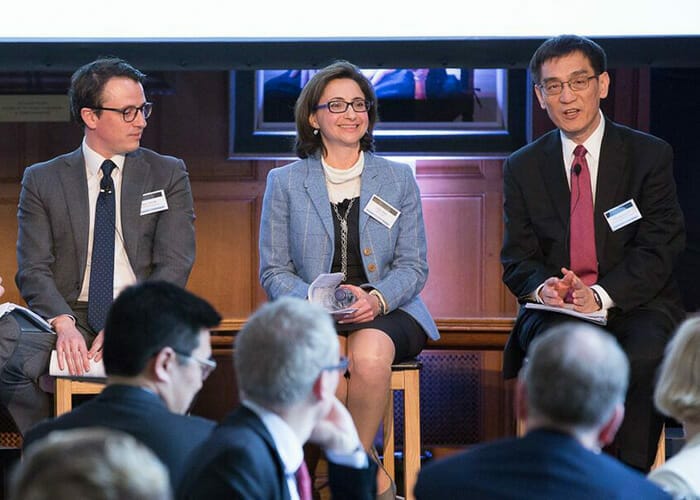
Experts mull strategies in slow growth climate

Speaking at the Fiduciary Investors Symposium at Oxford University’s Rhodes House Fiona Trafford-Walker, director of consulting at Frontier Advisors argues that Australian investors are operating in a changed environment and need to “get used to slower economic growth.”

Speaking as part of an expert panel on how the continued environment of slow growth and low interest rates will affect global institutional investors, and the best asset allocations to protect their portfolios, Trafford-Walker puts forward the Australian view.

She argues that Australian funds are entering a “brave new world” where returns will be much lower.

The slowdown in China has hit demand for key Australian resource exports with iron ore prices down 60 per cent from their recent highs. Australia’s funds face demographic challenges with a growing elderly population which will also hit GDP growth, she warns.

“By 2025 this demographic wave will cost 0.4 per cent of GDP.” Australia’s mining boom “hid structural problems in our economy which now needs to diversify and become more services led,” she says.

Strategies for Australian funds include reducing target returns and changing asset allocations, she suggests.

Sponsored Content

Funds could also take on more risk and pursue more active management strategies to “take them over the line.” She notes an appetite amongst funds to “creep up the risk curve to get returns” and a “huge amount of interest in infrastructure,” plus a continued appetite for equity investments but also “equity substitutes” in the hedge fund space. She expects “much greater use of derivatives to offer diversification and to protect downside risk.

Roger Gray, chief executive of USS Investment Management is similarly circumspect.

“We live in period of wealth elusion,” he warns, saying that perceived wealth is greatly exaggerated and funds need to tailor their asset allocation to “make a better job of navigating through a low return future.” Gray says investors are looking at a world where bond yields are significantly lower, “below nominal GDP growth,” and that funds need to diversify better, and more widely, developing alternative beta strategies. USS is pursuing more active strategies and structured positions, he says.

Over investment themes suggested by panel speaker Toby Nangle from Columbia Threadneedle Investments included Japanese equities which are currently “cheaper than they have been” where he suggested “investing tacticly round the edges.”

Short dated sterling debt which he described as “anchored, not volatile” is another investment theme.


Leave a Comment

Chinese market’s many pros and cons

Chinese market’s many pros and cons

The Asian giant has a vibrant tech sector, a growing middle class, and a government making changes to improve access. It’s enough to make many take on the market’s volatility and other issues.

Sort content by

Strong governance begins with robust culture and teams in place

Keith Ambachtsheer, Director Emeritus, Rotman International Centre for Pension Management argues that good governance begins with having “the right team in the room.” This means robust human resource teams, the ability to address issues around understaffing and raising the effectiveness of board members. “Board governance is still a work in progress today,” he argues, speaking

Institutions look to hedge funds to meet portfolio expectations

“Do hedge funds make sense?” asks Jean-Marc Stenger, chief investment officer for alternative investments at Lyxor Asset Management speaking at the Fiduciary Investors Symposium at Oxford University’s Rhodes House. Hedge fund assets may have reached a record $3 trillion in 2014 but the decision by a number of high profile pension funds to drop hedge funds from

Macro diversification: How do investors diversify risk?

“Geopolitics does matter and how to navigate geopolitical events on a portfolio is challenging,” argues Tom Clarke, partner and portfolio manager at William Blair speaking at the Fiduciary Investors Symposium at Rhodes House, Oxford University. In a session dedicated to macro strategies for investors to best navigate today’s complex investment universe and diversify risk, Clarke argues that “hiding” from

Oxford Professor urges urgent European reform

The University of Oxford’s distinguished Professor of Economics David Vines predicted the ongoing crisis in Europe will turn into a “train wreck with implications for investors” unless governments undertake significant reforms. He urges for large write downs of the sovereign debt of southern European countries, a loosening of austerity in those countries and a significant