
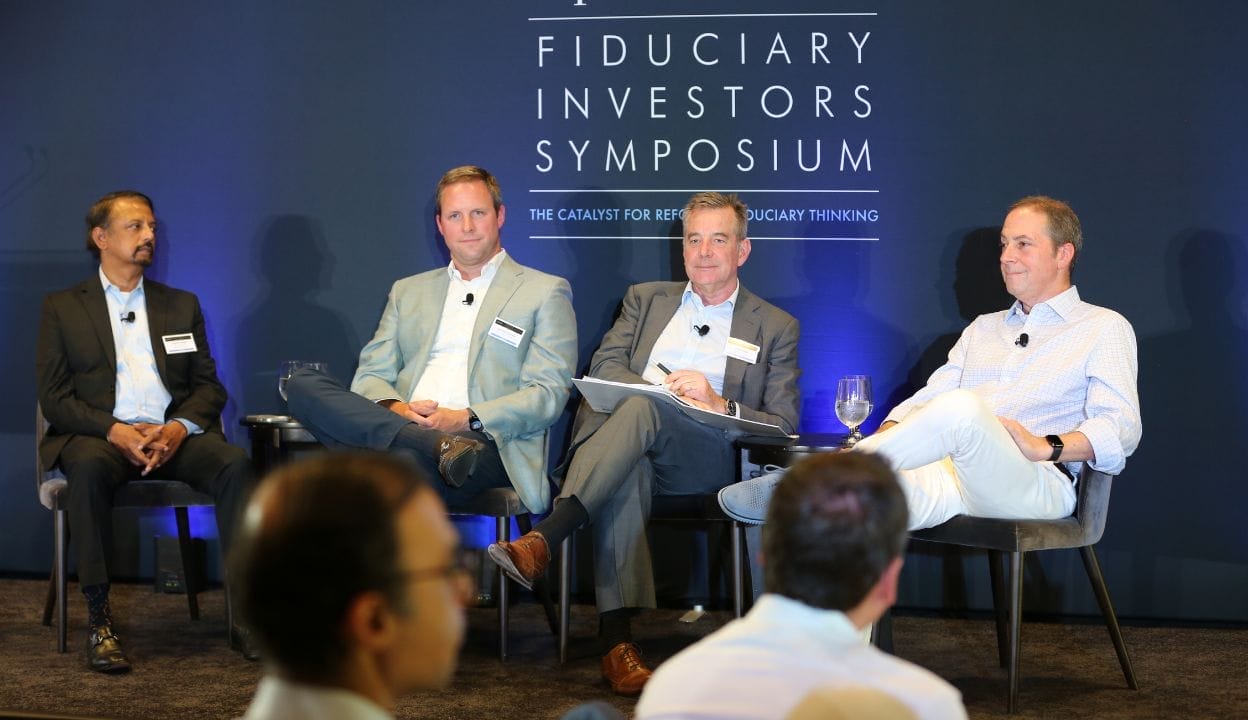

Most investors are getting their exposure to AI and other big technology themes through the public markets, and typically through passive exposure to the Magnificent Seven. But Prabhu Palani, CIO of the $10 billion City of San Jose Retirement System, says that the innovation investors should really want to tap has to come from the private markets.
“These entrepreneurs are risk takers, and those risk takers are meeting risk capital,” Palani told the Top1000funds.com Fiduciary Investors Symposium at Stanford University.
“And that magic happens here in the Valley and in other parts of the world. That incubation has to happen in startups and early-stage startups. What large companies do well is scale that innovation, right? They have deeper pockets, they have transparency, they have access to resources.
“Once that breakthrough has happened, how do you scale those businesses? Being in the public markets is all about scaling… but if you want breakthrough technology, it has to come from this ecosystem.”
About half of the plan Palani manages is in public equity; roughly half of that is in the US, and mostly passive. It’s been “automatically getting a lot of exposure” to the biggest components of the index. A quarter of the total plan is in private assets, with five per cent of that – or a quarter of that quarter – allocated to venture capital.
“We’re here in the Valley, which we believe gives us an edge,” Palani said.
“I’m 20 minutes from Sandhill Road, and that is just tremendous. For some time there was talk that, you know, the centre of gravity is shifting away from the Valley. But come AI – it’s all here. It’s at Stanford, it’s at Berkeley, it’s at San Jose State, it’s at UC Santa Cruz and so on.”
But Nick Rubinstein, managing director at global investment firm Jennison Associates, thinks that “innovation in the public space is definitely not dead”.
“Just recently, Google released their newest imaging model,” he said.
“They call it Nano Banana, and it’s an amazing product – and suddenly, in the app store, ChatGPT dropped into the top 10 and Google’s AI system for imaging immediately popped to number one, and the order of download increases was [significant]. So I think it might be somewhat short-sighted to take all of this innovation that’s happening in the private markets and say that these companies will become the next leader.”
Jennison Associates plays almost entirely in the listed equity space, and was an early investor in Tesla, though it does meet with private companies too. But the amount of capital that the listed incumbents have is “still massive, and they are still innovating”, Rubinstein said.
“Going back to the Mag Seven, you think about what they started as and what they are now; they’ve successfully transitioned their business models one, two, even three times. And I don’t think that trend is over.”
Jackson Garton, CIO of Makena Capital, which provides investment services to asset owners including endowments, family offices, pension funds and sovereign wealth funds, says that the firm is a “big believer” in the innovation coming out of the private markets space, but there’s also the “liquidity component of the equation” to consider. OpenAI is a $500 billion company, but it’s still relatively illiquid.
“From a plan perspective, from an asset owner perspective, that’s a big shift,” Garton said.
“Time to IPO has at least doubled over the last 10 years. The whole equation doesn’t work if you don’t get your money back, and the liquidity part of the equation, which has been stressed as of late, is something to be very cognisant of when you think about your asset allocation models and how much you can take within venture.
“If you just plug it into a traditional mean variance optimisation model, it would say put 75 to 80 per cent into venture capital. And you can’t run a plan that way.”







Leave a Comment
You must be logged in to post a comment.
Login