
TPA: Unlocking alpha through enhanced liquidity management

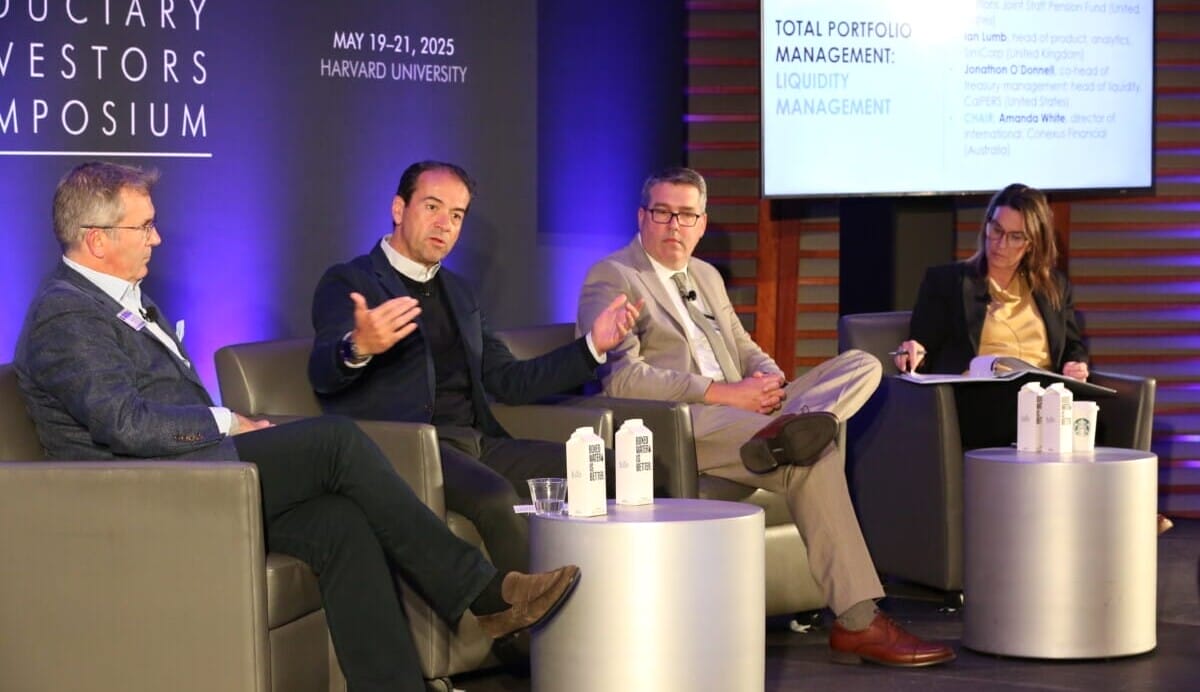
Ian Lumb (L), Pedro Guazo, Jonathon O’Donnell and Amanda White (Conexus Financial). Photo: Jack Smith

Stronger liquidity management through a total portfolio approach (TPA) can do more than manage real-time risk exposures – it can also help generate alpha, according to panellists at the Fiduciary Investors Symposium at Harvard University. 

The $533 billion CalPERS is one of the largest asset owners currently planning its own TPA rollout, which will bring several benefits including a better view of the pockets of liquidity residing across its balance sheet. 

“The total fund portfolio management team has been huge proponents of pushing for this total fund system that we’re implementing,” co-head of treasury management and head of liquidity, Jonathon O’Donnell, said, “and we can easily make the case that these activities – even on the margin – will pay the whole bill of implementing a gigantic system implementation.” 

CalPERS currently employs multiple order management systems, which makes it challenging from a centralised funding perspective to minimise cash drag through strategies such as securities lending, O’Donnell said. 

“The journey that we’re embarking upon right now is going to be a long and a hard one, I think, from a technical perspective, but one that is absolutely critical to getting us off the ground.” 

United Nations Joint Staff Pension Fund chief executive, Pedro Guazo, said liquidity management “helps on the defence, but should be used on the offence”.  

Sponsored Content

“In the absence of information… we end up having much more liquidity than what we need because when you don’t know exactly how much you will need, and how much you have, you tend to overstock. And of course, there’s an opportunity cost for that. So if we get better clarity on the liquidity management and better cash flows expectations, we can deploy that capital into something much more profitable.” 

The United Nations Joint Staff Pension Fund is currently facing several liquidity challenges including lower contributions from UN member nations, fewer contributing staff as countries pull back, and falling distributions from private assets in a more difficult market environment. 

“We’re taking liquidity as a systemic issue based on TPA, not only as a constraint in your portfolio construction under SAA, but a strategic discussion, and really understanding what is the real liquidity, and at which prices that you can drill on whenever your system starts to crank. 

However, Guazo said the disparate quality and fragmentation of private asset information – which underpinned valuations – created an even bigger challenge for cash forecasting. 

The necessity and limitations of models  

SimCorp head of product, analytics, Ian Lumb, said the systems that underpinned a TPA had to provide multiple lenses of risk, but modelling was constrained by limited private market data. 

“To build models where you can think about digging into the correlation across markets, between public and private, about the interplay of the cost of capital and liquidity, is really key,” he said.

“It’s not easy because there is no such thing as perfect data, especially in the illiquid space.” 

He said that “no models are perfect, but some are useful,” and that portfolio stress tests should be aligned with scenarios that cause issues for an asset owner’s board or would attract the attention of regulators. 

CalPERS’ O’Donnell said preparing to implement a TPA is about preparedness, with liquidity management the most important component. It underpins the ability to stay on strategy and to make capital calls, as well as make pension benefit payments, which are predictable and stable for CalPERS. 

“It’s all the other ‘what ifs’ that we’re talking about in terms of scenario testing and what happens to your margin, what happens to your securities lending book, how do you hedge different market environments, etc that is kind of the growing piece of how you prepare to enter into that TPA world.” 

Leave a Comment

Behind Norges’ search for pure alpha

Behind Norges’ search for pure alpha

Despite uncertainties, Norges Bank is tipping that the US stock market will continue to outperform Europe in the next two decades. The mammoth fund also explained how it carved out a $90 billion pure alpha portfolio from passive investments, overseen only by 8 portfolio managers.

Sort content by

Mental health issues in focus at Denmark’s Velliv

Denmark’s Velliv Association, the governance entity behind member-owned commercial pension fund Velliv, explained why a society where workers' mental health needs are looked after is better for pension funds and their liabilities. 

Alpha alone does not pay pensions – total returns do

Pension fund members in retirement want the sustainability of pension payments. OPTrust chief investment officer James Davis told the Top1000Funds Fiduciary Investors Symposium that a total portfolio approach is the best way to do that, and has been on a journey towards delivering it for the past 10 years.

Long-term investors can help break VC’s short-term trap

The short-term investment focus of venture capital investors and the withdrawal of government funding are opening the door to asset owners as providers of patient, long-term capital to fill an investment void, the Top1000funds.com Fiduciary Investors Symposium has heard.

TPA is in the eye of the beholder

Total portfolio approach is not a method, it’s a mindset, according to University of Toronto finance Professor Redouane Elkamhi. Also a senior advisor to HOOPP, Elkamhi said he would summarise TPA in one sentence: "How to be prepared for different market conditions."

Federal threats undermine Massachusetts’ edge, warns state treasurer

Massachusetts treasurer Deborah Goldberg warned that the state’s key strengths – including its higher education institutions and progressive social policies – are being targeted by the federal administration. She urged support from investors as federal funding for innovations and research wanes.

What it means if ‘DNA is not destiny’

Geneticist David Sinclair says aging is a disease and it is preventable and treatable. He told the Fiduciary Investors Symposium that research demonstrates we can slow down or even reverse the aging process. It sounds like good news, but the consequences for society and the investment community are profound.