
‘Don’t try to be a hero’: Volatility highlights the need for discipline

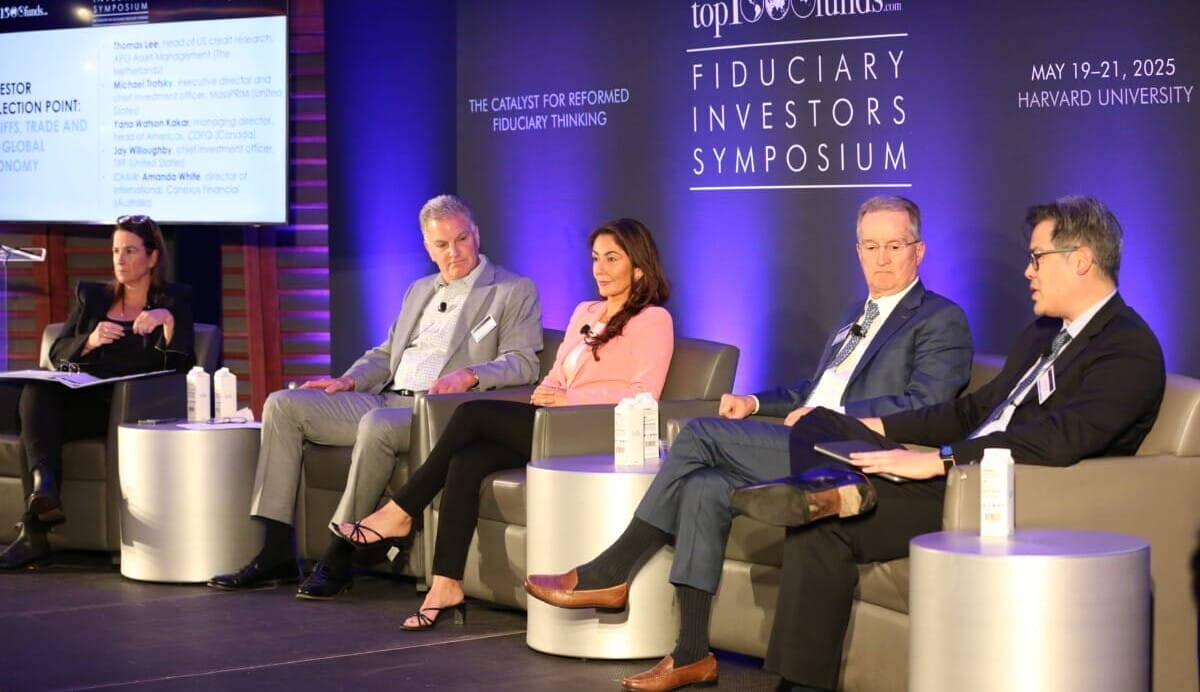
L-R: Amanda White (Conexus Financial), Michael Trotsky, Yana Watson Kakar, Jay Willoughby and Thomas Lee. Photo: Jack Smith

Leading asset owners have urged peers to remain cool-headed in volatile markets, warning against making big, risky bets when no one can really predict how policy uncertainties like tariffs will eventually play out. 

Michael Trotsky, chief investment officer of the $100 billion US public pension fund MassPRIM, said global markets have a long history of “the kind of chaos we’re going through”. 

The history of tariffs in the US can be traced as far back as the Early National Period when the first Treasury Secretary, Alexander Hamilton, used them to pay the federal government’s operating expenses and to redeem debts.   

“We at PRIM don’t…believe at all in tactical asset allocation, but we do believe in sticking to a strategic asset allocation,” Trotsky told the Top1000funds.com Fiduciary Investors Symposium at Harvard University.  

Trotsky said the fund is doing two things during times of extreme volatility. The first is making sure its managers are not making big tactical bets, including any excessive factor and country exposure that drags it away from benchmarks.   

The second is strictly adhering to a rebalancing strategy.  

Sponsored Content

“In times of volatility there are going to be some opportunities and, over time, we think by rebalancing aggressively monthly, which is what we’ve always done, that’ll be a tactical approach,” Trotsky said. 

Jay Willoughby, chief investment officer of outsourced CIO company TIFF Investment Management, echoed the need to stay close to SAA and not act rashly when there’s an overflow of information about the markets. 

“If you don’t know what’s going on, don’t try to be a hero and make bets on things that are very low-confidence bets,” he said.   

“I don’t think anybody knows what’s going to happen. I don’t think Donald Trump himself knows what’s going to happen. It’s a reflexivity situation that we’re in that could end very badly or very well for the markets.  

“I would stay close to my SAA as well, even by country.”  

Head of US credit research of Dutch investor APG, Thomas Lee, said the fund’s playbook during uncertainty is to generally become more conservative, but that does not mean pilling into cash.   

“When there’s a lot more unpredictability in the market, you make your portfolios more predictable,” Lee said. For example, he said the fund would gravitate towards investment-grade bonds or double-B ratings for high-yield bonds, which is exactly what it did after Liberation Day. 

Like many asset owners, APG is grappling with the broader shift away from US assets and its impact, but Lee is not too worried about the trend.  

“I do think that there isn’t going to be a major shift at the end of the day, in terms of dollar weakening or assets moving outside the US to other parts. I think there will be shifts, but I just don’t think it’s going to be seismic,” he said. 

“That keeps me more at peace in terms of dealing with the volatility from day to day, and the way that we see is that it does create opportunities, hopefully, to make investments at a lower entry point.”  

CDPQ’s New York-based managing director and head of Americas, Yana Watson Kakar, said she is bullish on the US. The fund has around $150 billion invested in the nation, and she pointed out that nine of the world’s 30 largest economies are states in the US – sizes significant enough to rival most countries. 

“Economic pain points in the US normally have been offset by what we’ve seen in the bond market and what the dollar does, but not now – so there are some warning signs,” Watson Kakar said.  

“But the fundamentals are strong. Any investment decision is both an absolute and a relative one.  

“Protectionism has been fairly structurally consistent in the United States for some time now. As a long-term investor, we spend a considerable amount of time scenario planning and pay close attention to those actions most likely to impact our investments in the country, or the Québec companies that we support,” she said. 

Leave a Comment

Behind Norges’ search for pure alpha

Behind Norges’ search for pure alpha

Despite uncertainties, Norges Bank is tipping that the US stock market will continue to outperform Europe in the next two decades. The mammoth fund also explained how it carved out a $90 billion pure alpha portfolio from passive investments, overseen only by 8 portfolio managers.

Sort content by

Alpha alone does not pay pensions – total returns do

Pension fund members in retirement want the sustainability of pension payments. OPTrust chief investment officer James Davis told the Top1000Funds Fiduciary Investors Symposium that a total portfolio approach is the best way to do that, and has been on a journey towards delivering it for the past 10 years.

Long-term investors can help break VC’s short-term trap

The short-term investment focus of venture capital investors and the withdrawal of government funding are opening the door to asset owners as providers of patient, long-term capital to fill an investment void, the Top1000funds.com Fiduciary Investors Symposium has heard.

TPA is in the eye of the beholder

Total portfolio approach is not a method, it’s a mindset, according to University of Toronto finance Professor Redouane Elkamhi. Also a senior advisor to HOOPP, Elkamhi said he would summarise TPA in one sentence: "How to be prepared for different market conditions."

Federal threats undermine Massachusetts’ edge, warns state treasurer

Massachusetts treasurer Deborah Goldberg warned that the state’s key strengths – including its higher education institutions and progressive social policies – are being targeted by the federal administration. She urged support from investors as federal funding for innovations and research wanes.

What it means if ‘DNA is not destiny’

Geneticist David Sinclair says aging is a disease and it is preventable and treatable. He told the Fiduciary Investors Symposium that research demonstrates we can slow down or even reverse the aging process. It sounds like good news, but the consequences for society and the investment community are profound. 

FIS Harvard 2025: Photo gallery

Explore our photo gallery from FIS Harvard, May 19-21, 2025.