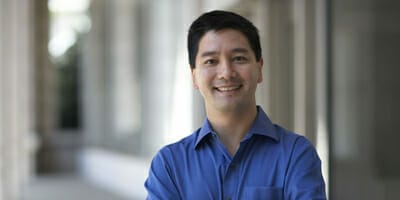

Why Andrew Ang joined Blackrock

Andrew Ang believes factor investing is a more efficient way to organise a portfolio as it allows liquid and illiquid strategies to be managed across the portfolio. It also has the added benefit of honing managers on value creation. He’s been working with a handful of investors while Professor of Finance at Columbia University on implementing factor investing, and the motivation to join Blackrock was the opportunity to springboard the practical implementation of these beliefs and transform the way assets are managed.


Ang says that his ambition is to see factor investing implemented across the industry more generally and oversee how funds managers can organise themselves and the management of assets to meet investor needs.

Already a few  investors, such as the Canadian Pension Plan Investment Board, the Singapore GIC, Norway’s sovereign wealth fund, and Japan’s GPIF, take a total portfolio view using factor investing. But Ang says there are missing tools in the industry to enable this to be more widespread, and part of his job will be to develop those platforms.

“It is obvious the benefits of organising a top down approach and treating liquid and illiquid investments in the same framework: more intelligent diversification and you can rebalance the factor exposures. It is more efficient to organise a portfolio that way and it is theoretically correct,” he says.

But re-orienting a portfolio along factor lines takes time, requires consultation and technology tools.

Sponsored Content

“The pulpit I have for factor evangelism at Blackrock is far wider than my reach as an academic,” he says, commenting on Blackrock’s scale, talent access and ability to innovate.

“It’s a huge opportunity to help transform how assets are managed,” he says.

Basically he sees smart beta and factor investing as versions of the same thing, with the main difference in the delivery.

“There are some differences in sophistication, whether you use leverage, shorting, and how you put it together in portfolio construction via weighting or security selection,” he says. “Smart beta is often a delivery vehicle, usually long-only, concentrating on different weighting schemes, factor investing is far broader.”

Choosing which factors, or vehicles, investors use is a very specific investor question, Ang says.

“Academia has discovered hundreds of factors. Pick only a few, understand they will have losses at some point, and implement them in a way appropriate for your fund where you can stay the course. Play to your comparative advantages on your ability to trade, whether you are best at making low versus high frequency decisions, and how skilful you are in dynamically constructing portfolios.”

In addition to being an ambassador for factor investing and a conduit for the industry at large Ang will be involved internally at Blackrock in the development of factor funds, re-organising the manager along factor lines and the development of a technology platform to help investors allocate to different factors.

While as managing director and head of the factor-based strategies group, Ang will report day-to-day to the global head of multi-asset strategies, Ken Kroner, he sees his role as much larger than just developing smart beta products for Blackrock.

“I will lead the design of accessible, scalable and cheap factor funds across asset classes and geographies and develop technology to help investors allocate optimally to those factors, and hopefully, eventually, see the whole portfolio through factors.”

It’s the technology that Ang is particularly passionate about, viewing it as a missing tool which will allow investors to facilitate factor implementation. While he sees Blackrock has having a competitive advantage in the development of such a platform, because of its risk analysis tools, he says there is a missing link in the ability to use forward-looking tools.

“Investors have good tools to see the factor risks in the portfolio they currently hold. They also want a tool that looks at what factors they ought to have, a forward-looking tool and I want to help them meet that gap,” he says.

In an age where driver-less cars are being invented he says finance is often behind when it comes to technology.

“You can go online and interact with websites and see the immediate results of our choices. But there is no tool today where you can allocate towards different factors and see the consequence of those decisions on the whole range of liquid and illiquid assets in an interactive, geographically-driven package,” he says.

He says investors don’t think of illiquid investments as bundles of factors but they are and should be considered in the overall portfolio as such. Private equity is not an asset class, he says, it is a bundle of stocks and bonds.

Factor investing is a better way to construct a portfolio, he says, all the way from the top-down portfolio to the benchmarks you give your active managers.

“This is transformative, that is one of the reasons I joined Blackrock. We can touch thousands of investors,” he says.

Ultimately, he says if investors outsource investment management they want to have funds managers spend most of the time on activities that add value. Factor investing hones the activity of a manager to decisions of compensated risk that consistently deliver higher returns, he says.

“In the long run primary benefit of factor investing is higher risk adjusted returns.”

Ang, who is the Ann F. Kaplan Professor of Business, at Columbia Business School, has been at Columbia for 15 years and was chair of the finance and economics division. As a professor he has had extensive experience consulting and advising large institutional investors, most regularly with the Norwegian sovereign wealth fund, but he’s had limited commercial experience working full-time for a commercial institution.

“I’m very proud of the work I’ve done at Columbia and the research I’ve done,” he says.

Ang’s approach to harvesting factor risk premiums is outlined in his recent book, Asset Management: A Systematic Approach to Factor Investing.


Andrew Ang will speak on factor investing at the Fiduciary Investors Symposium, Chicago Booth School of Business from October 18-20.

Leave a Comment

Sort content by

Accenture puts diversity into action

Anna Darnley, 24, recently joined the board of Accenture's UK pension scheme. She and chair Peter George discuss achieving age and gender balance, and what her perspective brings.

Canadian pensions form research hub

Canada’s biggest funds are among the founders of the National Pension Hub, which aims to sponsor research that can help the industry, and has a plan for getting the right academics onto the job.

NBIM takes aim at forex practices

The manager of the $1 trillion Government Pension Fund Global has adopted the FX Global Code of Conduct and expects its counterparties to do the same. But the pension giant hasn’t stopped there.

Call for higher pension ages

The ratio of working years to retirement years should be at least 2 to 1 and raising the pension age is a universal fix for strained systems, the author of Mercer’s Global Pension Index says.

Active strategies still valued

Prominent CIOs say active management’s place is secure, even as passive strategies surge in popularity. But the two types of strategies aren’t as distinct as in years past.

Largest pension funds get bigger

Willis Towers Watson’s report on the top 300 pension funds for 2016 shows the world’s largest 20 funds have increased their share of global pension assets under management by 7.1 per cent.

Previous




