
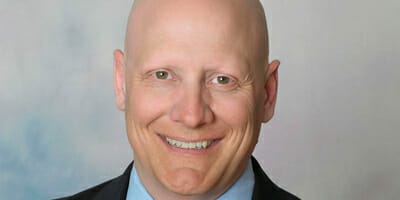

There are two things that drive the newly appointed global chief operating officer of State Street Global Advisors, Greg Ehret, in his bid to improve the client experience: the retirement business is a cause worth working on and the clients are the reason the business exists.
Ehret was appointed to the new position at SSgA, which manages $2.2 trillion, in September 2012, and as COO he is responsible for delivery to clients, which means operations, technology, client relationships, sales and marketing all report to him. It’s basically everything except investments, and there are 440 investment professionals, and 2350 employees in SSgA, so it’s no small task. He and the chief investment officer, Rick Lacaile, report to chief executive, Scott Powers, and interestingly both are based in London despite the firm’s strong Boston heritage.
He believes in what he is selling
Ehret is a State Street man, he believes in what he is selling and says that all evidence he can see points to the fact the manager is the best in the world at passive management.
But he’s not an index tragic. He believes in innovation and business evolution because he is driven by solving clients’ problems.
“Our goal is to be relevant to our clients. Passive is a core strength of SSgA, we are the best indexers in the world. But our goal is to be relevant in facing off clients’ problems, and those problems have changed, so the solution can be indexed, or alternative beta, or active strategies,” he says.
“Many pension funds are under water and there is a real need for alpha and to use efficient sources of beta. ‘Core and explore’ is a key tenet of ours and while I think the secular trend to passive is a long-term core trend, we offer tools to get alpha and efficiently deliver the core.”
Ehret looks at three core concepts – interest rates, returns and risk – and how the needs of clients have changed as those three issues shift.
Driving client solutions
Meeting those changing needs then drives client solutions and product innovation.
One such example is the recent launch of senior debt exchange traded funds developed by SSgA and GSO Capital Partners, the global credit business of The Blackstone Group.
“Rates will be back up eventually; it’s not sustainable for them to be so low or negative,” he says. “The challenge is looking for income now, but in the future we will diversify away from interest rates.”
He says liquid alternatives will become more important in the product-suite offering and points to the hedge fund manager, SSARIS, which is a State Street Global Alliance company, the joint initiative with APG.
“In their multi-strategy and single strategy they have developed strategies that are divergent trades, they go long volatility. In their investment discipline, they are consistently diversified with long volatility and, over the long term, they have lower risk and higher return,” he says. “Volatility is so much more important to clients. We are working on a number of different strategies in alternatives, and liquid alternatives will become more important to us. There is great talent available, so we can do it organically.”
Business savvy
Ehret is a 20-year veteran of SSgA, holding a number of executive positions in operations, sales and product development, including as co-head of the firm’s industry-leading SPDR exchange traded fund business.
While SSgA is fundamentally an institutional investment manager, Ehret says his background means he looks at things differently.
“It’s a roundabout way of getting here, and it’s given me a different view,” he says. “I started in intermediary, not institutional, and the intermediary business is becoming more important to the business. Our initial foray was in ETFs and now the intermediary is asking what else we can do for them, whether it be advice, product differentiation or delivering an outcome to customers. It shows how the firm has changed.”
Service has to be impeccable
Ehret’s goal when he started as global COO was to “improve the client experience”, and first and foremost in that mission is to have a relationship between the client that is spotless.
A new initiative to help benchmark that is the introduction of a new process in which clients are surveyed when they are new and “onboarded”.
Ehret is also emphasising the power of communication and the delivery of good direct, transparent communication about the firm and the portfolio.
“It has to be good communication, up to date and on time. We have to get in the client’s shoes and remember that delivering a report is not the end of it, rather making sure everyone in our value chain understands the impact on the client. By the way that’s why we’re here,” he says. “Service has to be impeccable, integrity is really important.”
Ehret says that asset managers are partners of their clients, and are frequently asked to do a lot of value added in the investments solutions team.
This includes such things as total portfolio analysis, or liability hedging analysis, or the appropriate use of leverage or derivatives.
SSgA also participates in some unique conversations such as with the chief financial officers of listed corporations to talk about their stock so they can get the opinion of the buy side.
State Street also recently launched Global Exchange, which provides data and analytic solutions.
“We’re in the retirement business; it’s a cause worth working on,” says Ehret.








Leave a Comment
You must be logged in to post a comment.
Login