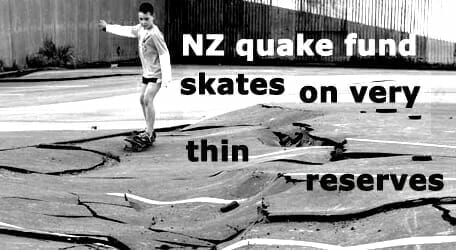

NZ quake fund skates on very thin reserves

New Zealand’s earthquake disaster relief fund could be completely drained following the fatal 6.3 quake that flattened large swathes of central Christchurch on February 22.

The Earthquake Commission (EQC) was already releasing about NZ$1.5 billion ($1.1 billion) of the $4.4 billion disaster fund to pay for claims generated by the 7.1 quake that caused widespread destruction in Christchurch last September.

The latest New Zealand government accounts to the end of January this year show the EQC had budgeted for insurance claims amounting to just over $1.78 billion from the September event.

While the fund itself must meet the first $1.1 billion in claims it had reinsurance in place up to a further $1.85 billion.

The EQC covers residential homeowners up to a value of $74,000 per claim. Owners who had been paid out after the September quake would be able to claim again if their homes sustained fresh damage following the latest catastrophe.

According to latest government estimates, about 10,000 Christchurch homes would have to be demolished while a further 100,000 required some level of repair as a result of the February earthquake.

Sponsored Content

If the latest round of claims exceeded $2.95 billion ($1.1 billion from the fund plus $1.85 billion from reinsurers), the EQC would have to dip into its remaining capital, which would amount to about $2.22 billion of New Zealand fixed-interest investments.

Last year Phil Jacques, EQC chief financial officer, told Top1000Funds’ sister publication, I&T News, the fund would first sell-down its $1.26 billion global equities portfolio to meet claims.

While EQC would not comment, it is understood the global equities sell-down had almost been completed. AXA’s annual accounts to the end of December last year, for example, reveal the EQC redeemed its $237.3 million global equities mandate with AllianceBernstein to cover costs incurred by the September earthquake.

The EQC also had global equity mandates with State Street Global Advisors, Tweedy Browne, T. Rowe Price and Capital International.

The remaining 70 per cent of the EQC portfolio was chiefly invested in a range of New Zealand government securities, including about 20 per cent in inflation-linked bonds.

Russell acts as investment adviser to the EQC fund.

EQC collects about $66.6 million in levies each year but New Zealand Prime Minister, John Key, said that figure could triple next year to replenish the disaster fund.

One response to “NZ quake fund skates on very thin reserves”

  1. Investor need to understand the risk of investing in infrastructure fund.

Leave a Comment

Sort content by

Towers Watson: complexity coming straight at you

To be a long-term investor requires thematic investing because markets and economies are complex adaptive systems, according to Tim Hodgson, global head of the thinking-ahead group at Towers Watson. Hodgson told delegates at the Towers Watson Ideas Exchange in Sydney that economies and markets are complex and adaptive, their path is not random and the

Hintze: people are
hungry for alpha

Interest rate risk is the biggest threat to portfolios and the chances of inflation are very high, according to Michael Hintze, founder and chief executive of CQS, who spoke at the AIMA Australia Hedge Fund Forum on September 10. Hintze believes there is a great deal of moral hazard in today’s markets, mostly in money

Asset owners invisible in capital debate

Asset owners are not visible in the policy debate about the structural shortage of long-term capital, according to Sony Kapoor, managing director of Re-Define, an economic and financial think tank that advises policy makers and civil society in the European Union. Kapoor, who recently completed a paper critiquing the Norwegian Sovereign Wealth Fund’s investment strategy,

Tapering talk poses tough questions

Talk of tapering sent markets into occasional spins this summer – with negative reactions even following positive economic signals at times. Should institutional investors be concerned though of a seemingly impending slowdown in quantitative easing? Opinions are split as to whether a potentially damaging crash is on the horizon or investors can largely dismiss the

UK funds “profoundly” hurt by low interest rates

In his first major announcement as governor of the Bank of England, Canadian-born Mark Carney says ultra-low interest rates are here to stay. This couldn’t be worse news for pension funds, according to pension’s expert, Ros Altmann, but private-public collaboration on infrastructure could help ease the pain.   The prospect of another three years of

New way for Norway’s investments

The Norwegian government should establish a new fund, the Government Pension Fund – Growth, to invest in developing countries, resulting in the dual benefits of jobs creation and investment returns for the fund, recommends a report by Re-define, commissioned by Norwegian Church Aid. The NCA, which is a member of the humanitarian alliance, Act Alliance,

Previous




