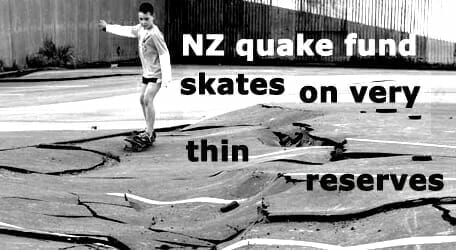
NZ quake fund skates on very thin reserves

New Zealand’s earthquake disaster relief fund could be completely drained following the fatal 6.3 quake that flattened large swathes of central Christchurch on February 22.

The Earthquake Commission (EQC) was already releasing about NZ$1.5 billion ($1.1 billion) of the $4.4 billion disaster fund to pay for claims generated by the 7.1 quake that caused widespread destruction in Christchurch last September.

The latest New Zealand government accounts to the end of January this year show the EQC had budgeted for insurance claims amounting to just over $1.78 billion from the September event.

While the fund itself must meet the first $1.1 billion in claims it had reinsurance in place up to a further $1.85 billion.

The EQC covers residential homeowners up to a value of $74,000 per claim. Owners who had been paid out after the September quake would be able to claim again if their homes sustained fresh damage following the latest catastrophe.

According to latest government estimates, about 10,000 Christchurch homes would have to be demolished while a further 100,000 required some level of repair as a result of the February earthquake.

Sponsored Content

If the latest round of claims exceeded $2.95 billion ($1.1 billion from the fund plus $1.85 billion from reinsurers), the EQC would have to dip into its remaining capital, which would amount to about $2.22 billion of New Zealand fixed-interest investments.

Last year Phil Jacques, EQC chief financial officer, told Top1000Funds’ sister publication, I&T News, the fund would first sell-down its $1.26 billion global equities portfolio to meet claims.

While EQC would not comment, it is understood the global equities sell-down had almost been completed. AXA’s annual accounts to the end of December last year, for example, reveal the EQC redeemed its $237.3 million global equities mandate with AllianceBernstein to cover costs incurred by the September earthquake.

The EQC also had global equity mandates with State Street Global Advisors, Tweedy Browne, T. Rowe Price and Capital International.

The remaining 70 per cent of the EQC portfolio was chiefly invested in a range of New Zealand government securities, including about 20 per cent in inflation-linked bonds.

Russell acts as investment adviser to the EQC fund.

EQC collects about $66.6 million in levies each year but New Zealand Prime Minister, John Key, said that figure could triple next year to replenish the disaster fund.


One response to “NZ quake fund skates on very thin reserves”

  1. Investor need to understand the risk of investing in infrastructure fund.

Leave a Comment

Sort content by

Invest in line with how old you feel

How old do you feel? Academics at Maastricht argue that not only our true age but also our subjective age should be integrated into designing and marketing financial products and services like target date funds and pension products.

Tough 2020 for Canadian funds: Aon

Now that we’re in the midst of 2020, it might be easy for investors to forget how big a turnaround 2019 actually was for financial markets. One way to look at it is through the Aon Median Solvency Ratio, a quarterly survey that gauges the financial health of an important slice of the institutional investor community, Canadian defined benefit pension plans. Erwan Pirou, Canada CIO for Aon asks whether markets – and, by extension, pension plan solvency – can stage a repeat performance in 2020.

Reaction to Coronavirus: Cambridge Assoc

The Wuhan coronavirus is still spreading, but according to Aaron Costello who is regional head, Asia, at Cambridge Associates, investors should stay calm. The virus remains less deadly and more contained than the SARS outbreak of 2002–03. Looking at other epidemics, history suggests that after an initial sharp hit, economies and markets typically recover quickly.

Live Stream 2020 | DAY 2

[vc_raw_html]JTVCVlN0YXRzX0dhdGUlMjBjb2RlJTNEJTIyZmlzanVuZTIwMjAtczQ0Z2NkNjAyJTIyJTIwcmVkaXJlY3QlM0QlMjJodHRwcyUzQSUyRiUyRnd3dy50b3AxMDAwZnVuZHMuY29tJTJGMjAyMCUyRjAxJTJGbGl2ZS1zdHJlYW0taGVscCUyRiUyMiU1RCUwQSUwQSUzQ2RpdiUyMGNsYXNzJTNEJTIydmNfY29sLXNtLTglMjIlM0UlMEElMEElNUJWU3RhdHNfVmlkZW8lMjBpZCUzRCUyMjQyNTE1MTUwMSUyMiU1RCUwQSUwQSUzQyUyRmRpdiUzRSUwQSUzQ2RpdiUyMGNsYXNzJTNEJTIydmNfY29sLXNtLTQlMjIlM0UlMEElMEElMEElM0NpZnJhbWUlMjBzcmMlM0QlMjJodHRwcyUzQSUyRiUyRmFwcC5zbGkuZG8lMkZldmVudCUyRmpzYm12d2FzJTIyJTIwZnJhbWVib3JkZXIlM0QlMjIwJTIyJTIwaGVpZ2h0JTNEJTIyMTAwJTI1JTIyJTIwd2lkdGglM0QlMjIxMDAlMjUlMjIlMjBzdHlsZSUzRCUyMm1pbi1oZWlnaHQlM0ElMjA1MTVweCUzQiUyMiUzRSUzQyUyRmlmcmFtZSUzRSUwQSUwQSUzQyUyRmRpdiUzRQ==[/vc_raw_html][vc_empty_space] Zoom room one Professor Stephen Kotkin, Professor in History and International Affairs, Princeton University (United States) Karen Karniol-Tambour, head of investment research, Bridgewater Associates (United States) Current number of participants: 1 [vc_btn title=”Join” color=”pink” align=”left” custom_onclick=”true” el_id=”zoom1″ custom_onclick_code=”window.open(“https://live.wallf.ly/vstats/zoom.php“+location.search+“&zoom=zoom2“);”]mrec4 Zoom room two Kate Barker, chair, BCSSS (United Kingdom) Michael Hewett, managing director, investor relations, SVP

The Curious Quant

The Curious Quant series, hosted by Michael Kollo, is a discussion between technically-minded professionals in the financial services, technology and data science fields. It carefully examines the application of new data and new methodologies to common problems in financial markets. The aim is to promote better discussions about these emerging areas, and a better understanding of new technologies.

Time’s up for climate lobbyists

While hopeful this week’s UN Climate Action Summit generates a huge leap forward, Fiona Reynolds calls on investors to redouble efforts to address negative corporate climate lobbying. She writes from New York.

Previous




