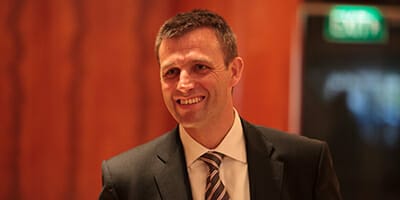

How the Future Fund found agility

Using a fund of funds enabled the Future Fund to build a large exposure to hedge funds quickly during the global financial crisis, chief investment officer of the Future Fund, David Neal says.

The Future Fund, which uses a combination of fund of funds and direct hedge fund investments, decided it did not have the breadth of skill and research to entirely invest directly.

“Could we realistically, or want to, try to build a team with enough talent and size to cover the industry? It’s not consistent with our notion to keep the investment team small enough to sit around a table and talk about all of the opportunities and strategies to build our portfolio,” Neal says.

“We thought with fund of funds, and the extra edge of someone who’s actually doing it, was worth exploring. As we started, we found other benefits of fund of funds, for example, in the crisis we were able to move quickly. We had one investment-management agreement with one organisation, which has relationships, and we can throw money at them quickly and could build a large exposure quickly. There was an execution service that came from it that would have taken a long time.”

Environment-specific risk

Neal says the Future Fund, which has almost 20 per cent exposure to hedge funds, is looking to expand its exposure and invest in commodities, catastrophe bonds and macro managers.

Sponsored Content

The fund has generated 4.9 per cent since inception, well below its mandate of consumer-price index plus 4.5 to 5.5 per cent

“We are clearly behind, but we don’t think there is much more we could have done. It is very dangerous to play catch-up. If you load up more risk, you’ll blow it,” Neal says. “You have to take the right amount of risk given the environment.”

Investors must manage the risk profile to the prevailing landscape, Neal says, but he believes there will be opportunity to take more risk in the next decade.

Meritocracy for assets

The Future Fund has a “dynamic” allocation process, but it is not relative to a benchmark. Rather, all investment opportunities are assessed on their merit.

“Long-term characteristics can change quickly, the GFC showed that,” he says. “It is not about active tilting but managing risk/return and adjusting accordingly.”

Because of this dynamic nature, the funds are shifted from one opportunity to another.

“There are managers we are happy with who we take money from because the opportunity changes,” Neal says.

The Future Fund considers every investment opportunity on a hedged basis, so each investment can be compared on a like-for-like basis. The fund then decides how much currency to hold.

At the moment it has 12.5 per cent in emerging-market currencies and 18 per cent in developed-market currencies

“Currency is the risk I worry about the most – or it is the cause and solution of the risk I worry about the most – liquidity.”

Neal sits on the Hedge Fund Standards Board and encourages investors to sign the standards’ investor chapter.

“The more investors that sign, the more that managers are interested.”

Asset Owner:Future Fund

Leave a Comment

Sort content by

CalPERS: a new framework of economy

CalPERS has adopted 10 preliminary investment principles following a board offsite in July, but a number of topics, including the role of active management, are still under debate ahead of the September board meeting that is the deadline for the principles’ adoption. The $266-billion Californian fund began the process for establishing investment principles in January

Social networks in the investment web

Reels of financial data and analysis coupled with the occasional piece of market gossip or personal hunch are the time-honoured tools investors rely on in building an active portfolio. More recently, an element of sustainability or corporate governance analysis has tried to muscle into the process. Soon there will be another revolutionary option complementing financial

Eijffinger’s decade of financial repression

Financial repression will define the economic landscape for at least another decade, according to professor of financial economics at Tilburg University, Sylvester Eijffinger, which has serious implications for institutional investors. Eijffinger, who also is also a visiting professor at Harvard, sits on the monetary experts panel of the European Union and is an adviser to

Is reviving Europe a suspended apparition?

Getting Europe’s swelling institutional capital to support long-term projects that could benefit its uninspired economies was an idea that sent heads nodding around the continent as it suffered the brunt of the financial crisis. Get pension, insurance and foundation money into where it is most needed with the attraction of reliable long-term cash flows and

Let’s talk about underfunding

Even using the assets of the pension plan was not enough of a leg-up to save the city of Detroit from bankruptcy. As the last words in the song Put your hands up for Detroit by Fedde Le Grand say, it is system shutdown. The fiscal demise of this city may be a lesson for

Johnson urges pension simplicity

There is a David-and-Goliath feeling to the battle Michael Johnson, a research fellow at the London-based think tank the Centre for Policy Studies, is waging against the pension industry. His research, which lays out the case for radically simplifying all aspects of the United Kingdom’s pension sector, has earned him a reputation as a maverick.

Previous




