
How the Future Fund found agility

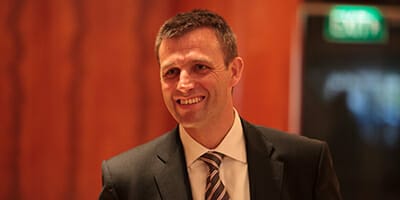
Using a fund of funds enabled the Future Fund to build a large exposure to hedge funds quickly during the global financial crisis, chief investment officer of the Future Fund, David Neal says.

The Future Fund, which uses a combination of fund of funds and direct hedge fund investments, decided it did not have the breadth of skill and research to entirely invest directly.

“Could we realistically, or want to, try to build a team with enough talent and size to cover the industry? It’s not consistent with our notion to keep the investment team small enough to sit around a table and talk about all of the opportunities and strategies to build our portfolio,” Neal says.

“We thought with fund of funds, and the extra edge of someone who’s actually doing it, was worth exploring. As we started, we found other benefits of fund of funds, for example, in the crisis we were able to move quickly. We had one investment-management agreement with one organisation, which has relationships, and we can throw money at them quickly and could build a large exposure quickly. There was an execution service that came from it that would have taken a long time.”

Environment-specific risk

Neal says the Future Fund, which has almost 20 per cent exposure to hedge funds, is looking to expand its exposure and invest in commodities, catastrophe bonds and macro managers.

Sponsored Content

The fund has generated 4.9 per cent since inception, well below its mandate of consumer-price index plus 4.5 to 5.5 per cent

“We are clearly behind, but we don’t think there is much more we could have done. It is very dangerous to play catch-up. If you load up more risk, you’ll blow it,” Neal says. “You have to take the right amount of risk given the environment.”

Investors must manage the risk profile to the prevailing landscape, Neal says, but he believes there will be opportunity to take more risk in the next decade.

Meritocracy for assets

The Future Fund has a “dynamic” allocation process, but it is not relative to a benchmark. Rather, all investment opportunities are assessed on their merit.

“Long-term characteristics can change quickly, the GFC showed that,” he says. “It is not about active tilting but managing risk/return and adjusting accordingly.”

Because of this dynamic nature, the funds are shifted from one opportunity to another.

“There are managers we are happy with who we take money from because the opportunity changes,” Neal says.

The Future Fund considers every investment opportunity on a hedged basis, so each investment can be compared on a like-for-like basis. The fund then decides how much currency to hold.

At the moment it has 12.5 per cent in emerging-market currencies and 18 per cent in developed-market currencies

“Currency is the risk I worry about the most – or it is the cause and solution of the risk I worry about the most – liquidity.”

Neal sits on the Hedge Fund Standards Board and encourages investors to sign the standards’ investor chapter.

“The more investors that sign, the more that managers are interested.”

Asset Owner:Future Fund

Leave a Comment

Sort content by

Invest in line with how old you feel

How old do you feel? Academics at Maastricht argue that not only our true age but also our subjective age should be integrated into designing and marketing financial products and services like target date funds and pension products.

Tough 2020 for Canadian funds: Aon

Now that we’re in the midst of 2020, it might be easy for investors to forget how big a turnaround 2019 actually was for financial markets. One way to look at it is through the Aon Median Solvency Ratio, a quarterly survey that gauges the financial health of an important slice of the institutional investor community, Canadian defined benefit pension plans. Erwan Pirou, Canada CIO for Aon asks whether markets – and, by extension, pension plan solvency – can stage a repeat performance in 2020.

Reaction to Coronavirus: Cambridge Assoc

The Wuhan coronavirus is still spreading, but according to Aaron Costello who is regional head, Asia, at Cambridge Associates, investors should stay calm. The virus remains less deadly and more contained than the SARS outbreak of 2002–03. Looking at other epidemics, history suggests that after an initial sharp hit, economies and markets typically recover quickly.

Live Stream 2020 | DAY 2

[vc_raw_html]JTVCVlN0YXRzX0dhdGUlMjBjb2RlJTNEJTIyZmlzanVuZTIwMjAtczQ0Z2NkNjAyJTIyJTIwcmVkaXJlY3QlM0QlMjJodHRwcyUzQSUyRiUyRnd3dy50b3AxMDAwZnVuZHMuY29tJTJGMjAyMCUyRjAxJTJGbGl2ZS1zdHJlYW0taGVscCUyRiUyMiU1RCUwQSUwQSUzQ2RpdiUyMGNsYXNzJTNEJTIydmNfY29sLXNtLTglMjIlM0UlMEElMEElNUJWU3RhdHNfVmlkZW8lMjBpZCUzRCUyMjQyNTE1MTUwMSUyMiU1RCUwQSUwQSUzQyUyRmRpdiUzRSUwQSUzQ2RpdiUyMGNsYXNzJTNEJTIydmNfY29sLXNtLTQlMjIlM0UlMEElMEElMEElM0NpZnJhbWUlMjBzcmMlM0QlMjJodHRwcyUzQSUyRiUyRmFwcC5zbGkuZG8lMkZldmVudCUyRmpzYm12d2FzJTIyJTIwZnJhbWVib3JkZXIlM0QlMjIwJTIyJTIwaGVpZ2h0JTNEJTIyMTAwJTI1JTIyJTIwd2lkdGglM0QlMjIxMDAlMjUlMjIlMjBzdHlsZSUzRCUyMm1pbi1oZWlnaHQlM0ElMjA1MTVweCUzQiUyMiUzRSUzQyUyRmlmcmFtZSUzRSUwQSUwQSUzQyUyRmRpdiUzRQ==[/vc_raw_html][vc_empty_space] Zoom room one Professor Stephen Kotkin, Professor in History and International Affairs, Princeton University (United States) Karen Karniol-Tambour, head of investment research, Bridgewater Associates (United States) Current number of participants: 1 [vc_btn title=”Join” color=”pink” align=”left” custom_onclick=”true” el_id=”zoom1″ custom_onclick_code=”window.open(“https://live.wallf.ly/vstats/zoom.php“+location.search+“&zoom=zoom2“);”]mrec4 Zoom room two Kate Barker, chair, BCSSS (United Kingdom) Michael Hewett, managing director, investor relations, SVP

The Curious Quant

The Curious Quant series, hosted by Michael Kollo, is a discussion between technically-minded professionals in the financial services, technology and data science fields. It carefully examines the application of new data and new methodologies to common problems in financial markets. The aim is to promote better discussions about these emerging areas, and a better understanding of new technologies.

Time’s up for climate lobbyists

While hopeful this week’s UN Climate Action Summit generates a huge leap forward, Fiona Reynolds calls on investors to redouble efforts to address negative corporate climate lobbying. She writes from New York.

Previous




