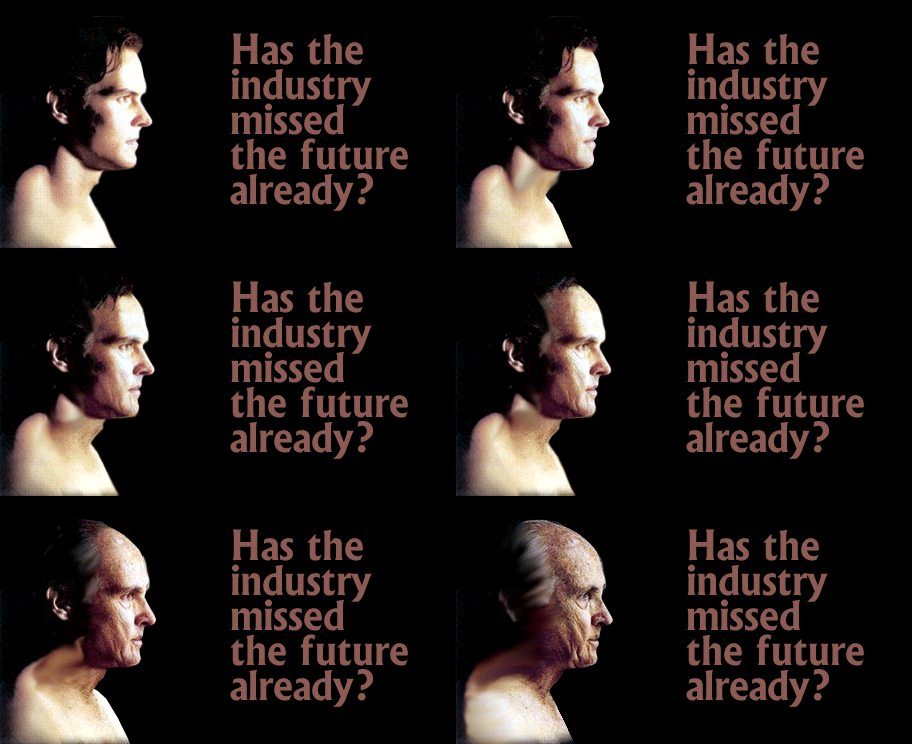
Has the industry missed the future already?

The investment management industry will need to be restructured to meet the demands of ageing demographics globally.

Ingo Walter, Professor at Stern School of Business and director of SimCorp StrategyLab, says demographic changes “will pose both challenges and opportunities to all sectors within investment management”.

“In the next 10-20 years, many parts of the investment management industry will have to be restructured in order to meet the demands posed by the growing retiring population. The companies best prepared to handle the challenges and, in particular, take advantage of the opportunities are likely to become the future winners,” he says.

“The pensions industry, for instance, will be required to provide very high returns as well as stable cashflows while simultaneously being able to manage risk better; and the fund industry will be met with a growing demand for products suited for investing people’s retirement savings.”

Speaking at the SimCorp StrategyLab in Copenhagen, Walter went on to say that demographic changes are key to the future of the global investment management industry.

As part of its 2011-12 research program, SimCorp StrategyLab gathered three executive research groups in Copenhagen. The research groups consisted of academics and high-level industry representatives, who convened to discuss challenges and recommendations for the fund industry, the asset management industry, and the pension and insurance industries.

Sponsored Content

The results of the meeting as well as recommendations for how to meet the challenges faced by the global investment management industry will be elaborated on and published in three sector-specific white papers in September.


Leave a Comment

Sort content by

Lepelmeier: interest rates ruin German strategy

German institutional investors face an urgent need to reconsider their bond-heavy investment strategies, argues Dirk Lepelmeier, a former investment head at one of the country’s largest pension funds. Herr Prof Dr Dirk Lepelmeier, to use his appropriate German titles, would rather be addressed as Dirk. That might be of no surprise to many, but it

2013 Nobel Prize in economics split three ways

There is no way to predict whether the price of stocks and bonds will go up or down over the next few days or weeks. However, it is quite possible to foresee the broad course of the prices of these assets over longer time periods, such as the next three-to-five years. These findings, which may

ATP: experiments with alpha and beta

“There is very little pure alpha” said Henrik Jepsen, chief investment officer of ATP, at the Fiduciary Investors Symposium in Amsterdam when reflecting on the giant Danish fund’s experiences with the return class. The DKK 624-billion ($114-billion) ATP decided to merge the alpha and beta platforms of its investment portfolio earlier this year. This wound

New NAPF chair to build trust in UK pensions

New chairman Ruston Smith’s inaugural speech at the United Kingdom’s National Association of Pension Fund annual conference in Manchester focused on building trust in the pensions industry. Talking about the need to create “pensions people trust to deliver a decent income, pensions people trust to be there when they retire and pensions people trust not

The Fama of modern finance

When Eugene Fama enrolled at Chicago Booth School of Business in 1960, “finance was a joke”, he says in a candid and fascinating insight into his more than 50 years as a student, academic and teacher at the university. The essay, published by Chicago Booth’s Capital Ideas, details Fama’s own history but also a short

Walmart takes divestment blows to the body

Two more high profile investors have punished US retailer Walmart for its anti-union stance and poor labour practices by divesting their holdings in the company. AP Funds, Sweden’s cluster of state pension funds named AP1 through to AP4 and AP6 (there is no AP5) worth a combined $140 billion, sold its equity and corporate bond

Previous



