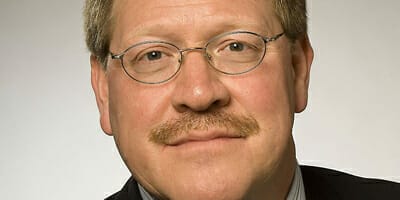
Eijffinger’s decade of financial repression

Financial repression will define the economic landscape for at least another decade, according to professor of financial economics at Tilburg University, Sylvester Eijffinger, which has serious implications for institutional investors.

Eijffinger, who also is also a visiting professor at Harvard, sits on the monetary experts panel of the European Union and is an adviser to the International Monetary Fund, says negative interest rates are the major issue of our time.

Negative real interest rates are here to stay, a realisation that has huge implications for investors.

“Governments have to de-leverage risk in times of low growth and they are not prepared to increase taxes; they have to do it with financial repression,” he says. “As an investor, be prepared. You have to realise that low interest rates are here to stay at the short-end and possibly at the long-end of the yield curve. This has huge implications for investments.”

By way of example, he says the European Central Bank’s policy rate stands at 0.5 per cent, while the eurozone’s annual inflation rate is 2.5 per cent. The Bank of England keeps its policy rate at only 0.5 per cent, despite an inflation rate that hovers above 2 per cent. And, in the United States, where inflation exceeds 2 per cent, the Federal Reserve’s benchmark federal funds rate remains at an historic low of 0 to 0.25 per cent.

This will be the financial and economic environment of the immediate future.

Sponsored Content

He says negative interest rates, which he describes as a kind of wealth tax, are necessary for governments to de-risk, but they come at the expense of savers.

“People who save should be aware that governments need to do this for at least a decade,” he says.

Eijffinger will give a keynote address at the Fiduciary Investors Symposium, an event that brings together institutional investors to examine the power and responsibility of fiduciary investment.

The event, which is convened by Conexus Financial, the publisher of conexust1f.flywheelstaging.com, will be held in Amsterdam from October 20 to 22, 2013. www.fiduciaryinvestor.com

Read an article by Eijffinger on the subject here.



Leave a Comment

Sort content by

“Periodic table” for investment shows case for diversification

The latest “periodic table” of investment returns – which ranks the performance of key equity and credit indices over two decades – from Callan Associates reinforces a lasting rule for long-term investors: diversification works. mrec4inarticleinline Sponsored Content scnative1 scnative2 scnative3

US funds lag in risk management

US public sector funds spend less than half the time and resources on risk management than the average of their global peers according to a survey of 58 funds by Canadian-based CEM Benchmarking. mrec4inarticleinline Sponsored Content scnative1 scnative2 scnative3

Private equity is ‘train crash’: expert

The collapse of a private equity manager lacks the impact of a hedge fund failure: it’s like a “slow-motion train wreck,” says Chris Hunter, managing director of Cambridge Associates in London. Now that fundraising among private equity managers is down, leveraged finance is scarce and the market for exits is weak, mega-buyout funds are busy

Going green boosts property returns

Green properties are better financial performers, says of Maastricht University, who recently helped build a global environmental real estate index. But most property managers are either unaware of this dynamic or prefer to talk about sustainability rather than take action. However, some exceptions provide a ‘green’ benchmark for institutional investors in property. Simon Mumme reports. mrec4inarticleinline

New private equity head for New York Teachers

The New York State Teachers’ Retirement System has restructured its internal investment team creating a new role of head of private equity, to create five direct investment reports to the executive director, and has already made a number of additional investments in that asset class. mrec4inarticleinline Sponsored Content scnative1 scnative2 scnative3

Investors take credit in Say on Pay reform

Investor action through letters and company dialogue has resulted in more than 40 companies in the US, including Goldman Sachs, State Street, BNY Mellon and Conoco, agreeing to implement Say on Pay reform, according to Timothy Smith, senior vice president, Walden Asset Management who recently coordinated a letter signed by investors including CalPERS chief investment

Previous




