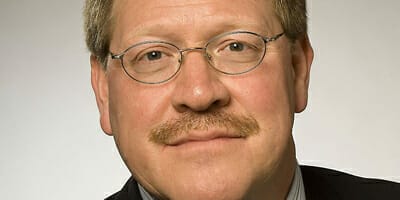
Eijffinger’s decade of financial repression

Financial repression will define the economic landscape for at least another decade, according to professor of financial economics at Tilburg University, Sylvester Eijffinger, which has serious implications for institutional investors.

Eijffinger, who also is also a visiting professor at Harvard, sits on the monetary experts panel of the European Union and is an adviser to the International Monetary Fund, says negative interest rates are the major issue of our time.

Negative real interest rates are here to stay, a realisation that has huge implications for investors.

“Governments have to de-leverage risk in times of low growth and they are not prepared to increase taxes; they have to do it with financial repression,” he says. “As an investor, be prepared. You have to realise that low interest rates are here to stay at the short-end and possibly at the long-end of the yield curve. This has huge implications for investments.”

By way of example, he says the European Central Bank’s policy rate stands at 0.5 per cent, while the eurozone’s annual inflation rate is 2.5 per cent. The Bank of England keeps its policy rate at only 0.5 per cent, despite an inflation rate that hovers above 2 per cent. And, in the United States, where inflation exceeds 2 per cent, the Federal Reserve’s benchmark federal funds rate remains at an historic low of 0 to 0.25 per cent.

This will be the financial and economic environment of the immediate future.

Sponsored Content

He says negative interest rates, which he describes as a kind of wealth tax, are necessary for governments to de-risk, but they come at the expense of savers.

“People who save should be aware that governments need to do this for at least a decade,” he says.

Eijffinger will give a keynote address at the Fiduciary Investors Symposium, an event that brings together institutional investors to examine the power and responsibility of fiduciary investment.

The event, which is convened by Conexus Financial, the publisher of conexust1f.flywheelstaging.com, will be held in Amsterdam from October 20 to 22, 2013. www.fiduciaryinvestor.com

Read an article by Eijffinger on the subject here.



Leave a Comment

Sort content by

CIC expands portfolio with major investment bank stake

The China Investment Corporation (CIC) is having its domestic portfolio boosted through the transfer of the 43.5 per cent stake in China International Capital Corp (CICC), the country’s largest investment bank, by it’s state-controlled brokerage firm, China Jianyin Investment Securities.mrec4inarticleinline Sponsored Content scnative1 scnative2 scnative3

Real estate and infrastructure shine in private markets

Real estate and infrastructure are attractive investments in the private markets space, but individual investment selection has become more important in private equity and debt, according to the latest major analysis by global private markets investment management firm Partners Group.mrec4inarticleinline Sponsored Content scnative1 scnative2 scnative3

China’s greening attracting more investment

China is stepping up its clean energy drive, both through a reduction of its own emissions and by becoming the biggest supplier of some clean-energy equipment in the world. Picture (courtesy China Daily) shows cooling towers being demolished with explosives amid efforts to reduce emissions in Zoucheng, East China’s Shandong province, last week.mrec4inarticleinline Sponsored Content

Multi asset class products the winners in Europe: survey

Multi-asset class and alternative investments, particularly unleveraged absolute return funds will attract the highest inflows in Europe over the next few years, according to a survey which also reported groundswell support for more shareholder engagement.mrec4inarticleinline Sponsored Content scnative1 scnative2 scnative3

European shocks strike Norway fund

The world’s second largest sovereign wealth fund, Norway’s Government Pension Fund Global, has experienced a material effect of the European sovereign debt challenges, a region where it holds more than half its equity holdings, and the BP oil spill.mrec4inarticleinline Sponsored Content scnative1 scnative2 scnative3

How your hedge funds make money

Outspoken hedge fund manager, Cliff Asness, says breaking down the sources and challenges to manager performance will determine how investors should pay for alpha.mrec4inarticleinline Sponsored Content scnative1 scnative2 scnative3

Previous




