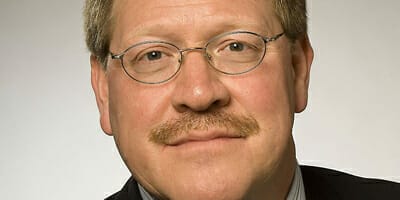
Eijffinger’s decade of financial repression

Financial repression will define the economic landscape for at least another decade, according to professor of financial economics at Tilburg University, Sylvester Eijffinger, which has serious implications for institutional investors.

Eijffinger, who also is also a visiting professor at Harvard, sits on the monetary experts panel of the European Union and is an adviser to the International Monetary Fund, says negative interest rates are the major issue of our time.

Negative real interest rates are here to stay, a realisation that has huge implications for investors.

“Governments have to de-leverage risk in times of low growth and they are not prepared to increase taxes; they have to do it with financial repression,” he says. “As an investor, be prepared. You have to realise that low interest rates are here to stay at the short-end and possibly at the long-end of the yield curve. This has huge implications for investments.”

By way of example, he says the European Central Bank’s policy rate stands at 0.5 per cent, while the eurozone’s annual inflation rate is 2.5 per cent. The Bank of England keeps its policy rate at only 0.5 per cent, despite an inflation rate that hovers above 2 per cent. And, in the United States, where inflation exceeds 2 per cent, the Federal Reserve’s benchmark federal funds rate remains at an historic low of 0 to 0.25 per cent.

This will be the financial and economic environment of the immediate future.

Sponsored Content

He says negative interest rates, which he describes as a kind of wealth tax, are necessary for governments to de-risk, but they come at the expense of savers.

“People who save should be aware that governments need to do this for at least a decade,” he says.

Eijffinger will give a keynote address at the Fiduciary Investors Symposium, an event that brings together institutional investors to examine the power and responsibility of fiduciary investment.

The event, which is convened by Conexus Financial, the publisher of conexust1f.flywheelstaging.com, will be held in Amsterdam from October 20 to 22, 2013. www.fiduciaryinvestor.com

Read an article by Eijffinger on the subject here.



Leave a Comment

Sort content by

Coming out for gay and lesbian themes

With the return to favour of top-down equities management and renewed focus by pension funds on their asset allocation and beta exposures, there has consequently been a resurgence in thematic investment styles and products. CLICK HERE TO READ MOREmrec4inarticleinline Sponsored Content scnative1 scnative2 scnative3

‘Lazy’ actuaries need to look forward, not back

The answer to underfunding is a closer working relationship between actuaries and investment professionals in forecasting investment returns and setting lower discount rates, according to Karen Harris, vice-president in the capital markets research group at Callan Associates, who believes funds cannot rely on investment strategies alone to get them “out of this hole”.mrec4inarticleinline Sponsored Content

Norway’s SWF makes first property investment

Norges Bank Investment Management, which manages the Norwegian $2,908 billion kroner ($500 billion) Government Pension Fund Global, has made its first property investment following approval by the Norwegian Government to invest in the asset class in March.mrec4inarticleinline Sponsored Content scnative1 scnative2 scnative3

Rebalancing not so simple with diverse beta sources

Simple reblancing of portfolios back to strategic ranges after a market rise or fall is not as simple as you may think, according to a research note from brokers Morgan Stanley. The new investment required after a fall may be surprisingly large.mrec4inarticleinline Sponsored Content scnative1 scnative2 scnative3

GMO says QE2 set to hit shoals

On the eve of an anticipated second round of quantitative easing – QE2 – a number of commentators, including GMO’s Jeremy Grantham, have criticised Fed’s policy as a large net negative to the production of a healthy, stable economy. mrec4inarticleinline Sponsored Content scnative1 scnative2 scnative3

A 22-year love affair transforms KIC

Everyone asks Scott Kalb, the chief investment officer for the $37 billion Korean Investment Corporation, how he got the job. Scott, as his name suggests, is not Korean. Well, it’s a long story.mrec4inarticleinline Sponsored Content scnative1 scnative2 scnative3

Previous




