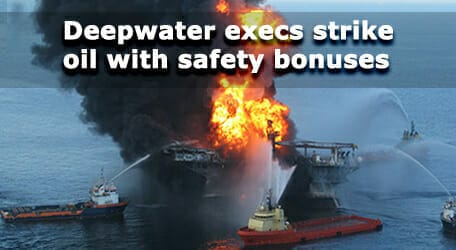
Deepwater execs strike oil with safety bonuses

As incongruous as it sounds, executives at Transocean Ltd – the company that owns the Deepwater Horizon oil rig which exploded in the Gulf of Mexico last year killing 11 people – have been paid bonuses for their improved safety performance.

According to a company SEC filing last week, last year was its best-ever for safety, “notwithstanding the tragic loss of life in the Gulf of Mexico”.

Executives receive 25 per cent of their bonuses based on the company’s safety performance in a given year.

Last year, they were given two-thirds of this. In 2009, the company withheld all bonuses after four deaths.

The calculation for overall safety performance is not based on deaths alone, but rather the number of “incidents” and their “potential severity”.

The number of incidents fell 4 per cent in 2010 and their potential severity fell 15 per cent.

Sponsored Content

The Deepwater Horizon rig was leased by BP, which operated the rig. Transocean blames BP for the damage.

The US Government is continuing its investigation into the cause of the explosion.

Leave a Comment

Sort content by

Academics and industry unite

The gargantuan impact of systemic risk in global financial markets has been corroborated by a consortium of industry and academics collaborating to provide independent quantitative research, insight and leadership on systemic risk. Driven by director of MIT’s Laboratory for Financial Engineering,  Andrew Lo, senior managing director at State Street Global Markets, Jessica Donohue, and managing

Rethink remuneration

Institutional investors around the world have been lobbying for the right to have a say on pay, a right to have an input into the remuneration of the executives in the companies they invest in. In June the UK’s business secretary, Vince Cable, laid out new plans that will give shareholders three-yearly votes on executive

Endowments fall
from grace

US college and university endowments have gone from pioneers in the adoption of socially responsible investing (SRI) to markedly trailing the rest of the investment industry in integrating environmental social and corporate governance (ESG), new research reveals. The Boston-based Tellus Institute, an independent not-for-profit think-tank, looked at 464 endowments and was damning in its findings,

Kay Review recommendations tackle short-termism

Co-head of responsible investment at the £32 billion Universities Superannuation Scheme, David Russell, says asset manager engagement with companies should move away from its “almost myopic focus on remuneration” to other issues that impact value and strategy. His comments come on the back of the final report of the Kay Review of the UK equity

POLL: Which strategy within emerging markets debt do you find the most compelling?

mrec4inarticleinline Sponsored Content scnative1 scnative2 scnative3

CalPERS: “opaquely transparent”

A Columbia Business School case study on CalPERS has criticised the fund for being “opaquely transparent”, with a computation of investment expenses revealing the fund pays three-to-four times its peers in fees. Written by Columbia professor of business Andrew Ang and Columbia CaseWorks fellow, Jeremy Abrams, Californian dreamin’: The mess at CalPERS examines the political,

Previous




