Deepwater execs strike oil with safety bonuses

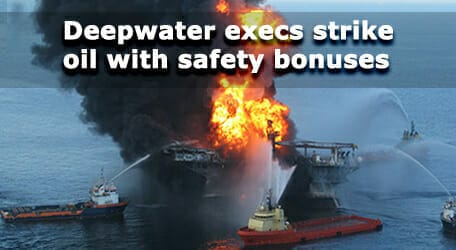
As incongruous as it sounds, executives at Transocean Ltd – the company that owns the Deepwater Horizon oil rig which exploded in the Gulf of Mexico last year killing 11 people – have been paid bonuses for their improved safety performance.

According to a company SEC filing last week, last year was its best-ever for safety, “notwithstanding the tragic loss of life in the Gulf of Mexico”.

Executives receive 25 per cent of their bonuses based on the company’s safety performance in a given year.

Last year, they were given two-thirds of this. In 2009, the company withheld all bonuses after four deaths.

The calculation for overall safety performance is not based on deaths alone, but rather the number of “incidents” and their “potential severity”.

The number of incidents fell 4 per cent in 2010 and their potential severity fell 15 per cent.

Sponsored Content

The Deepwater Horizon rig was leased by BP, which operated the rig. Transocean blames BP for the damage.

The US Government is continuing its investigation into the cause of the explosion.

Leave a Comment

Sort content by

Maverick Series video: Gonski part I

In the first of a new series of video interviews featuring thought leaders in global institutional investment, chair of the $80 billion Australian Future Fund, David Gonski, outlines his views on governance. mrec4inarticleinline Sponsored Content scnative1 scnative2 scnative3

ATP reunites alpha and beta after 6 years

Alpha and beta rely to a large extent on exposures to systematic risk factors, so goes the “2013 thinking” of ATP in reversing the decision to separate alpha and beta in its investment portfolio six years ago. ATP has separate hedging and investment portfolios, with the hedging portfolio significantly larger at around DKK 670 billion

State Street’s Probyn into 2013

The current equity rally is not predicated on a shift in economic performance, according to chief economist at State Street, Chris Probyn, who says it would be reasonable to say the market may “pause for thought”. Probyn says the move from fixed income to equities has been fostered by some of the “economic areas for

CalPERS’ sustainability initiative drives investment beliefs

Launched this week, CalPERS’ Sustainable Investment Research Initiative (SIRI) will drive the development the $250-billion fund’s first set of investment beliefs. While difficult to believe a fund of its size, reach and history could invest without a set of investment beliefs, it is encouraging to see that sustainability will be a core part of that

Finnish pension reform a lesson for all

The findings from the first review of the Finnish pension system, commissioned by the Finnish Centre for Pensions, were handed down by Nicholas Barr from the London School of Economics and Keith Ambachtsheer from the Rotman International Centre for Pension Management last month. Although Helsinki in January is far from a party Ambachtsheer and Barr

European investors stay on the offensive

2012 was a year of battles for European pension funds. An ongoing war was waged against a severe regulatory challenge from the European Commission in the shape of Solvency II-style legislation. Aside from the uncertain struggle of that campaign, major European investors gained plenty of credit from standing up to corporate boards in the “shareholder

Previous




