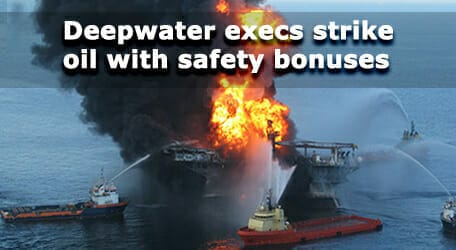
Deepwater execs strike oil with safety bonuses

As incongruous as it sounds, executives at Transocean Ltd – the company that owns the Deepwater Horizon oil rig which exploded in the Gulf of Mexico last year killing 11 people – have been paid bonuses for their improved safety performance.

According to a company SEC filing last week, last year was its best-ever for safety, “notwithstanding the tragic loss of life in the Gulf of Mexico”.

Executives receive 25 per cent of their bonuses based on the company’s safety performance in a given year.

Last year, they were given two-thirds of this. In 2009, the company withheld all bonuses after four deaths.

The calculation for overall safety performance is not based on deaths alone, but rather the number of “incidents” and their “potential severity”.

The number of incidents fell 4 per cent in 2010 and their potential severity fell 15 per cent.

Sponsored Content

The Deepwater Horizon rig was leased by BP, which operated the rig. Transocean blames BP for the damage.

The US Government is continuing its investigation into the cause of the explosion.

Leave a Comment

Sort content by

Integrating ESG at Norway’s giant SWF

Behind the Strategy Council’s report to the Norwegian Ministry of Finance on responsible investment for the Norwegian Government Pension Fund Global.

Defining fiduciary duty

What constitutes fiduciary duty is an ongoing discussion in the pension sector. The UK Law Commission has weighed in on the debate with its own interpretation.     Pension funds mulling the definition and obligations of their fiduciary duty can now refer to a consultation paper from the Law Commission, Fiduciary Duties of Investment Intermediaries.

Investors call for conflict of interest code

As an outsourced provider, fund managers make a series of promises to investors. Anything that tempts the promise to be broken is a conflict of interest, according to chief executive of Carne Group, John Donohoe, whose organisation has conducted a survey of institutional investors’ attitudes to conflicts of interest. In a survey of global allocators

Stock exchanges ‘need nudge on sustainability disclosure’

 A study ranking the world’s stock exchanges against disclosure on sustainability themes ranks the BME Spanish Exchange at the top. But the study’s author managing director of CK Capital, Doug Morrow, says stock exchanges need a nudge by regulators to enforce tougher disclosure standards.   The world’s stock exchanges “need a bit of a nudge”

Dry up: how investors assess water risks

The world is running short of water, but what does that mean for investors? Asset owners in the Netherlands and Norway assess and manage the water-related risks in their portfolios, including the measurement of portfolio companies’ water dependence and water security. The drought hitting South Africa’s North West Province sounds another warning shot around the

Serving itself: why the financial services industry needs reform

What would the financial services industry look like if it was structured to service the non-financial services sector, rather than itself? Economist John Kay, author of the Kay Review into short termism in UK equity markets, aims to find out.   In an ideal world there would be one, maybe two, intermediaries between the saver

Previous




