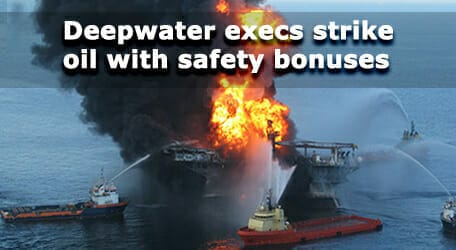
Deepwater execs strike oil with safety bonuses

As incongruous as it sounds, executives at Transocean Ltd – the company that owns the Deepwater Horizon oil rig which exploded in the Gulf of Mexico last year killing 11 people – have been paid bonuses for their improved safety performance.

According to a company SEC filing last week, last year was its best-ever for safety, “notwithstanding the tragic loss of life in the Gulf of Mexico”.

Executives receive 25 per cent of their bonuses based on the company’s safety performance in a given year.

Last year, they were given two-thirds of this. In 2009, the company withheld all bonuses after four deaths.

The calculation for overall safety performance is not based on deaths alone, but rather the number of “incidents” and their “potential severity”.

The number of incidents fell 4 per cent in 2010 and their potential severity fell 15 per cent.

Sponsored Content

The Deepwater Horizon rig was leased by BP, which operated the rig. Transocean blames BP for the damage.

The US Government is continuing its investigation into the cause of the explosion.

Leave a Comment

Sort content by

Schapiro considers action on pay to play

The US Securities and Exchange Commission (SEC) is currently considering pay-to-play activities and will report back on any proposed action in the next few weeks, according to its chairman Mary Schapiro, speaking via video at the annual International Corporate Governance Network conference this week. mrec4inarticleinline Sponsored Content scnative1 scnative2 scnative3

Hermes chief calls for mandate overhaul

Pension funds should demand an overhaul in the product offerings of funds managers and change the terms of mandates to incorporate environmental, social and governance issues in portfolios, according to Colin Melvin, chief executive of Hermes Equity Ownership Services, who pointed to a number of funds in the UK, including the owner of Hermes, BT

How to allocate if the world has changed forever

The financial crisis has challenged pension funds to rethink standard asset allocation models, but as Jonathan Armitage, head of US equities at Schroders observes, a lot of investors are questioning whether they need to react. mrec4inarticleinline Sponsored Content scnative1 scnative2 scnative3

Crisis fails to derail support for ESG

A new report commissioned by the International Finance Corporation (IFC), a member of the World Bank Group, has found environmental, social and governance investment criteria in emerging markets are being embraced by most of the asset management community despite the economic crisis. mrec4inarticleinline Sponsored Content scnative1 scnative2 scnative3

USS, ABP and PGGM collaborate on real estate

Three of Europe’s largest institutional investors have teamed up to investigate the way environmental issues are assessed and managed by real estate companies. mrec4inarticleinline Sponsored Content scnative1 scnative2 scnative3

Shareholder influence under question: ICGN conference

The ability to appoint and dismiss company board directors is the most important shareholder right according to an overwhelming majority of delegates at the International Corporate Governance Network (ICGN) annual conference, who were more cautious on whether shareholders could actually influence corporate governance once they had the right to vote. mrec4inarticleinline Sponsored Content scnative1 scnative2

Previous




