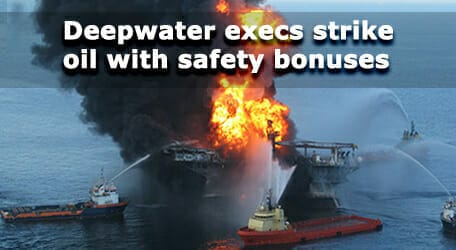
Deepwater execs strike oil with safety bonuses

As incongruous as it sounds, executives at Transocean Ltd – the company that owns the Deepwater Horizon oil rig which exploded in the Gulf of Mexico last year killing 11 people – have been paid bonuses for their improved safety performance.

According to a company SEC filing last week, last year was its best-ever for safety, “notwithstanding the tragic loss of life in the Gulf of Mexico”.

Executives receive 25 per cent of their bonuses based on the company’s safety performance in a given year.

Last year, they were given two-thirds of this. In 2009, the company withheld all bonuses after four deaths.

The calculation for overall safety performance is not based on deaths alone, but rather the number of “incidents” and their “potential severity”.

The number of incidents fell 4 per cent in 2010 and their potential severity fell 15 per cent.

Sponsored Content

The Deepwater Horizon rig was leased by BP, which operated the rig. Transocean blames BP for the damage.

The US Government is continuing its investigation into the cause of the explosion.

Leave a Comment

Sort content by

New method for incentive compensation at CalPERS

CalPERS is contemplating an incentive schedule for senior investment executives that builds in downside risk, by expanding the range of the factor multipliers for the quantitative elements of investment performance plans, a move which could potentially eliminate a small compensation incentive award. mrec4inarticleinline Sponsored Content scnative1 scnative2 scnative3

End of an era as APG appoints new CIO

A focus on governance and sustainability has been recognised by APG Asset Management, in appointing former global chief executive of ING Investment Management, Europe, Angelien Kemna, as successor to chief investment officer Roderick Munsters, the man who has sat at the helm of two of the Netherlands’ biggest pension funds. mrec4inarticleinline Sponsored Content scnative1 scnative2

NYSTRS leaves UNPRI but remains committed to governance

The New York State Teachers Retirement System has voluntarily withdrawn active participation in the United Nations Principles for Responsible Investment (UNPRI) initiative but will continue to support strong corporate governance principles through memberships in the Council of Institutional Investors and Ceres. mrec4inarticleinline Sponsored Content scnative1 scnative2 scnative3

Pastoral musings on investments

Chief research strategist and head of beta research at RogersCasey, Cynthia Steer, takes a summertime look at the “New World” of investing. She compares today’s investment challenges to those of gardening, and in contemplating the stoicism and constancy of long-time gardeners and farmers, she notes that portfolios today need to be re-constituted, the risk within

CalPERS’ securities lending loss

CalPERS will continue its securities lending program following an annual review, despite significant pressure on its collateral pool, with income of $220 million generated for the year to March but unrealised losses on the internal collateral reinvestment of $854 million. mrec4inarticleinline Sponsored Content scnative1 scnative2 scnative3

Does less leverage mean lower returns for listed property?

The financial crisis has put an end to the excessive use of leverage by real estate companies, and the prospect of distressed assets presents opportunities for pension funds. Kristen Paech discusses the outlook for the sector with Ritson Ferguson, CEO and chief investment officer of ING Clarion Real Estate Securities.   mrec4inarticleinline Sponsored Content scnative1

Previous




