Deepwater execs strike oil with safety bonuses

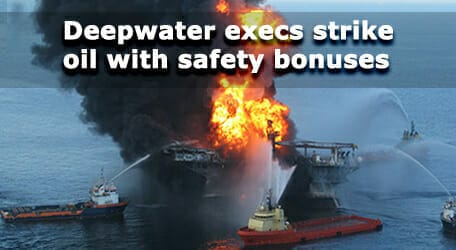
As incongruous as it sounds, executives at Transocean Ltd – the company that owns the Deepwater Horizon oil rig which exploded in the Gulf of Mexico last year killing 11 people – have been paid bonuses for their improved safety performance.

According to a company SEC filing last week, last year was its best-ever for safety, “notwithstanding the tragic loss of life in the Gulf of Mexico”.

Executives receive 25 per cent of their bonuses based on the company’s safety performance in a given year.

Last year, they were given two-thirds of this. In 2009, the company withheld all bonuses after four deaths.

The calculation for overall safety performance is not based on deaths alone, but rather the number of “incidents” and their “potential severity”.

The number of incidents fell 4 per cent in 2010 and their potential severity fell 15 per cent.

Sponsored Content

The Deepwater Horizon rig was leased by BP, which operated the rig. Transocean blames BP for the damage.

The US Government is continuing its investigation into the cause of the explosion.

Leave a Comment

Sort content by

Quants in need of a makeover

Quantitative investing needs to change, and should do so by scaling up to produce more proprietary data,  reducing excessive numbers of signals and becoming more “market savvy”, according to the global head of equity research at BlackRock, Ronald Kahn.mrec4inarticleinline Sponsored Content scnative1 scnative2 scnative3

Average is OK in active management

At times when markets are moving around more than usual, such as in the past three years, institutional investors tend to pay more concern to the value of active management. New global figures from Mercer show that while they should be concerned there is still value to be found in active management. mrec4inarticleinline Sponsored Content

Controversy dogs Australian system review

The Australian Government released its report of the review into the governance, efficiency, structure and operation of the superannuation system, last week. Some of the recommendations have been met with controversy by industry participants, with continued support of innovative and alternative investments at risk. mrec4inarticleinline Sponsored Content scnative1 scnative2 scnative3

Temasek takes long view of Asia

The already heavy exposure to Asia of the S$186 billion ($134 billion) Temasek Holdings will be increased over the next decade as the investor favours the long-term secular growth of Asia over global growth. “Directionally, we are likely to increase our exposure to Asia over the next decade, but will continue to maintain the full

Infrastructure leads in steady alts demand

Infrastructure, commodities and private equity funds of funds (FoFs) were the fastest growing asset classes among alternatives invested by pension funds around the world last year, according to the annual alternatives survey from Towers Watson. The survey, conducted in association with the Financial Times of London, showed continued support for alternatives by institutional investor, although

Sovereign debt’s grave new world

Bonds have been the saviour for institutional investors in the global recovery, but a new bout of risk-aversion induced by concerns about sovereign risk threatens the stability of the traditionally defensive assets. mrec4inarticleinline Sponsored Content scnative1 scnative2 scnative3

Previous




