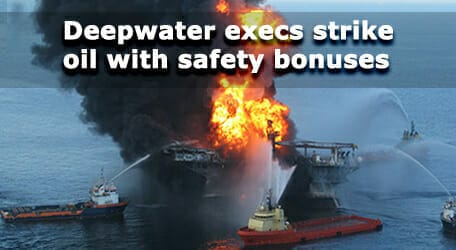
Deepwater execs strike oil with safety bonuses

As incongruous as it sounds, executives at Transocean Ltd – the company that owns the Deepwater Horizon oil rig which exploded in the Gulf of Mexico last year killing 11 people – have been paid bonuses for their improved safety performance.

According to a company SEC filing last week, last year was its best-ever for safety, “notwithstanding the tragic loss of life in the Gulf of Mexico”.

Executives receive 25 per cent of their bonuses based on the company’s safety performance in a given year.

Last year, they were given two-thirds of this. In 2009, the company withheld all bonuses after four deaths.

The calculation for overall safety performance is not based on deaths alone, but rather the number of “incidents” and their “potential severity”.

The number of incidents fell 4 per cent in 2010 and their potential severity fell 15 per cent.

Sponsored Content

The Deepwater Horizon rig was leased by BP, which operated the rig. Transocean blames BP for the damage.

The US Government is continuing its investigation into the cause of the explosion.

Leave a Comment

Sort content by

Architect of Future Fund investment strategy resigns

A chief architect of the A$68 billion ($60 billion) Australian Future Fund‘s investment strategy will leave in two weeks to form a new business offering asset allocation and macroeconomic strategy advice to large fiduciary investors globally. Tony Day, who joined the Future Fund in its early days of 2007, said that at 44 years of

Process over performance

Using performance, even as a filter, to hire or fire funds managers is a dangerous game, according to head of the international division at Enhanced Investment Technologies (INTECH), David Schofield. Choosing any partner, whether personal or business, can be fraught with complexity, and the process of hiring and firing managers does not escape those selection

Hedge FoFs on the wane with experienced investors

Hedge funds have had a bad rap for a long time, often undeserved. But the global financial crisis coupled with the Madoff scandal has affected their growth. UK-based alternatives research firm Preqin surveyed 50 institutional investors about their investments with hedge funds and hedge funds of funds (FoFs). The demands of institutional investors following their

Be aware of absolute returns, because it’s a relative world

Is it possible for a human being to manage an absolute-returns fund? If you believe the latest behavioural finance research, it must be very difficult. mrec4inarticleinline Sponsored Content scnative1 scnative2 scnative3

How active management saved the UN

The $32 billion United Nations Joint Staff Pension Fund has outperformed due to a commitment to active management, a willingness to invest away from the trending market, and a realistic target return. (click on the photo for more…)mrec4inarticleinline Sponsored Content scnative1 scnative2 scnative3

UniSuper’s specialist revolution for global equities

The A$25 billion ($21 billion) UniSuper is revolutionising its $4 billion international equities portfolio, terminating every active developed markets manager in favour of passively tracking the MSCI World, while alpha is sought among specialist regional and sectoral managers, with a listed technology mandate to be first cab off the rank. The chief investment officer of

Previous




