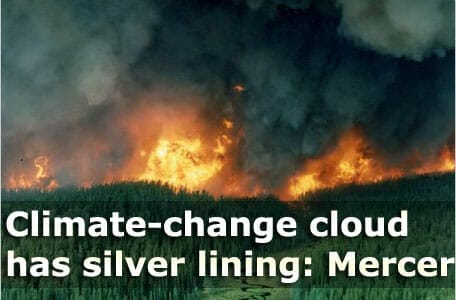
Climate-change cloud has silver lining: Mercer

Climate change could slash as much as 10 per cent off portfolios in the next 20 years, according to Mercer’s much-anticipated climate change report, the result of an 18-month collaboration with 14 institutional investors from around the globe.

With support from the International Finance Corporation and the Carbon Trust, the report, ‘Climate Change Scenarios – implications for strategic asset allocation’, had three broad objectives:

1.      To investigate and analyse the potential investment risk from climate change

2.      Look at the key performance drivers for markets

3.      Identify scenarios around climate change that help in understanding and framing climate change as a strategic investment priority.

Sponsored Content

“It is about setting the framework so institutional investors can transform to a low carbon economy,” Danyelle Guyatt, head of global research in Mercer’s responsible investment team, said.

The report looks at the impact of climate change on investments, concluding it could contribute as much as 10 per cent to portfolio risks.

Guyatt said Mercer would research managers with the best ideas across ideas and regions, and urged investors to introduce climate risk into reviews and strategic asset allocation.

Mercer’s chief investment officer, Andrew Kirton, said investors should look to allocate more to infrastructure, real estate, private equity, agriculture land, timberland, and sustainable assets.

The 14 global institutional investors, representing more than $2 trillion in AUM, are: AP1, APG, AustralianSuper, British Columbia Investment Management Corporation, British Telecom Pension Scheme, CalPERS, CalSTRS, Environment Agency Pension Scheme, Government of Singapore Investment Corporation, Maryland State Retirement and Pension System, Norwegian Government Pension Fund, Ontario Municipal Employees Retirement System, PGGM and VicSuper.


Leave a Comment

Sort content by

Growing financial knowledge poses challenge

As with most education, financial literacy is dependent on many personal and social factors. But now it turns out that for those living in the USA, the state in which you live may also be a determining factor.mrec4inarticleinline Sponsored Content scnative1 scnative2 scnative3

Investors hold power for sustainable future

Serious investors need to look at the sustainability of capital and their responsibility under UNPRI. They are not serious about their ESG commitment.

NYSTRS has stellar year

The $89.9 billion New York State Teachers Retirement System (NYSTRS) has achieved its best result for 25 years, returning 23.2 per cent for the year to June 30, 2011, with the strong performance driven mainly by its equity portfolio. NYSTRS, which claims to be one of the few fully-funded public pension funds in the country,

Avoiding biggest loser new reality for investors: Rogercasey

Uncertainty in global markets, and the potential for the Eurozone crisis to worsen, means investors should be focusing on capital preservation and shedding risk, says the managing director of Rogerscasey, and former CIO of the Kentucky Retirement Systems, Adam Tosh.mrec4inarticleinline Sponsored Content scnative1 scnative2 scnative3

NY funding controversy spurs pension reforms

The arrest of a fundraiser for New York city comptroller John Liu and the ongoing federal investigation into his finances confirms the need for the governance reform planned for the city’s five public pension funds, Columbia Business School Professor Andrew Ang says.mrec4inarticleinline Sponsored Content scnative1 scnative2 scnative3

Private engagement dominates results for CalPERS

Private engagement has more influence on company behaviour and performance a new study of CalPERS’ corporate governance reveals. Analysis by Wilshire Associates has found that because privately engaged companies are more receptive to reform and move more quickly to better governance standards, the turnaround in their stock performance is quicker. It found that the turnaround

Previous



