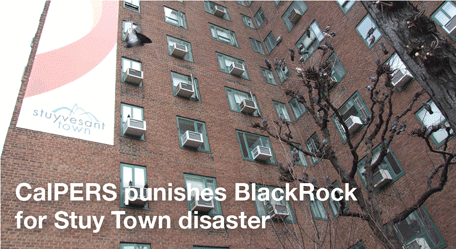
CalPERS punishes BlackRock for Stuy Town disaster

Another page has turned in the history of the Stuyvesant Town – Peter Cooper Village apartment buildings in New York, as iconic as they have been controversial since their initial construction in the 1940s. CalPERS, America’s largest pension fund, has terminated BlackRock, one of its property managers which led a 2006 purchase of the 80-acre site, after a 12-year relationship.

CalPERS wrote off US$500 million of its apartment portfolio after real estate manager Tishman Speyer Properties, which together with BlackRock and investors paid $5.4 billion for what the residents call “Stuy Town”, had given up control of the properties to avoid bankruptcy in January this year.

This week CalPERS terminated a $1 billion apartment management mandate with BlackRock, which had dated back to 1998. The fund has consolidated this with another long-time manager, the privately owned GID Investment Advisers.

The Stuy Town development marked the first major clearing of slum dwellings in New York, starting in 1943, financed largely by the insurer MetLife, which was awarded tax breaks and other government assistance.

It has been the subject of many court actions over the years, some on the basis of race. Courts ruled that the managers did not have to adhere to race discrimination laws applicable for public landlords, despite the government assistance in the development, and almost all the early tenants in the rent-controlled apartments were white.

CalPERS reported a loss of 37 per cent in its total real estate portfolio in the year to June. The fund is anticipating reduced costs and improved efficiency from consolidating its mandates under one partner/manager.


Sponsored Content

Leave a Comment

Sort content by

Innovation to align investors with the social good

The CFA Institute’s president John Rogers, believes there is evidence of innovation in investment products that meet the needs of asset owners in a more sustainable, longer-term way, and points to the work of professors and advisors to the CFA , Andrew Lo of MIT and Robert Shiller of Yale.   One of the main

Adding value through risk allocations

2013 was a great year to add value by using risk to assign asset allocation, according to chief investment officer of Windham Capital, Lucas Turton, whose fund added 300 basis points above benchmark last year by dynamically allocating according to risk.   Windham Capital Management’s style is to focus on measuring and understanding risk to

Alternatives increase as investors manage to outcomes

Investor allocations to alternatives will increase over the next three years as the focus on outcome-oriented investments heightens, according to respondents in the annual conexust1f.flywheelstaging.com /Casey Quirk Global Fiduciary CIO sentiment survey. The second annual survey, which included respondents from 56 asset owners with combined assets of $3 trillion, showed an accelerating trend to moving

Organisational change: asset owners 2.0

A key ingredient for success in any organisation is strong leadership. It is common in the corporate world for the chief executive to change every five to 10 years as the organisation evolves. Are the same principles true for large institutional investors?     Roger Urwin, global head of investment content at Towers Watson, who

The rise of the foreign trustee

Which developed world pension fund will become the first to have a Chinese national sit on its board? The debate on board diversity has focused on gender, race and age, but in future it could extend to having representatives of the countries your fund would most like to invest in. As funds travel along the

Economic growth outlook positive but integrity needs work

The outlook for economic growth this year is markedly positive, compared to last year, but capital market integrity is not improving, according to the opinions of more than 6,000 CFA Institute members. The CFA Institute global markets sentiment survey, measures the views of its members on market integrity and economic issues. This year’s survey, which

Previous



