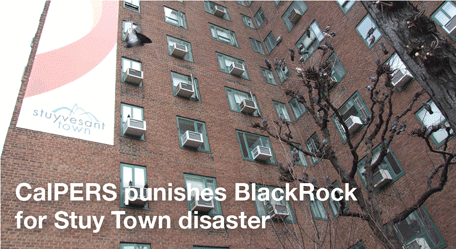
CalPERS punishes BlackRock for Stuy Town disaster

Another page has turned in the history of the Stuyvesant Town – Peter Cooper Village apartment buildings in New York, as iconic as they have been controversial since their initial construction in the 1940s. CalPERS, America’s largest pension fund, has terminated BlackRock, one of its property managers which led a 2006 purchase of the 80-acre site, after a 12-year relationship.

CalPERS wrote off US$500 million of its apartment portfolio after real estate manager Tishman Speyer Properties, which together with BlackRock and investors paid $5.4 billion for what the residents call “Stuy Town”, had given up control of the properties to avoid bankruptcy in January this year.

This week CalPERS terminated a $1 billion apartment management mandate with BlackRock, which had dated back to 1998. The fund has consolidated this with another long-time manager, the privately owned GID Investment Advisers.

The Stuy Town development marked the first major clearing of slum dwellings in New York, starting in 1943, financed largely by the insurer MetLife, which was awarded tax breaks and other government assistance.

It has been the subject of many court actions over the years, some on the basis of race. Courts ruled that the managers did not have to adhere to race discrimination laws applicable for public landlords, despite the government assistance in the development, and almost all the early tenants in the rent-controlled apartments were white.

CalPERS reported a loss of 37 per cent in its total real estate portfolio in the year to June. The fund is anticipating reduced costs and improved efficiency from consolidating its mandates under one partner/manager.


Sponsored Content

Leave a Comment

Sort content by

Target date funds go to Washington

Last week, Professor of Finance at Griffith Business School at Griffith University, Michael E. Drew*, was the only academic invited to present at the Securities and Exchange Commission and the Department of Labor Joint-Hearing on target date funds. He writes exclusively for conexust1f.flywheelstaging.com on his submission, which questions the conventional use of age-based approaches to

New York fund fulfills green promise with $200m Generation mandate

The $122 billion New York State Common Retirement Fund has allocated $200 million to Generation Investment Management, partly fulfilling the commitment made by New York State Comptroller, Thomas DiNapoli, in April last year to increase commitments to environmentally focused strategies across the whole portfolio by $500 million in three years. mrec4inarticleinline Sponsored Content scnative1 scnative2

Time to rebalance, equities are back: McCaughan

Economic evidence is starting to show the US is emerging from recession, but the really good news, according to Jim McCaughan the chief executive of Principal Global Investors, is that credit is flowing again, which means a sustained recovery. Amanda White spoke to him about the implications for institutional investors. mrec4inarticleinline Sponsored Content scnative1 scnative2

OMERS widens its scope to third-party offerings

The C$43 billion ($38 billion) Ontario Municipal Employees Retirement System (OMERS) has been granted expanded powers by the Ontario government to provide third-party investment and pension administration services, and is at various stages of discussion with a number of plans to provide investment management services. mrec4inarticleinline Sponsored Content scnative1 scnative2 scnative3

CalPERS officially alters asset allocation, reduces discretionary ranges

The $183 billion CalPERS board has made the first formal changes to its asset allocation targets since January 2008, increasing exposures to private equity and cash, and narrowing the discretionary ranges around all asset classes set in December last year. mrec4inarticleinline Sponsored Content scnative1 scnative2 scnative3

Climate change and capital markets: A global opportunity

Tackling the social, environmental and economic risks presented by climate change will require one of the biggest public-private partnerships ever seen.

Previous



