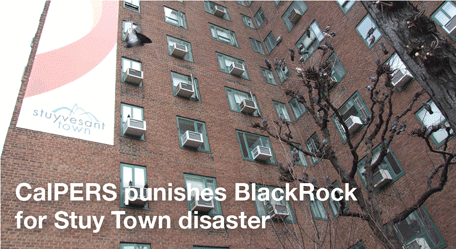
CalPERS punishes BlackRock for Stuy Town disaster

Another page has turned in the history of the Stuyvesant Town – Peter Cooper Village apartment buildings in New York, as iconic as they have been controversial since their initial construction in the 1940s. CalPERS, America’s largest pension fund, has terminated BlackRock, one of its property managers which led a 2006 purchase of the 80-acre site, after a 12-year relationship.

CalPERS wrote off US$500 million of its apartment portfolio after real estate manager Tishman Speyer Properties, which together with BlackRock and investors paid $5.4 billion for what the residents call “Stuy Town”, had given up control of the properties to avoid bankruptcy in January this year.

This week CalPERS terminated a $1 billion apartment management mandate with BlackRock, which had dated back to 1998. The fund has consolidated this with another long-time manager, the privately owned GID Investment Advisers.

The Stuy Town development marked the first major clearing of slum dwellings in New York, starting in 1943, financed largely by the insurer MetLife, which was awarded tax breaks and other government assistance.

It has been the subject of many court actions over the years, some on the basis of race. Courts ruled that the managers did not have to adhere to race discrimination laws applicable for public landlords, despite the government assistance in the development, and almost all the early tenants in the rent-controlled apartments were white.

CalPERS reported a loss of 37 per cent in its total real estate portfolio in the year to June. The fund is anticipating reduced costs and improved efficiency from consolidating its mandates under one partner/manager.


Sponsored Content

Leave a Comment

Sort content by

Investors x embrace ethics

More than half of the world’s largest sovereign wealth funds, and around a third of the largest US state pension funds, have a disclosed code of ethics for their staff. According to the Public Fund Investment Policies 2015 annual review produced by the Ohio State University Moritz College of Law, a code of ethics helps

Shared fund objectives key to investor success

The practice of benchmarking the salaries of senior executives of institutional funds with reference to external financial services firms, instead of the shared objectives of the fund, is a major barrier to their success, according to Professor Gordon Clark of Oxford University and director of Smith School of Enterprise and the Environment. Clark sees the

PGGM halves CO2 footprint in investments

Ahead of the COP21 in Paris, the second largest Dutch fund with €161 billion ($160 billion), Pensioenfonds Zorg en Welzijn (PFZW), has announced it will halve the CO2 footprint of its investments by 2020. After an in-depth study with its fund manager, PGGM, the fund has decided its capital should be focused on companies that

Mercer’s seven tools for risk management reflect evolving landscape

Mercer Investments is using its deep insurance and environmental, social and governance (ESG) skills, contacts and processes to evolve its tools for advising clients on investment risk assessment, analysis and reporting – a move that reflects the evolving landscape for risk faced by investors. Partner and global head of responsible investment at Mercer, Jane Ambachtsheer,

OTPP advises on climate risk mitigation

Ontario Teachers’ Pension Plan (OTPP), an investor known for its advanced risk-management tools and processes, considers that the common tools available to investors to mitigate carbon risk for investors – portfolio carbon footprints and thematic divestment – provide incomplete risk management. The fund has suggested macro- and microanalysis is necessary to understand a company’s complete

PRI to consider new principle focusing on systemic risks

The UN-backed Principles for Responsible Investment (PRI) is considering a seventh principle that will focus on broad financial system systemic risks. The six principles were written before the global financial crisis and are focused on environmental, social and governance (ESG) integration. Now, a decade after their creation, consideration of systemic risks is on the agenda and

Previous



