
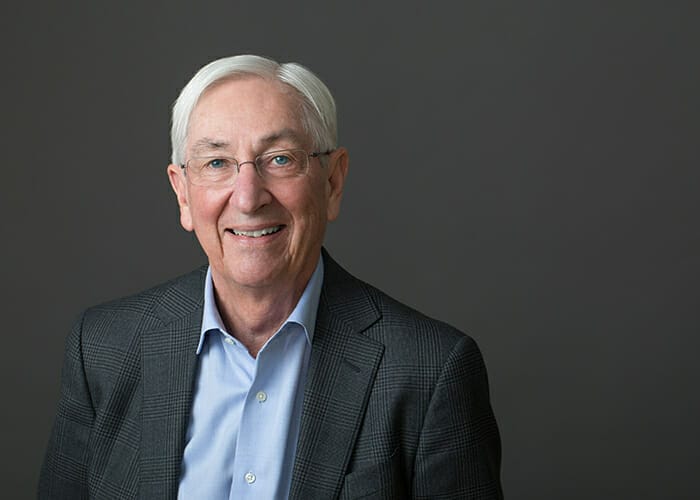

Keith Ambachtsheer wants a brighter spotlight on the behaviours and processes in the investment industry that lead to less desirable outcomes for the recipients of its services.
Ambachtsheer is an adjunct professor of finance in the Rotman School of Management at the University of Toronto, and a regular adviser to large pension funds and governments on pension design. He is on a quest to find the “better way”. And as his December 2017 Ambachtsheer Letter outlines, part of finding a better way means calling out non-performing people, practices and behaviours.
Ambachtsheer’s latest target is the Chartered Financial Analysts credentials and the CFA curriculum. While recognising that it is the most respected investment management designation in the world, he asks whether it is good enough.
Specifically, Ambachtsheer, who is on the CFA Institute’s Future of Finance Advisory Council, asks whether the CFA curriculum is future-oriented enough.
After reviewing all 18 volumes and 9000 pages of its reading material for Levels I, II and III, he concludes from a “reasonable sample” that the reference articles are, on average, 20 years old.
As a specific example, in the Level III material on asset/liability management in defined-benefit plans, the publication dates of the eight literature citations spanned from 1976 to 2004.
“A lot of stuff is outdated,” Ambachtsheer said in an interview. “In 2017, the data about corporate plans moving towards defined contribution and hybrid models is from 2002. Really? They can’t get a more timely update of the data?”
(A quick Google search finds a Willis Towers Watson report has data on this for 2015).
But Ambachtsheer says more recent data is just the tip of the iceberg in terms of what he’d like to see in an evolving CFA curriculum.
“The big thing for me is that there are a number of elephants in the investment management room that are not addressed in the curriculum,” he explains.
For one, he says, a thorough discussion of the problem of asymmetric information is missing.
“The retail market for active investment management is probably the largest asymmetric information market in the world,” the Letter states. “Most buyers of these services continue to have no idea that it is a zero-sum game, minus the typical 2 per cent a year cost of playing the game…the sellers don’t tell them.” The result is that customers pay billions in fees and transaction costs for no measurable value, relative to indexed funds.
Ambachtsheer says this is an ethical issue the industry needs to address.
The CFA Institute’s mission statement is to “lead the investment profession globally by promoting the highest standards of ethics, education and professional excellence for the ultimate benefit of society”.
“If the CFA Institute wants its members to offer services ‘for the ultimate benefit of society’ shouldn’t this asymmetric information problem be clearly presented in the Ethics and Professional Standards sections of its Level I, II and III course material?”
Ambachtsheer also thinks more attention should be paid to the variety of organisational models in investment management, and in particular to the role of large, sophisticated asset-owning fiduciaries.
“When you look at the spectrum of organisations providing services, there’s a whole range of models. At one end of the spectrum, the asset owner becomes the investment manager (the Canadian model) and takes this mythical investment management firm, described in the [CFA] curriculum, out of the loop. This [Canadian model] is not mentioned anywhere in the curriculum, but is a growing part of the investment market, and needs to be acknowledged,” he says. “There is a mismatch between the curriculum idealisation and the reality that exists in the industry.”
Ambachtsheer also thinks that for the curriculum’s future focus to improve, it has to incorporate macro- and microeconomic models that consider sustainability issues such as climate change, food and water security, illiteracy, income and wealth inequality, and financial markets stability.
“The Institute has taken a very specific post-GFC position that we as an industry screwed up and we need to take responsibility for that and make sure it doesn’t happen again,” he says. “As part of this, we need to beef up our approach to ethics and the professionalisation of the industry.
“The CFA has been taking out full-page ads in The Economist, it wants to be the best certification and to recognise professionalism in investment management. This means it has obligations to look at these elephants in the room.”
Ambachtsheer received the CFA Institute’s Award for Professional Excellence in 2011, and the CFA’s James R. Vertin Award for producing a body of research of enduring value. Ambachtsheer doesn’t have a CFA designation, neither does his daughter Jane (partner and global head of responsible investment at Mercer Investments) but his daughter Julie, head of programs at the Responsible Investment Association in Canada, does.








Leave a Comment
You must be logged in to post a comment.
Login