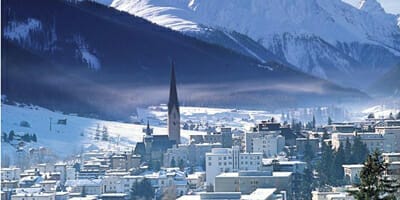
A sustainable financial system on the agenda at Davos

The United Nations Environment Programme’s Inquiry into the Design of a Sustainable Financial System will present its interim report in Davos this week. The report has been initiated to advance policy options to improve the financial system’s effectiveness in mobilising capital towards a green and inclusive economy, and the interim report profiles innovations in five areas including institutional investment.

Here it explores policy changes in three broad areas: capital allocation, investor governance and market incentives in order to align the assets of institutional investors with sustainable development.

The report’s authors are positive about progress, saying that 2015 is poised to be the year of sustainable development, with growing focus on innovative policies to mobilise the trillions of dollars needed for long-term inclusive wealth creation.

The report identifies a number of high potential areas which could contribute to this shift including three major asset pools – banking, bond markets and institutional investors – as well as two emerging policy tools – monetary policy and ‘environmental stress tests’.

The UNEP Inquiry into Design Options for a Sustainable Financial System, now entering the second half of its two-year work program, was created to explore emerging changes and reforms to the financial system that would improve its alignment with sustainable development. Its investigations to date have revealed many innovations in financial and monetary policy, regulation and financial market standards.

The Inquiry is now half way through its work program and will complete its research and engagement at the end of 2015.

Sponsored Content


To access the report, Pathways to Scale, click below

 Inquiry – Pathways to Scale

Leave a Comment

Sort content by

Siguler: buy good quality companies

As the world and companies globalise, George Siguler, managing director and founding partner of private equity firm, Siguler Guff, has a simple recommendation for investors. “My recommendation for stock investors is to look at great global companies,” he says. “Look at companies like Johnson and Johnson, Unilever or Boeing. They all have great balance sheets

A series of shorts
don’t make a long

It is easy for long-term investors to avoid short termism, and the solution lies in avoiding momentum and conducting risk analysis using cash flows – not market pricing. “Diversification is a joke. Diversification and risk analysis relies on pricing, but pricing is distorted because it’s driven by momentum,” says Paul Woolley, chairman of the Paul

ShareAction mainstreams responsible investment

“ShareAction has become the premier organisation to give voice to those who wish to invest their values as well as their assets,” enthused former vice president of the United States Al Gore, speaking to a packed audience at ShareAction’s annual lecture in London’s Guildhall last week. ShareAction is only a tiny pressure group but Gore’s

Cass creates principles
for DC model

As almost every market in the world looks to move from defined benefit to some sort of defined contribution model, academics at the Pensions Institute of the Cass Business School, City University London have developed a set of 15 principles for designing a defined contribution model. The principles, consistent with the recently published OECD guidelines, are based

Pension funds reject EU financial transaction tax

When the European Commission announced plans on February 14 to introduce a Financial Transaction Tax (FTT) by the start of 2014, it planted a bomb under Europe’s pension funds. That is not, of course, the view of Algirdas Šemeta (pictured below right), the EU’s commissioner for taxation. He says the proposed tax is “unquestionably fair

Ugo Bassi focuses on transparency at ICGN

For many people their most memorable in situ news moment is when man landed on the moon or when John Lennon, Princess Diana or Michael Jackson died. But most Italians will remember where they were when Pope Benedict XVI resigned. A country with record unemployment, no head of state and no head of the church

Previous




