


The prevailing view in institutional investment circles, where I have worked on and off for the last two decades, is that investing for explicit social and environmental benefits necessarily undermines financial performance.
“How could we possibly serve two masters?” the argument goes. “By focusing on two bottom lines, surely we do a disservice to both.”
It’s an understandable perspective.
While the performance debate is all but settled when it comes to ESG integration, impact investing represents another giant leap forward in responsible investing.
Where ESG integration refers primarily to the management of material ESG risks across an entire portfolio, including in public markets, impact investing tends to be more targeted, with a focus only on sectors that deliver positive externalities, primarily in private markets, thereby limiting the opportunity set and upping the complexity of putting capital to work.
The problem is that emphasising the constraints inherent in some impact investing strategies represents only one side of the argument.
The opposite perspective contends that, with signs of convergence between business and society all around us, societally driven alpha is being left on the table when investors myopically focus only on the business drivers of value.
It was a point the United Nations made recently in the United Nations Environment Programme Finance Initiative report Rethinking Impact to Finance the SDGs. In the report, UNEP-FI points to new impact-based business models like smart lampposts, which provide wireless broadband connectivity in addition to street lighting. UNEP-FI proposes putting “impact considerations at the heart of our decision-making tools, from public tendering to…financial analysis, [in order] to help align the interests of governments, businesses and capital providers, and ultimately benefit society at large”.
The Business Commission report Better Business, Better World states that there is a $12 trillion market opportunity in building and scaling impactful businesses in four sectors: food and agriculture, cities, energy and materials, and health and wellbeing.
Now, new research from Tideline, in partnership with Impact Capital Managers (ICM)and 13 of the US-based network’s members, sheds more light on how exactly these mostly private equity managers are delivering financial performance through impact.
What we discovered were 10 specific drivers of financial return directly related to the pursuit of an impact objective, organised around three core value-generators familiar to all investment practitioners:
- Accessing unique and high-quality investment opportunities. Impact investment managers leverage unique impact-focused networks, relationships and expertise in sectors like health, education and renewable energy that are increasingly shaping the global economy, thereby unlocking proprietary and high-quality investment opportunities.
- Creating value across the portfolio. Impact investment managers bring market insights and networks that help design more effective products, build authentic brands, and attract differentiated sources of talent and capital, at a time when consumers are increasingly focused on their social and environmental footprint and talented young professionals indicate a strong preference for making a positive impact through their careers.
- Strengthening outcomes through operational rigor and risk management. By focusing on social and environmental outcomes throughout the investment process – integrated with business results – impact investment managers bring additional rigor and discipline to operations, stakeholder engagement and risk management.
Figure 1: The 10 drivers of impact alpha
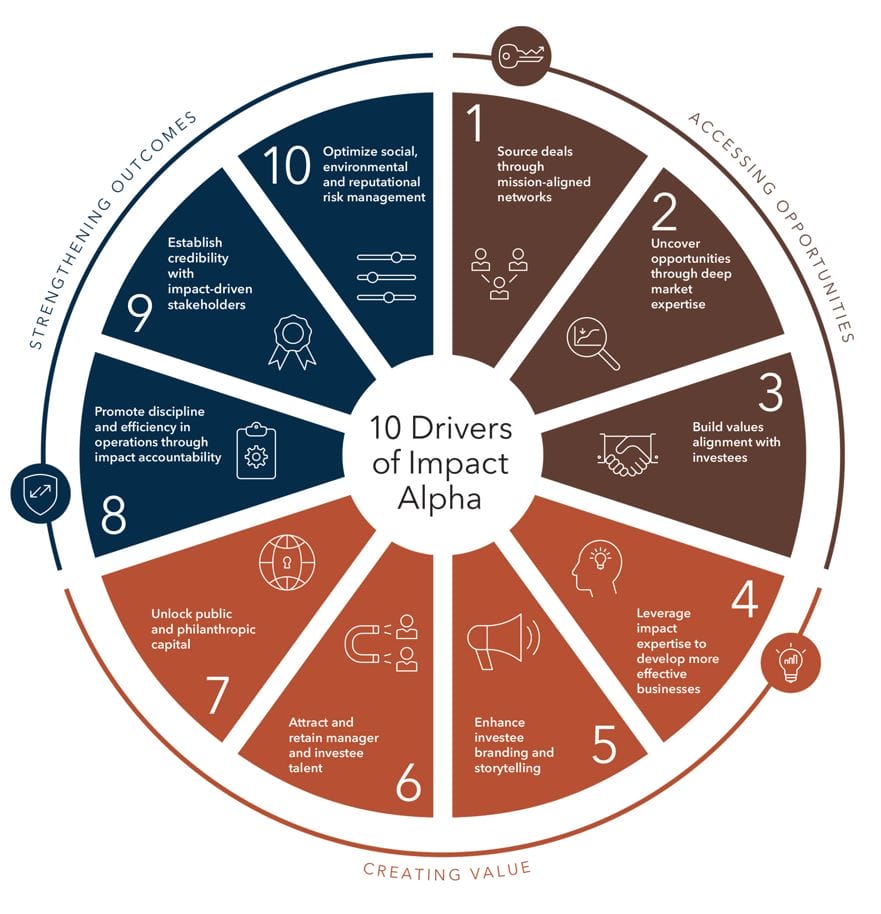
Each of these drivers links to specific sources of financial value, including increased deal flow and higher win rates, more attractive terms at entry, increased revenues, and lower capital and operating costs.
In 2015, Bridges US Sustainable Growth Fund, an impact private equity fund based in New York and London, beat out a bidder that lacked an impact focus to invest inSpringboard Education, a company that provides high-quality after-school programs at public, charter and private schools across the US. The owners of Springboard preferred to partner with an impact investor to deepen their mission and strengthen their social outcomes. Since Bridges’ investment, the company has grown from 50 schools to 110 schools and increased annual revenues 56 per cent.
Bridges’ unique impact perspective also surfaced a US federal government voucher program that could provide a new source of revenue for Springboard, which eventually helped the company increase enrolment in existing schools and forge partnerships with new institutions.
In 2016, another ICM member, Bain Capital Double Impact, invested in Impact Fitness – an operator of low-cost gyms focused on underserved communities in Michigan, Indiana and Canada – as a franchisee of Planet Fitness.
Bain established rules that linked a meaningful part of management bonuses to social metrics, which has proved to be an effective driver of performance. Gym memberships increased by 12 per cent and a strong sense of mission among gym staff has improved morale and reduced turnover 25 per cent among lower-wage employees.
The jury is still out on whether the “enhanced value proposition” argument will win the day over the “constraints” argument for most impact managers, most of the time. Yet there’s no question that, if the job of fiduciaries is to maximise financial returns, the ways performance is likely to be enhanced by managers pursuing explicit impact objectives merit serious attention.
Ben Thornley is a managing partner at Tideline.








Leave a Comment
You must be logged in to post a comment.
Login