
Recession likely in six months: index

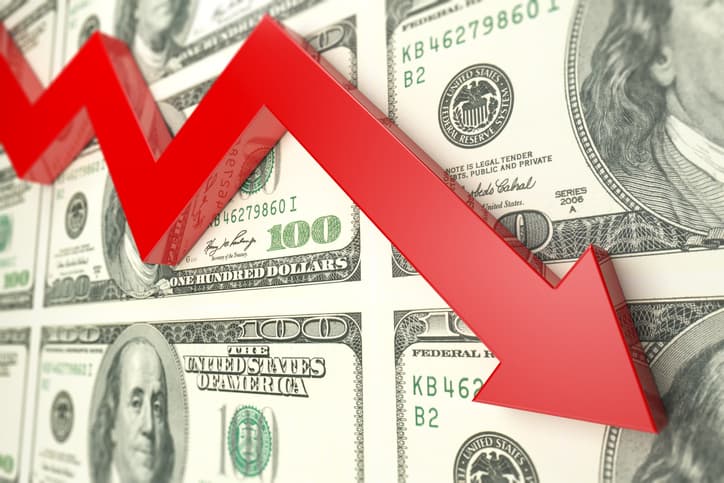
Red arrow And dollar finance decline graph. (Red arrow shows dollar's decline index ) Finance chart, dollar, and red arrow concept.

There is a 70 per cent chance a recession will occur in the next six months, according to a new index measuring the state of the economy that uses a statistical method first applied to analysing human skulls.

The KKT index, named after is creators Will Kinlaw, Mark Kritzman and Dave Turkington, can put a value on the likelihood of a recessionary or growth period over three, six and 18 month periods.

The index diagnoses the condition of the economy by measuring variables considered by the authors to be vital signs, and whether they are more closely associated with the values that prevailed during past recessions or periods of robust growth, and then converting that data into a likelihood.

The economic variables, or vital signs, the authors use are: industrial production which is a proxy for output; nonfarm payrolls, measuring employment; return of the stock market; and the slope of the yield curve, considered by many to be one of the best indicators.

“We can synthesise these four variables into a likelihood of recession,” says Will Kinlaw one of the authors and managing director of State Street Global Markets.

The index uses the Mahalanobis distance, which was originally introduced in 1927 to analyse resemblances in human skulls among castes in India. The authors have since used it in their research for different applications including financial turbulence and foreign exchange markets to observe unusual correlations in currencies. It’s also been used in diagnosing disease and research to correct self-driving cars.

Sponsored Content

In this case, the index can measure the distance a particular set of observations is from what prevails during a recession or growth period. The distance depends on the level of the variables but also on the correlation and interaction effect between them.

“What we like about it, is it converts different types of data into something you can understand,” Kinlaw says. “It’s a very powerful tool as it can convert things to common units.”

Kinlaw said the index spiked up to 70 per cent in September which was the first time since 2009 it has been at that level. It shifted up to 71 last month, and as at January 30 it is at 72.

The likelihood of a recession in the next six months when the index is above the 70 per cent threshold is 70 per cent; the likelihood of a recession in the next 18 months at that level is even higher, at 84 per cent. (see table below)

Looking at history by comparison, the index first rose above 70 around the GFC in January 2007, and before the 1990 recession it first rose to that level in October 1989.

At the moment the main drivers of the index’s position are weak industrial production and the yield curve, and it is getting to above 70 despite the strong stock market.


KKT Index and recession realisations

Above threshold: 50% 60% 70% 80% 90% Unconditional Frequency
This month 35% 42% 52% 61% 86% 13%
Next one month 40% 48% 57% 65% 91% 13%
Next three months 43% 50% 60% 66% 91% 13%
Next six months 54% 61% 70% 77% 91% 17%
Next 12 months 68% 74% 83% 86% 91% 24%
Next 18 months 75% 78% 84% 86% 91% 30%


Kinlaw says the index is quite simple and can be useful for policy makers and investors.

For investors it could be used for stress testing portfolios and scenario analysis. A large sovereign wealth fund is currently using it to measure the likelihood of scenarios in its stress testing, he said.

In stress testing it overcomes the problem of diluted information in volatile periods which can be seen in the typical stress testing process of using average assumptions of standard deviation or correlation.

The authors detail the research behind the index in a MIT Sloan Research Paper titled A New Index of the Business Cycle.


Leave a Comment

La Caisse’s oil exit pays off as renewables portfolio pulls ahead of fossil fuels

La Caisse’s oil exit pays off as renewables portfolio pulls ahead of fossil fuels

Divesting from the oil sector has been a boon for La Caisse’s performance, as the Canadian pension giant says its energy investments have earned billions in value-add compared to the benchmark since the inception of its climate strategy. Head of sustainability Bertrand Millot unpacks the fund’s approach in an interview with Top1000funds.com.

Sort content by

CIOs’ confidence wanes as agility becomes the focus

The 2023 CIO Sentiment Survey, a collaboration between Top1000funds.com and CaseyQuirk, finds asset owners focusing on agility as they observe dramatic market changes not seen in a generation. Only 36 per cent of CIOs are confident they will reach their return targets in 2023.

CalPERS weathers SVB hit; resilience and transparency pays

Norway's sovereign wealth fund and Sweden’s largest pension fund Alecta are among funds with heavy losses from the SVB collapse. For CalPERS, which only had a small exposure, the tumultuous weekend highlighted the importance of resilience and transparency with the team quick to identify exposures and provide analysis.

Investors can’t afford to ignore China risk: Kotkin

A video interview with geopolitical expert Professor Stephen Kotkin looks at the investor implications of the Russia Ukraine conflict, the recalibration in the US China relationship and where the "real" geopolitical risk lies.

Kotkin talks transition, Ukraine war and western resilience

In a sweeping discussion at FIS Maastricht, Professor Stephen Kotkin argues that Ukraine still has a long fight ahead, China has learnt economic strangulation and diplomatic coercion are a better strategy than invasion in Taiwan - and the west must invest more in its financial systems, military alliances and society.

IMF flashes dangers ahead

The worst is yet to come, warns the IMF in its sobering World Economic Outlook report. Investors will increasingly prioritise safe assets with implications for emerging markets while chaos in the UK gilts markets underscores the risks of a policy mistake.

Why liquidity management will be harder in a post-COVID-19 world

CIOs need more sophisticated tools to manage liquidity in a post-COVID world, experts say, now that the DC retirement landscape has been permanently changed following the precedent of early release schemes.

Previous




