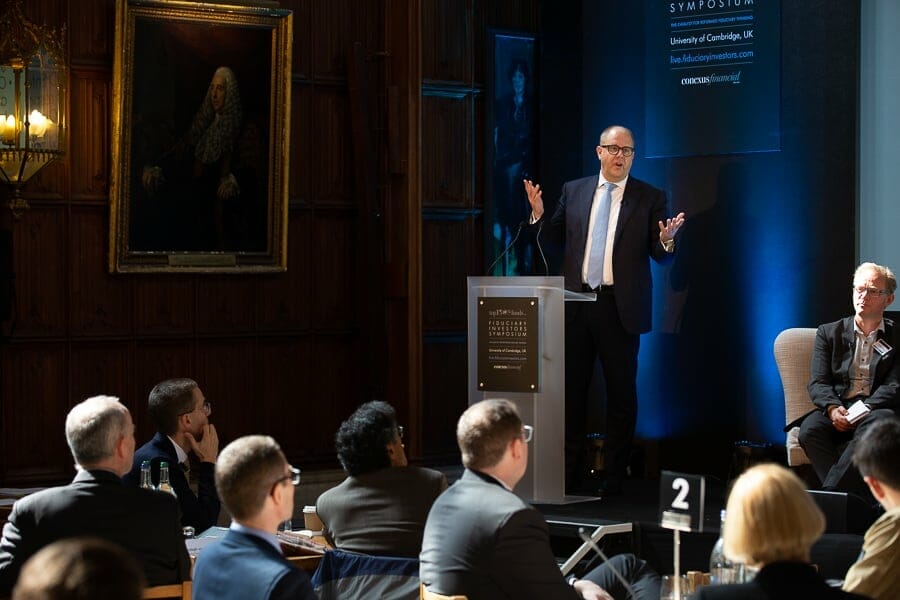

Different ways to navigate risk

Institutional investors are navigating the different risks that can impact their portfolios in different ways, explained chief risk offers speaking at the Fiduciary Investors Symposium in Cambridge. Arjen Pasma, chief risk officer at 211 billion euro Dutch asset manager PGGM noted how risks span investment risk, counterparty risk, liquidity risk and ESG risk.

Measuring ESG risk in the manager’s large allocation to private markets where each deal is scored on ESG and climate risk is particularly important, he said.

Pasma said that an important part of PGGM’s approach to risk comes from a Risk Appetite Statement. This outlines the risk the manager is willing to accept, those risks that it has to accept and those it seeks to avoid. This statement also helps build dialogue around risk, he said. Executives don’t like talking about risk, but it’s important they do because out of this conversation comes a risk tolerance and risk capacity. It also forms the basis of a risk culture.

“Without a risk culture you can never get it right,” he said, noting that a crucial pillar here is an Incident Management Process that avoids a blame culture, but sets out to learn from mistakes when crisis hits. Compensation and staff incentives also play a crucial role in feeding into that culture.

He also noted that one of his key jobs was to “settle down executives” when shocks hit the portfolio. Executives can often spring into “action mode” when analysis and calm informs better results. Moreover, risk teams shouldn’t sit in separate corners of the officer but embed with teams in a process than enables discussion and dialogue, he said.

The 34-strong risk team at BCI Canada does not take on a policing role. Instead the risk team is viewed as a business partner and risk teams are also embedded in the asset class teams.

Sponsored Content

Liquidity risk and the ability of the fund to pay pensions and take advantage of investment opportunities in a downturn, is one of the key risks the fund navigates, said Samir Ben-Tekaya, head of risk at the C$145 billion pension manager.

An important part of this analysis is knowing how long it takes to liquidate assets and here the fund divides its allocations into liquid, highly liquid and illiquid assets.

In a lesson learnt from the financial crisis when liquidity disappeared, the fund has a liquidity ratio where it can stress test potential liquidity supply versus demand in a crisis. This takes into account benefit payments, the fund’s derivatives exposure, cash needed for rebalancing and capital calls arising from private markets.

Danish pension fund ATP invests according to three steps: it believes it needs to take enough risk to ensure a long-term, decent return; it believes it needs to invest in a diversified way which it achieves through it’s factor exposure, and it also believes in stock selection and timing, explained Mads Gosvig, vice president, portfolio construction, ATP.


Leave a Comment

La Caisse’s oil exit pays off as renewables portfolio pulls ahead of fossil fuels

La Caisse’s oil exit pays off as renewables portfolio pulls ahead of fossil fuels

Divesting from the oil sector has been a boon for La Caisse’s performance, as the Canadian pension giant says its energy investments have earned billions in value-add compared to the benchmark since the inception of its climate strategy. Head of sustainability Bertrand Millot unpacks the fund’s approach in an interview with Top1000funds.com.

Sort content by

Asset owners fear rising inflation and falling equity valuations

The 2022 annual CIO Sentiment Survey, a collaboration between Top1000funds.com and CaseyQuirk, finds asset owners most concerned about equity valuations and inflation. After three years of fee rises, asset owners are paying less for investments while CIOs in 2022 are also working with a smaller manager roster.

Beyond traditional portfolio construction: incorporating uncertainty

Incorporating uncertainty into the asset allocation process is a complicated but essential ingredient of building portfolio resilience, something investors are valuing more than ever in an environment where inflation, geopolitical and climate risks dominate. GIC and BlackRock have both developed asset allocation frameworks that incorporate investors’ aversion for uncertainty.

Climate policy key to balancing incoming economic shocks

The methods central banks use to predict inflation are breaking down, and world governments will need to look beyond monetary policy and incorporate fiscal and climate policy levers to balance fragile economies, according to renowned economics professor Warwick McKibbin.

Leverage: Friend or foe?

Against the backdrop of rising rates, market turmoil and pension funds’ ever-growing illiquid allocations, leverage is going to increasingly come under the spotlight. Today’s changing macro picture of increasing interest rates and rising borrowing costs will put pressure on pension funds to ensure financing costs are compensated with expected returns.

Gulf SWFs have most exposure to Russia as crisis grows

Gulf SWFs funds face some of the biggest losses to their investments in Russia, particularly through investing alongside Russia's RDIF, a fund set up to attract foreign capital into the country.

Kotkin warns of Ukraine break up as key geopolitical risk

It is not war between Russia and Ukraine that investors should be concerned about, according to Professor Stephen Kotkin, but the destabilising effects of Russia’s actions that could impact globalisation and harm the west. Watch this video interview with Princeton University's geopolitical expert.

Previous




