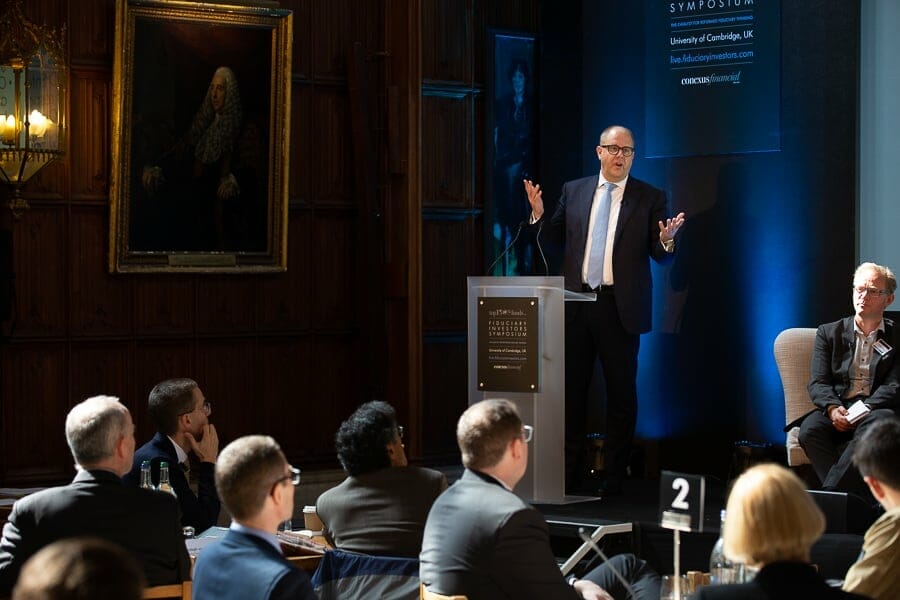

Different ways to navigate risk

Institutional investors are navigating the different risks that can impact their portfolios in different ways, explained chief risk offers speaking at the Fiduciary Investors Symposium in Cambridge. Arjen Pasma, chief risk officer at 211 billion euro Dutch asset manager PGGM noted how risks span investment risk, counterparty risk, liquidity risk and ESG risk.

Measuring ESG risk in the manager’s large allocation to private markets where each deal is scored on ESG and climate risk is particularly important, he said.

Pasma said that an important part of PGGM’s approach to risk comes from a Risk Appetite Statement. This outlines the risk the manager is willing to accept, those risks that it has to accept and those it seeks to avoid. This statement also helps build dialogue around risk, he said. Executives don’t like talking about risk, but it’s important they do because out of this conversation comes a risk tolerance and risk capacity. It also forms the basis of a risk culture.

“Without a risk culture you can never get it right,” he said, noting that a crucial pillar here is an Incident Management Process that avoids a blame culture, but sets out to learn from mistakes when crisis hits. Compensation and staff incentives also play a crucial role in feeding into that culture.

He also noted that one of his key jobs was to “settle down executives” when shocks hit the portfolio. Executives can often spring into “action mode” when analysis and calm informs better results. Moreover, risk teams shouldn’t sit in separate corners of the officer but embed with teams in a process than enables discussion and dialogue, he said.

The 34-strong risk team at BCI Canada does not take on a policing role. Instead the risk team is viewed as a business partner and risk teams are also embedded in the asset class teams.

Sponsored Content

Liquidity risk and the ability of the fund to pay pensions and take advantage of investment opportunities in a downturn, is one of the key risks the fund navigates, said Samir Ben-Tekaya, head of risk at the C$145 billion pension manager.

An important part of this analysis is knowing how long it takes to liquidate assets and here the fund divides its allocations into liquid, highly liquid and illiquid assets.

In a lesson learnt from the financial crisis when liquidity disappeared, the fund has a liquidity ratio where it can stress test potential liquidity supply versus demand in a crisis. This takes into account benefit payments, the fund’s derivatives exposure, cash needed for rebalancing and capital calls arising from private markets.

Danish pension fund ATP invests according to three steps: it believes it needs to take enough risk to ensure a long-term, decent return; it believes it needs to invest in a diversified way which it achieves through it’s factor exposure, and it also believes in stock selection and timing, explained Mads Gosvig, vice president, portfolio construction, ATP.


Leave a Comment

La Caisse’s oil exit pays off as renewables portfolio pulls ahead of fossil fuels

La Caisse’s oil exit pays off as renewables portfolio pulls ahead of fossil fuels

Divesting from the oil sector has been a boon for La Caisse’s performance, as the Canadian pension giant says its energy investments have earned billions in value-add compared to the benchmark since the inception of its climate strategy. Head of sustainability Bertrand Millot unpacks the fund’s approach in an interview with Top1000funds.com.

Sort content by

CIOs’ confidence wanes as agility becomes the focus

The 2023 CIO Sentiment Survey, a collaboration between Top1000funds.com and CaseyQuirk, finds asset owners focusing on agility as they observe dramatic market changes not seen in a generation. Only 36 per cent of CIOs are confident they will reach their return targets in 2023.

CalPERS weathers SVB hit; resilience and transparency pays

Norway's sovereign wealth fund and Sweden’s largest pension fund Alecta are among funds with heavy losses from the SVB collapse. For CalPERS, which only had a small exposure, the tumultuous weekend highlighted the importance of resilience and transparency with the team quick to identify exposures and provide analysis.

Investors can’t afford to ignore China risk: Kotkin

A video interview with geopolitical expert Professor Stephen Kotkin looks at the investor implications of the Russia Ukraine conflict, the recalibration in the US China relationship and where the "real" geopolitical risk lies.

Kotkin talks transition, Ukraine war and western resilience

In a sweeping discussion at FIS Maastricht, Professor Stephen Kotkin argues that Ukraine still has a long fight ahead, China has learnt economic strangulation and diplomatic coercion are a better strategy than invasion in Taiwan - and the west must invest more in its financial systems, military alliances and society.

IMF flashes dangers ahead

The worst is yet to come, warns the IMF in its sobering World Economic Outlook report. Investors will increasingly prioritise safe assets with implications for emerging markets while chaos in the UK gilts markets underscores the risks of a policy mistake.

Why liquidity management will be harder in a post-COVID-19 world

CIOs need more sophisticated tools to manage liquidity in a post-COVID world, experts say, now that the DC retirement landscape has been permanently changed following the precedent of early release schemes.

Previous




