
Emerging market funds need to diversify

Rush hour people movement during Lathmaar Holi Barsana

The extremely low levels of foreign investments in pension funds in emerging countries is cause for concern, according to the World Bank, which is calling for more diversification of portfolios.

A new paper by the World Bank, Pension funds capital markets and the power of diversification, outlines the need for pension funds, in emerging markets in particular, to invest more of their assets internationally in order to achieve higher returns with potentially lower volatility.

The paper calls for a deliberate creation of innovative domestic investment vehicles combined with more reasonable overseas investment limits, based on the size of the pension fund assets relative to macroeconomic and market factors.

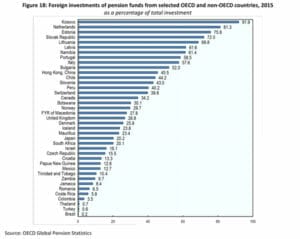
Some countries, including Brazil, Turkey, Thailand, Colombia, Costa Rica and Romania, have less than 7 per cent of their pension assets in foreign investments.

Brazil has less than 0.2 per cent investing offshore, according to the OECD global pension statistics. This compares to the Netherlands, which has 81 per cent of its pension assets invested outside the country.

Some emerging market countries have restrictions on the amount of foreign investments, notably some African countries and India which have a limit of zero.

Sponsored Content

“There is often much resistance to allowing pension fund assets to invest overseas as governments and authorities wish to see domestic savings used for domestic purposes,” the paper says. “Macroeconomic factors clearly play an important role – including foreign exchange regime, capital flows and policy and availability of foreign currency held by a country’s central bank … however, deciding on the amount and allocation of these international investments should be done in a systematic fashion.”

In particular it says that the amount of foreign investment allowed should be linked to the size of a pension fund’s assets compared to the size and turnover of domestic capital markets or flows, and currency movements.

The paper looks at Chile as an example of a country that has more systematically increased its overseas investment limits, raising them as the pension fund assets have grown and become too large for the domestic market.

The regulatory authorities in Peru have also gradually increased their limits on several asset classes.

The paper also points out that improving governance and management is an important precondition for diversifying these portfolios.



Asset Owner:World Bank

Leave a Comment

GIC, Temasek eye trillions of growth in climate adaptation market

GIC, Temasek eye trillions of growth in climate adaptation market

Singapore’s two largest asset owners, GIC and Temasek, see attractive opportunities in climate adaptation solutions – a relatively underfunded area compared to decarbonisation. The former has already made selective adaptation investments and said the opportunity set across public and private debt and equity could increase to $9 trillion by 2050.

Sort content by

Friends or Foes? The Stock Price Impact of Sovereign Wealth

This paper examines the stock price impact of 163 announcements of Sovereign Wealth Fund (SWF) investments. We document an average positive risk-adjusted return of 2.1 percent for target firms during two days surrounding SWF acquisition announcements. The announcement effect is both statistically and economically significant. A multivariate analysis shows that the degree of transparency of

Defining Moments: the future for pension funds and the pension fund industry

The goal of the research was to drill deeply into the evolving forces in the industry and present a plausible picture of its future landscape, through both near-term and longer-term trends. Our time horizon looked out towards 2020. We, however, acknowledge the considerable difficulties with longer-range forecasting given the increasing pace of change. There is

Seize the Opportunity: Investing in US Real Estate

US investors have increased their sophistication in real estate investing – more private real estate, a greater risk appetite and use of synthetic investment tools. Rob Kochis and Christopher Lennon report.mrec4inarticleinline Sponsored Content scnative1 scnative2 scnative3

Infrastructure on the Defensive

The unwinding of several high profile infrastructure funds in the recent past has prompted questions as to the performance of infrastructure assets/investments and the impact of the current credit markets, on the outlook for the sector. Mercer remains positive on the long-term fundamentals for the infrastructure sector, especially in the emerging markets. Moreover, we believe

The Role of Commodities and Timberland in a Portfolio

Over the last several years, institutional investors have more than doubled their allocation, to over $110 billion, to financial products whose returns are linked to those of commodity indices. Commodities may be attractive due to the low correlation between the returns of commodities and those of other asset classes, the high correlation of commodities returns

Hedge Fund Alert: Looking Around the Corner for More Risk and Opportunity

How do current market activities, regulatory changes and dislocations potentially impact the ability of hedge funds to prosper going forward? The huge changes occurring in the markets are having a significant impact on hedge funds, including short sale restrictions, disclosure requirements and the effective elimination of the investment banking model and its attendant impact on

Previous




