
Emerging market funds need to diversify

Rush hour people movement during Lathmaar Holi Barsana

The extremely low levels of foreign investments in pension funds in emerging countries is cause for concern, according to the World Bank, which is calling for more diversification of portfolios.

A new paper by the World Bank, Pension funds capital markets and the power of diversification, outlines the need for pension funds, in emerging markets in particular, to invest more of their assets internationally in order to achieve higher returns with potentially lower volatility.

The paper calls for a deliberate creation of innovative domestic investment vehicles combined with more reasonable overseas investment limits, based on the size of the pension fund assets relative to macroeconomic and market factors.

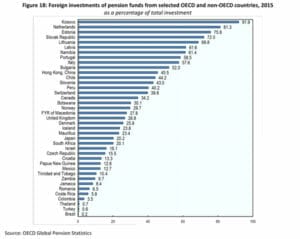
Some countries, including Brazil, Turkey, Thailand, Colombia, Costa Rica and Romania, have less than 7 per cent of their pension assets in foreign investments.

Brazil has less than 0.2 per cent investing offshore, according to the OECD global pension statistics. This compares to the Netherlands, which has 81 per cent of its pension assets invested outside the country.

Some emerging market countries have restrictions on the amount of foreign investments, notably some African countries and India which have a limit of zero.

Sponsored Content

“There is often much resistance to allowing pension fund assets to invest overseas as governments and authorities wish to see domestic savings used for domestic purposes,” the paper says. “Macroeconomic factors clearly play an important role – including foreign exchange regime, capital flows and policy and availability of foreign currency held by a country’s central bank … however, deciding on the amount and allocation of these international investments should be done in a systematic fashion.”

In particular it says that the amount of foreign investment allowed should be linked to the size of a pension fund’s assets compared to the size and turnover of domestic capital markets or flows, and currency movements.

The paper looks at Chile as an example of a country that has more systematically increased its overseas investment limits, raising them as the pension fund assets have grown and become too large for the domestic market.

The regulatory authorities in Peru have also gradually increased their limits on several asset classes.

The paper also points out that improving governance and management is an important precondition for diversifying these portfolios.



Asset Owner:World Bank

Leave a Comment

GIC, Temasek eye trillions of growth in climate adaptation market

GIC, Temasek eye trillions of growth in climate adaptation market

Singapore’s two largest asset owners, GIC and Temasek, see attractive opportunities in climate adaptation solutions – a relatively underfunded area compared to decarbonisation. The former has already made selective adaptation investments and said the opportunity set across public and private debt and equity could increase to $9 trillion by 2050.

Sort content by

Peer Group Comparison – it’s only natural

Peer comparison is not just something that nervous super fund trustees and investment managers do. mrec4inarticleinline Sponsored Content scnative1 scnative2 scnative3

AIMA’s Roadmap to Hedge Funds

One of the great things about hedge funds is that they have provided a field day for academic researchers to write scholarly articles on their risks and returns. Yet, for all of this scholarship, a practical roadmap to hedge funds has remained elusive. Until now. mrec4inarticleinline Sponsored Content scnative1 scnative2 scnative3

Making Sense of Distressed Investment Opportunities

In early 2007, we started advising clients that we thought the next major investment opportunity would be in distressed securities. As the credit crisis has unfolded and the first ripples of this tidal wave have appeared, we have often been asked for our views on how to structure and fund these types of investments  mrec4inarticleinline

Unlocking future value in commercial real estate

The drive towards a sustainable, low-carbon economy presents both risks and opportunities for commercial real estate investors. Here, we consider the potential impacts on rental income, capital value and future investment returns.  mrec4inarticleinline Sponsored Content scnative1 scnative2 scnative3

Investing In Climate Change 2009

One year ago, we published Investing in Climate Change: An Asset Management Perspective. We argued that the growing investment opportunities in climate change were driven by long-term mega-trends that would continue into the foreseeable future. One year on, the absolute necessity to act now to mitigate and adapt to climate change is even more urgent,

Realization Utility: an inbuilt bias to transact

We study the possibility that, aside from standard sources of utility, investors also derive utility from realizing gains and losses on assets that they own. We propose a tractable model of this “realization utility,” derive its predictions, and show that it can shed light on a number of puzzling facts. These include the poor trading

Previous




