
Emerging market funds need to diversify

Rush hour people movement during Lathmaar Holi Barsana

The extremely low levels of foreign investments in pension funds in emerging countries is cause for concern, according to the World Bank, which is calling for more diversification of portfolios.

A new paper by the World Bank, Pension funds capital markets and the power of diversification, outlines the need for pension funds, in emerging markets in particular, to invest more of their assets internationally in order to achieve higher returns with potentially lower volatility.

The paper calls for a deliberate creation of innovative domestic investment vehicles combined with more reasonable overseas investment limits, based on the size of the pension fund assets relative to macroeconomic and market factors.

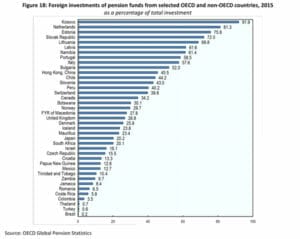
Some countries, including Brazil, Turkey, Thailand, Colombia, Costa Rica and Romania, have less than 7 per cent of their pension assets in foreign investments.

Brazil has less than 0.2 per cent investing offshore, according to the OECD global pension statistics. This compares to the Netherlands, which has 81 per cent of its pension assets invested outside the country.

Some emerging market countries have restrictions on the amount of foreign investments, notably some African countries and India which have a limit of zero.

Sponsored Content

“There is often much resistance to allowing pension fund assets to invest overseas as governments and authorities wish to see domestic savings used for domestic purposes,” the paper says. “Macroeconomic factors clearly play an important role – including foreign exchange regime, capital flows and policy and availability of foreign currency held by a country’s central bank … however, deciding on the amount and allocation of these international investments should be done in a systematic fashion.”

In particular it says that the amount of foreign investment allowed should be linked to the size of a pension fund’s assets compared to the size and turnover of domestic capital markets or flows, and currency movements.

The paper looks at Chile as an example of a country that has more systematically increased its overseas investment limits, raising them as the pension fund assets have grown and become too large for the domestic market.

The regulatory authorities in Peru have also gradually increased their limits on several asset classes.

The paper also points out that improving governance and management is an important precondition for diversifying these portfolios.



Asset Owner:World Bank

Leave a Comment

GIC, Temasek eye trillions of growth in climate adaptation market

GIC, Temasek eye trillions of growth in climate adaptation market

Singapore’s two largest asset owners, GIC and Temasek, see attractive opportunities in climate adaptation solutions – a relatively underfunded area compared to decarbonisation. The former has already made selective adaptation investments and said the opportunity set across public and private debt and equity could increase to $9 trillion by 2050.

Sort content by

Adveq Private Equity Market Assessment and Outlook

Over the last 12 months global financial markets have undergone major corrections following, fundamentally, a break-down in the confidence and trust in the financial system as practiced by the Western world. Along with this break-down we experienced a steep fall in US housing prices, the nationalization of financial institutions, the forced merger and/or failure of

Activist Investing

Activist investing is an investment approach whereby an investor seeks to influence the strategy of a company. Strategy may be very broadly defined to include acquisitions, divestitures, capital structure, dividend policy and board composition, inter alia. We see two broad aspects of this strategy that may exist separately or together. First, activist investing may seek

Is Alpha Just Beta Waiting to be Discovered? What the rise of hedge fund beta means for investors

Alpha is shrinking, and it’s good news for investors. This idea may seem paradoxical. But alpha is really just the portion of a portfolio’s returns that cannot be explained by exposure to common risk factors (betas). With the emergence of new betas, the unexplained portion (alpha) shrinks – alpha gets reclassified as beta. The rise

Basis Risk in Liability-Hedging Strategies

Recent pricing dislocations in U.S. fixed-income markets have illustrated there is more to hedging a liability’s interest rate risk than simply matching its duration. Basis risk – in the context of liability hedging – is the risk that the changes in the market value of assets, designated as a hedge, will deviate from the changes

Diversification With Attitude, parts A and B

Diversification is one of the few reliable ‘free lunches’ in asset markets. Nevertheless, investors do not always extract the best from the available benefits. Many portfolios still carry some concentrated risk exposures. And when diversification is pursued, it often occurs under the shotgun approach of increasing the number of return sources, albeit guided by a

Previous




