
Emerging market funds need to diversify

Rush hour people movement during Lathmaar Holi Barsana

The extremely low levels of foreign investments in pension funds in emerging countries is cause for concern, according to the World Bank, which is calling for more diversification of portfolios.

A new paper by the World Bank, Pension funds capital markets and the power of diversification, outlines the need for pension funds, in emerging markets in particular, to invest more of their assets internationally in order to achieve higher returns with potentially lower volatility.

The paper calls for a deliberate creation of innovative domestic investment vehicles combined with more reasonable overseas investment limits, based on the size of the pension fund assets relative to macroeconomic and market factors.

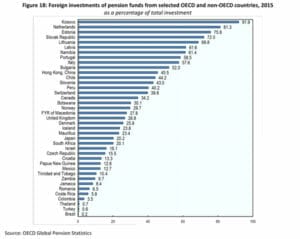
Some countries, including Brazil, Turkey, Thailand, Colombia, Costa Rica and Romania, have less than 7 per cent of their pension assets in foreign investments.

Brazil has less than 0.2 per cent investing offshore, according to the OECD global pension statistics. This compares to the Netherlands, which has 81 per cent of its pension assets invested outside the country.

Some emerging market countries have restrictions on the amount of foreign investments, notably some African countries and India which have a limit of zero.

Sponsored Content

“There is often much resistance to allowing pension fund assets to invest overseas as governments and authorities wish to see domestic savings used for domestic purposes,” the paper says. “Macroeconomic factors clearly play an important role – including foreign exchange regime, capital flows and policy and availability of foreign currency held by a country’s central bank … however, deciding on the amount and allocation of these international investments should be done in a systematic fashion.”

In particular it says that the amount of foreign investment allowed should be linked to the size of a pension fund’s assets compared to the size and turnover of domestic capital markets or flows, and currency movements.

The paper looks at Chile as an example of a country that has more systematically increased its overseas investment limits, raising them as the pension fund assets have grown and become too large for the domestic market.

The regulatory authorities in Peru have also gradually increased their limits on several asset classes.

The paper also points out that improving governance and management is an important precondition for diversifying these portfolios.



Asset Owner:World Bank

Leave a Comment

GIC, Temasek eye trillions of growth in climate adaptation market

GIC, Temasek eye trillions of growth in climate adaptation market

Singapore’s two largest asset owners, GIC and Temasek, see attractive opportunities in climate adaptation solutions – a relatively underfunded area compared to decarbonisation. The former has already made selective adaptation investments and said the opportunity set across public and private debt and equity could increase to $9 trillion by 2050.

Sort content by

Macro sensitive portfolio strategies

This research paper by MSCI defines macro-economic risk as the change in asset value due to persistent shocks to real economic growth. This definition underscores the role of long horizons in macroeconomic risk and the principal issue facing investors: how should asset allocation respond to large macroeconomic shocks, given that their consequences are likely to

What is intergenerational justice?

In the paper Pension Funds, Sovereign-wealth Funds and Intergenerational Justice from the Norwegian School of Economics, those Scandinavians have come up with something better than the national alcohol monopoly: a natty new finance term. “Intergenerational justice” (try saying it thrice after a glass of aquavit) seems to refer to a combination of two things: a

Handy Sandy:
analysing the hurricane

When Hurricane Sandy descended on the east coast of the United States and headed inland, it forced the closure of all the nation’s financial markets. Christopher Finger and Oleg Ruben at MSCI thought this was important because, although there are plenty of precedents for natural disasters in terms of economic impact, the storm was singular

The procyclicality premium

Moving with business cycles, procyclical stocks have been found to yield higher average returns than countercyclical stocks. William Goetzmann and Akiko and Masahiro Watanabe use 50 years of real GDP growth expectations from economists’ surveys to determine forecasted economic states in order to avoid the effects of econometric forecasting model error. The scholars created a

Leverage aversion, efficient frontiers and the efficient region

This paper suggests a new specification for leverage aversion, which may better capture the unique risks of leverage. The authors also introduce mean-variance-leverage efficient frontiers, comparing them with conventional mean-variance efficient frontiers. They conclude that leverage aversion can have a large impact on portfolio choice. Leverage aversion, efficient frontiers and the efficient regionmrec4inarticleinline Sponsored Content

Previous




