
Emerging market funds need to diversify

Rush hour people movement during Lathmaar Holi Barsana

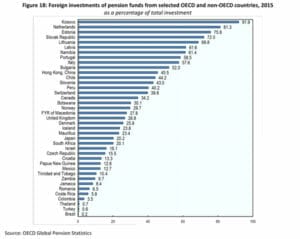
The extremely low levels of foreign investments in pension funds in emerging countries is cause for concern, according to the World Bank, which is calling for more diversification of portfolios.

A new paper by the World Bank, Pension funds capital markets and the power of diversification, outlines the need for pension funds, in emerging markets in particular, to invest more of their assets internationally in order to achieve higher returns with potentially lower volatility.

The paper calls for a deliberate creation of innovative domestic investment vehicles combined with more reasonable overseas investment limits, based on the size of the pension fund assets relative to macroeconomic and market factors.

Some countries, including Brazil, Turkey, Thailand, Colombia, Costa Rica and Romania, have less than 7 per cent of their pension assets in foreign investments.

Brazil has less than 0.2 per cent investing offshore, according to the OECD global pension statistics. This compares to the Netherlands, which has 81 per cent of its pension assets invested outside the country.

Some emerging market countries have restrictions on the amount of foreign investments, notably some African countries and India which have a limit of zero.

Sponsored Content

“There is often much resistance to allowing pension fund assets to invest overseas as governments and authorities wish to see domestic savings used for domestic purposes,” the paper says. “Macroeconomic factors clearly play an important role – including foreign exchange regime, capital flows and policy and availability of foreign currency held by a country’s central bank … however, deciding on the amount and allocation of these international investments should be done in a systematic fashion.”

In particular it says that the amount of foreign investment allowed should be linked to the size of a pension fund’s assets compared to the size and turnover of domestic capital markets or flows, and currency movements.

The paper looks at Chile as an example of a country that has more systematically increased its overseas investment limits, raising them as the pension fund assets have grown and become too large for the domestic market.

The regulatory authorities in Peru have also gradually increased their limits on several asset classes.

The paper also points out that improving governance and management is an important precondition for diversifying these portfolios.



Asset Owner:World Bank

Leave a Comment

GIC, Temasek eye trillions of growth in climate adaptation market

GIC, Temasek eye trillions of growth in climate adaptation market

Singapore’s two largest asset owners, GIC and Temasek, see attractive opportunities in climate adaptation solutions – a relatively underfunded area compared to decarbonisation. The former has already made selective adaptation investments and said the opportunity set across public and private debt and equity could increase to $9 trillion by 2050.

Sort content by

Short-term consequences of long-term risk

Estimates of the equity risk premium suggest higher levels of uncertainty in equities markets, despite the fact daily VIX risk levels have declined. Risk managers need to confront the tension between short-term risk levels and long-term macroeconomic uncertainties. This MSCI research prescribes the need for risk managers and investors to make fuller use of a

Is the emerging markets
concept dated?

Are broad emerging-markets allocations still appropriate? By analysing the trend of mandate configuration, this paper by MSCI looks at whether the emerging-markets concept is dated and whether broad-based emerging-markets investing remains an appealing way to capture economic growth premium. Read the report here.mrec4inarticleinline Sponsored Content scnative1 scnative2 scnative3

UK equity allocation falls

Equity allocation by UK pension schemes continues to fall, but the assets are being re-allocated into “everything else except gilts”, according to Mercer chief investment officer, Andrew Kirton. Last year equities allocations by UK pension funds fell by 5 per cent, according to Mercer, as they attempt to deal with the enormous amount of pension

The ultimate forward rate: implications for Dutch pension plans

A research paper by MSCI examines the implications for Dutch pension plans if the country’s regulators introduce the ultimate forward rate in the construction of the yield curve used to discount pensions’ liabilities to their present value. Read all about it here: Research_Insights_Dutch_Pension_Plans_Sept_2012mrec4inarticleinline Sponsored Content scnative1 scnative2 scnative3

Research: CEO pay peaked in 1990s

In this paper, Steven Kaplan from the University of Chicago Booth School of Business and National Bureau of Economic Research considers the evidence for three common perceptions of US chief executive officer pay and corporate governance. The first is that chief executive officers are overpaid and their pay keeps increasing; the second is that CEOs

The pitfalls of risk modelling

Many portfolio managers use multi-factor models, but these are only as good as the various inputs used to construct them. MSCI looks at how flawed-model construction can result in optimised portfolios that are not efficient. The paper, Is Your Risk Model Letting Your Optimized Portfolio Down?, reveals that faulty risk models tend to underestimate risk

Previous




