
Emerging market funds need to diversify

Rush hour people movement during Lathmaar Holi Barsana

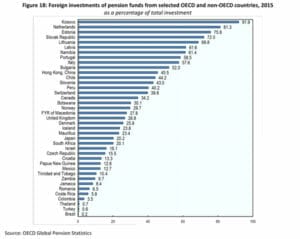
The extremely low levels of foreign investments in pension funds in emerging countries is cause for concern, according to the World Bank, which is calling for more diversification of portfolios.

A new paper by the World Bank, Pension funds capital markets and the power of diversification, outlines the need for pension funds, in emerging markets in particular, to invest more of their assets internationally in order to achieve higher returns with potentially lower volatility.

The paper calls for a deliberate creation of innovative domestic investment vehicles combined with more reasonable overseas investment limits, based on the size of the pension fund assets relative to macroeconomic and market factors.

Some countries, including Brazil, Turkey, Thailand, Colombia, Costa Rica and Romania, have less than 7 per cent of their pension assets in foreign investments.

Brazil has less than 0.2 per cent investing offshore, according to the OECD global pension statistics. This compares to the Netherlands, which has 81 per cent of its pension assets invested outside the country.

Some emerging market countries have restrictions on the amount of foreign investments, notably some African countries and India which have a limit of zero.

Sponsored Content

“There is often much resistance to allowing pension fund assets to invest overseas as governments and authorities wish to see domestic savings used for domestic purposes,” the paper says. “Macroeconomic factors clearly play an important role – including foreign exchange regime, capital flows and policy and availability of foreign currency held by a country’s central bank … however, deciding on the amount and allocation of these international investments should be done in a systematic fashion.”

In particular it says that the amount of foreign investment allowed should be linked to the size of a pension fund’s assets compared to the size and turnover of domestic capital markets or flows, and currency movements.

The paper looks at Chile as an example of a country that has more systematically increased its overseas investment limits, raising them as the pension fund assets have grown and become too large for the domestic market.

The regulatory authorities in Peru have also gradually increased their limits on several asset classes.

The paper also points out that improving governance and management is an important precondition for diversifying these portfolios.



Asset Owner:World Bank

Leave a Comment

GIC, Temasek eye trillions of growth in climate adaptation market

GIC, Temasek eye trillions of growth in climate adaptation market

Singapore’s two largest asset owners, GIC and Temasek, see attractive opportunities in climate adaptation solutions – a relatively underfunded area compared to decarbonisation. The former has already made selective adaptation investments and said the opportunity set across public and private debt and equity could increase to $9 trillion by 2050.

Sort content by

Public pension governance and asset allocation

This paper from Matt Dobra and Bruce Lubich, of the Methodist University in North Carolina and the University of Maryland University College, respectively, analyses the relationship between governance, asset allocation, and risk among state and local government-operated pension systems in the United States of America. It is argued that governance influences investment decisions and risk profiles of public

A Framework for Examining Asset Allocation Alpha

Recognising that different asset allocation portfolios are suitable for investors with different needs, Jason Hsu and Omid Shakernia think it is probably too ambitious to establish a unifying structure for determining benchmark asset allocation portfolios. Instead, they propose a framework for thinking about asset allocation alpha, assuming that investors have suitably determined their asset allocation policy portfolio. And the framework is:

A healthier way to de-risk

Defined-benefit funds all over the world are focused on de-risking but the amount of innovation and players to meet this demand is wanting. Until now. A new report by the Pensions Institute at the Cass Business School examines the emergence of medically enhanced, underwritten or enhanced, bulk buy-ins, in which trustees buy a bulk annuity

Raising ESG ratings with improved returns

While environmental, social and governance factors may be all the rage in investment strategies, the right tools to measure results of their implementation would make tangible what skeptics might think are the emperor’s new clothes. Cue researchers Zoltán Nagy, Doug Cogan and Dan Sinnreich from MSCI with their December 2012 paper, Optimizing ESG Risk Factors

GTAA and institutional investment management

The $70 billion AIMCo uses global tactical asset allocation to help add return in excess of passive portfolios. This research piece details how it has used GTAA over the past few years, advising other funds that executing a successful GTAA requires developing world-class talent, systems, process and governance.   To access the paper click below

How Norway’s SWF deals with FX tail risk

From a risk management perspective, tail risks and return distribution asymmetries of investments are important to analyse. Norges Bank Investment Management (NBIM) in this note describes a modelling approach that addresses some of the weaknesses of standard risk models. It uses the model internally as a complement to standard models to evaluate tail risk in foreign-exchange

Previous




