
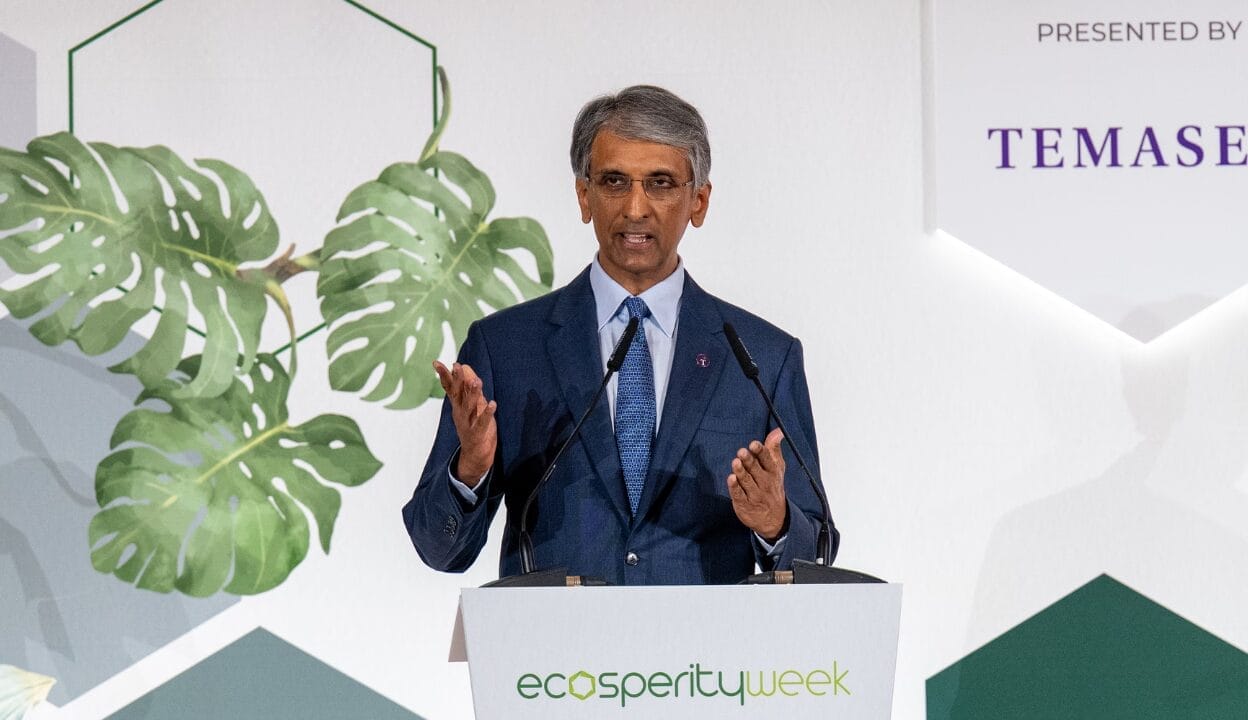

Dilhan Pillay, chief executive of Temasek, said the S$434 billion ($339 billion) Singaporean sovereign investor is likely to miss its 2030 interim climate target as exposures to the aviation and power generation sectors are crimping the investor’s ability to reduce portfolio target emissions.
He stressed that the fund remains committed to achieving net zero by 2050 but said the slower-than-expected decarbonisation rate merely “reflects the realities of the broader global economy”, where technologies and solutions needed to cut emissions in hard-to-abate sectors are not yet economically viable.
Temasek set a target to halve its portfolio emissions to 11 million tCO2e by 2030 compared to the 2010 level of 22 million.
“What we committed to achieving come 2030 still serves as an important directional marker befitting of our ambition and we will continue to press forward on every available lever, but our pace must reflect today’s realities,” Pillay said during an opening ceremony for Ecosperity, the fund’s annual sustainability event.
“The prevailing view was that while the transition would be challenging and costly, there would be a convergence of policy, innovation and capital that would help accelerate the reduction of carbon abatement costs – particularly in hard-to-abate sectors – that would allow us to have a chance to achieve net zero by 2050,” he said, citing the US Inflation Reduction Act an example of such support.
“But today, the world has fundamentally changed.”
In the year to 2025, national carrier Singapore Airlines contributed 43 per cent of Temasek’s total portfolio emissions while Singaporean power company Sembcorp contributed 22 per cent.
Temasek is the largest shareholder in Singapore Airlines, with the investment worth S$20.2 billion ($15.7 billion) at the end of March 2025.
The Singapore Airlines Group (SIA) itself is targeting net-zero carbon emissions by 2050 through investments in new generation aircraft and adoption of sustainable aviation fuels, but the economics are working against that effort. Pillay said sustainable aviation fuels account for less than 1 per cent of global jet fuel supply and remain two to five times more expensive than conventional fuels.
The company delivered earnings above analysts’ expectations last Friday. Its profit was boosted by a 7.7 per cent surge in annual passenger numbers to almost 43 million as travellers opt for direct flights between Asia and Europe, rather than layovers in the Gulf countries due to the Iran war.
“As a shareholder, we are, of course, pleased with this, but on the other hand, with our sustainability cap on, we lament the increase in the emissions arising from this,” Pillay said.
“But if SIA does not do well, it will be debilitated from doing the right thing in terms of fleet renewal and SAF adoption.”
Temasek also holds a controlling stake worth S$11.3 billion ($8.8 billion) in Sembcorp. The company acquired Australia’s Alinta Energy last December, which resulted in a “short-term” increase in emission intensity due to Alinta’s coal plants.
“This is what a just transition looks like in practice. The reality is that the world cannot transition overnight,” Pillay said.
“A credible transition is not simply about shutting assets down quickly – it is about replacing them responsibly, while preserving energy security, affordability, and grid reliability along the way.”
Other challenging sectors to decarbonise in Temasek’s portfolio include agriculture, port operations and data centres, according to its website, with holdings such as agri-food business Olam Group, port operator PSA International and communications company ST Telemedia.
Transport and industrials, as well as financials are the largest sectors in Temasek’s portfolio, representing a 22 per cent allocation each at the end of March 2025. Life sciences and agri-food sector represents 7 per cent.
Meanwhile, it has S$46 billion ($35 billion) or 11 per cent of its portfolio invested in “sustainable living”-aligned assets, which is one of its core ESG themes focused on companies and technologies that advance environmental protection and climate transition.
Pillay said the green premium issue must be addressed to facilitate more scalable deployment of capital from investors, calling for more subsidies and concessional capital as well as innovative financing structure.
Concessional capital, to which Temasek allocated S$100 million ($78 million), can provide more favourable terms for financing ESG-aligned projects, and especially plays an important role in de-risking and attracting larger pools of commercial capital, he added.
“Many economies in Asia remain reliant on imported fossil fuels and are highly exposed to climate risks. This sharpens the trade-offs between growth, energy security, affordability and decarbonisation,” Pillay said.
“The journey will be harder and less linear but it is one we must continue, because the cost of inaction is far higher.
“In this new reality, what matters is not perfection, but progress at scale across real assets, real markets, and real-world impact,” he said.








Leave a Comment
You must be logged in to post a comment.
Login