
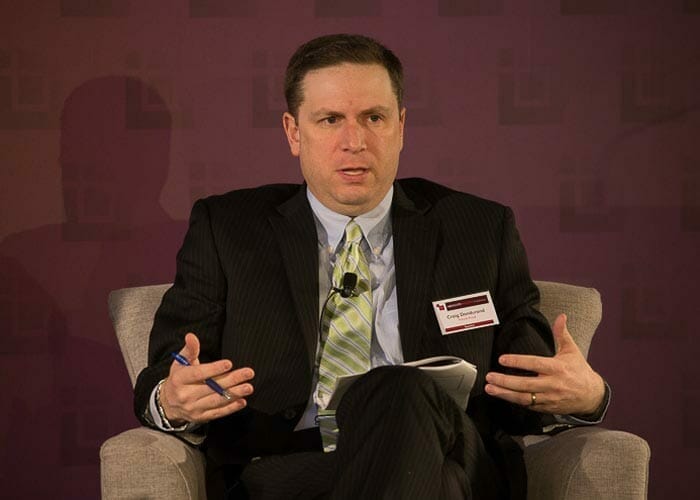

When Californian Craig Dandurand made the move to Melbourne nearly four years ago to join the A$135 billion ($101 billion) Future Fund as director of debt and alternatives, he arrived as the fund’s leadership was embarking upon a rethink about how to structure the portfolio and extract greater value out of managers.
The Future Fund’s current portfolio is distinct from the herd in its ‘barbell’ approach to risk: a heavy allocation to cash at one end of the spectrum and a big bet on absolute-return strategies at the other.
As at September 30, 2017, the Future Fund had an 18.9 per cent allocation to cash and a 15.4 per cent allocation to hedge funds and other alternative risk premia assets.
That compares with averages among local superannuation funds of 6.9 per cent in cash and 10.9 per cent in hedge funds and other alternative risk premia assets, data from SuperRatings shows. Together, the investments in cash, debt and alternatives total $45 billion, or 44.2 per cent of the Future Fund’s total portfolio.
Having a stash of cash at the ready means the fund is well-positioned to take advantage of buying opportunities, should a market correction occur.
In the meantime, a focus on hedge funds and other liquid alternatives is central to the fund’s overall strategy of stripping out beta and focusing on alpha-generating assets.
Dandurand reports to Future Fund head of debt and alternatives David George.
Appetite for alternatives
He admits the magnitude of the allocation to hedge funds and liquid alternatives, which the Future Fund refers to simply as alternatives, can throw people off. He says it is about looking beyond other drivers of performance – such as listed equities, credit and property – to add to the overall resilience of the portfolio.
The allocation is not just about chasing higher returns – it’s also about managing risk. In fact, Dandurand says the motive behind the alternatives strategy is to focus on return sources that diversify the key risks across the total portfolio. A key element of that is using macro-directional and multistrategy managers. The Future Fund also has significant exposures to alternative risk premia in the portfolio, which is part insurance and part other things.
Dandurand made the preceding comments in a wide-ranging interview with Conexus Financial head of institutional content Amanda White, on stage at the 2017 Investment Magazine Absolute Returns Conference, which was held in Sydney on September 14. During the candid talk, he outlined the fund’s for the role of alternatives within the portfolio, and how the fund is reducing costs and extracting additional value by forging stronger relationships with some of the world’s leading hedge funds.
Before joining the Future Fund, Dandurand spent 13 years at the California Public Employees’ Retirement System (CalPERS), the largest public pension plan in the United States, as a specialist alternatives portfolio manager. Prior to starting a career in investments, he was a lawyer and banker.
Sum of the whole
Future Fund chief investment officer Raphael Arndt espouses a whole-of-portfolio approach that requires the investment team to assess risks and opportunities in the context of how they interact across all asset classes. This is distinct from more traditional strategic asset allocation, in which decisions are made in a more siloed way by those responsible for particular parts of the portfolio. For Dandurand, the whole-of-portfolio approach has much appeal. It enables the fund to do more with the alternatives portfolio and simultaneously drive different return streams, rather than looking at things through too narrow an aperture.
One of the most important tasks at the Future Fund has been ensuring currency exposures across the total portfolio are managed more efficiently. As a result of these efforts, the altenatives portfolio now has more AUD denominated exposures, reducing the need to hedge.
“But [currency] is still a material risk to the fund, given the fact that a large majority of our portfolio is held in non-AUD assets,” Dandurand explains.
Alpha and diversification
Managing currency risk has been part of a larger project to recalibrate the alternatives portfolio to deliver greater diversification.
To this end, he has spent the last few years focused on finding “enough genuinely good diversifying things” to sit in the alternatives portfolio. This has enabled the fund to take more meaningful concentrated risk, without imperilling its downside risk profile, he explains.
The first step in revamping the alternatives portfolio was to remove managers entrenched in beta strategies.
“Unless you’re paying them zero, you probably have no chance of being adequately compensated for the cost of doing business with that manager,” Dandurand said.
The Future Fund now gives much greater attention to exploring one-off opportunities with entities that are looking to co-invest. The fund has also identified managers who need some kind of boost at an early stage in order to achieve scale.
This creates the opportunity to build stronger relationships and share ideas.
To demonstrate, Dandurand points to how increased collaboration with private-equity managers has gleaned valuable insights for the debt portfolio.
“If we’re managing a debt portfolio with an awful lot of money into middle-market firms and we don’t spend time talking to our [private-equity] guys about what they’re seeing from their side of the balance sheet, then we’re doing ourselves a disservice,” he says.
The Future Fund employs about 30 external fund managers in hedge funds and liquid alternatives, including: Arrowgrass Capital Partners and Citadel for multi-strategy and relative value exposures; Elementum Advisors and SouthPeak Investment Management for alternative risk premia; and macrodirectional hedge funds such as Brevan Howard Asset Management and Bridgewater Associates.
Dandurand says it’s a challenge for the industry that far too many managers have reached a scale where their incentive to take on enough risk to make the value proposition work well for the investor is gone. One of his priorities has been ensuring all of the Future Fund’s debt and alternatives managers are allocating enough risk, so the value the fund gets for the fees it’s paying for diversification is as high as possible.
Fees in focus
Of course, he is also focused on negotiating a better deal on fees, but says the emphasis is on making sure managers deliver adequate value. Every manager the Future Fund looks at is run through filters to ensure they are delivering a material degree of alpha generation that is generally diversifying, not just from asset classes, but also from the other betas out there.
Nevertheless, there will be times, Dandurand adds, when the fund may have to pay up for a fund it wants, even though it may not be ‘that hot’, based on market filters.
Determining how much to pay for talent is “always a question of supply and demand”, he notes. But costs matter, especially with an outlook for subdued returns.
“If my gross is the same and I paid less in fees, my net is higher, and I like that.








Leave a Comment
You must be logged in to post a comment.
Login