
Looking backwards is a poor way to assess Asia’s future

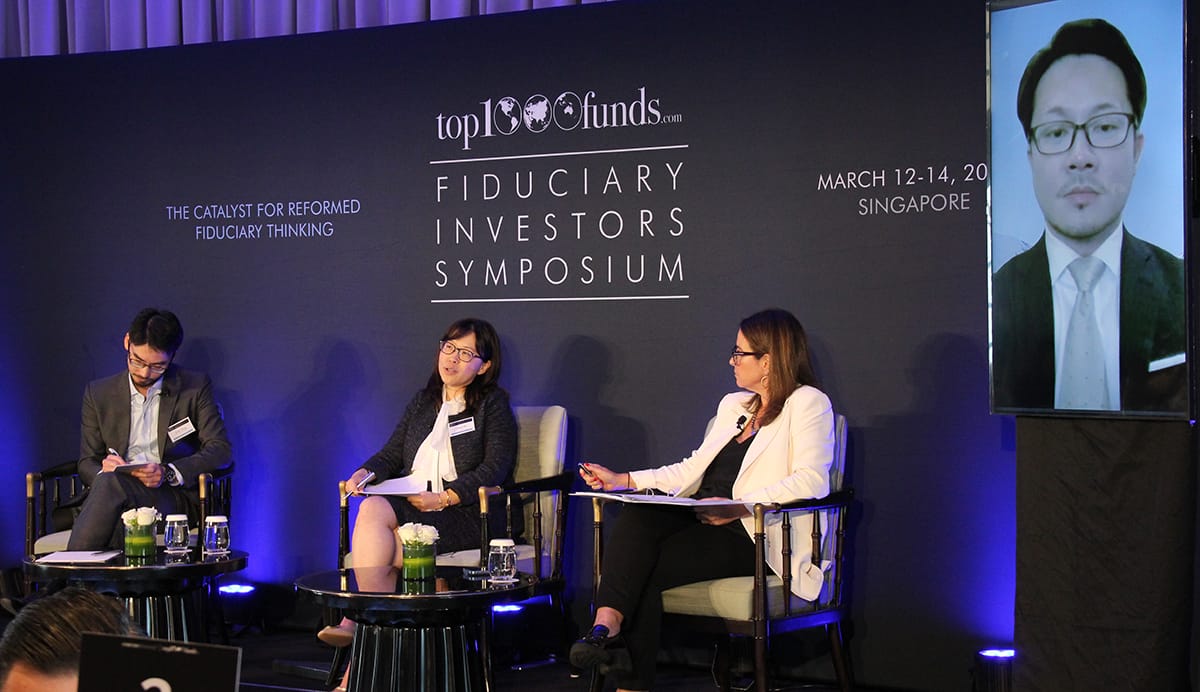
L-R: Andy Wong; Grace Qiu; Top1000funds.com's Amanda White; Kevin Bong (on screen)

The specific drivers of growth for Asian economies means a traditional view of asset allocation is not necessarily the best way to approach investing in the region, the 2024 Top100funds.com Fiduciary Investors Symposium in Singapore has heard.

GIC senior vice president, total portfolio policy and allocation, Grace Qiu told the symposium that the backward-looking nature of benchmarks means that they may not necessarily be the best guides when assessing the potential of developing markets or regions.

Qiu said investors on the ground can often make better decisions.

“Benchmarks may be the best simple and transparent rule-based solution you can come up with in a single asset class. But in a total portfolio context, some of these important decisions can be made by ourselves.”

“As investors, we know the investment objective, the time horizon, and the risk tolerance. So, we should potentially take those decisions in-house, and make the right allocation accordingly.”

Qiu said that in emerging markets “the benchmark may potentially be even worse than…in developed markets”.

Sponsored Content

“Because [the benchmarks] are backward-looking, they’re not really reflective of the true [reason] why we allocate or invest in emerging markets,” she said.

“For us, making more granular decisions on not just the asset class, but also regional allocation, in a consistent manner across the total portfolio is an important task for asset allocation.”

Pictet Asset Management senior investment manager, multi asset Andy Wong agreed that asset allocations based on benchmarks are by definition backward-looking.

“Your variance, covariance matrices [are] mostly backward-looking,” Wong said. “Also, it is quite arbitrarily confined. People say the US economy is doing well, you should buy S&P 500. Actually, half of the revenue is from overseas.”

Wong said he has “a strong view that the semiconductor is the foundation of modern technology”, and being located close to supply chains for major manufacturers provides a useful perspective.

“Understanding some of the bottlenecks, understanding some of where the new technology is going to will help us think about where the world actually globally will be heading next,” Wong said.

Wong said investors shouldn’t use today’s use-case – which might be reflected in current benchmarks – to try to assess the investment potential of technology.

“When Apple was at $200 billion market cap, people were saying that even if every phone in the world is an Apple phone, they were overvalued. At $2.6 trillion today, quite clearly, it’s more than just a phone call machine; it is connectivity, it’s ecosystem, it’s productivity, it’s GPS, iPod, everything in one. All of these things we couldn’t imagine from before.”

Wong said asset allocation needs to be “a little bit more nuanced”.

“You need to look at fundamental drivers,” he said. “If you want to understand risk, you need to understand equities. If you want to understand equities, you need to understand US equities, which is 70 per cent of the market now.

“And then you need to understand Magnificent Seven, you need to understand AI, you need to understand semiconductor. So, from our perspective, themes and ideas are an integral part of asset allocation.”

Senior managing director, chief investment strategist and head of Singapore, AIMCo (Singapore) Kevin Bong said that from a portfolio construction perspective “diversification benefits; differing sector compositions; different stages in the economic and market development cycle; differing political, economic, and policy cycles; they all mean that the investment markets will not be perfectly in sync with what is I think, typically a developed market-heavy portfolio, and most of us have”.

“You could argue that some of it is an unfortunate side effect of slowing or a reversal of globalisation,” Bong said.“But I suppose if the markets give you lemons, you make a lemonade portfolio.”

Bong said that it is “admittedly more aspirational than a reality, but there is always alpha potential in new markets”.

“One could argue that active management opportunities are attractive across the Asia Pacific region, in part because the markets are not as efficient for the most part, but also because there’s meaningful dispersion in the region,” Bong said.

“All of that sums up to a picture where, especially for where we’re starting from Asia is an attractive opportunity.”

Qiu said asset allocation “needs to adapt to the new environment, to the new regime; and under the new environment asset allocation we believe at least, should be more flexible, more deliberate, and more granular.

“What is the next frontier? What is the newest area of innovation in asset allocation that we can think of to actually bring our portfolio to the next step?

“Those activities lie in some of the maybe more traditionally called bottom-up or more granular type of activities that doesn’t necessarily fall into traditional asset allocation mandate or asset allocation job description.”

Leave a Comment

Impact investing’s case for scale

Impact investing’s case for scale

Impact investing has come a long way in the past two decades, going from a niche strategy to a $1.5 trillion industry, but there are still challenges for it to reach institutional scale due to the lack of products and insufficient evidence of outperformance in some parts of the market.

Sort content by

COVID-19 hits retirement system adequacy

COVID-19 has exacerbated retirement insecurity and governments need to use this as an opportunity to examine their system inadequacies and make improvements according to David Knox, partner at Mercer and author of the annual Mercer CFA Institute Global Pension index which measures adequacy, sustainability and integrity of 39 retirement systems.

Verification essential for more impact

A new impact investing verification, which uses the same level of rigor that institutional investors approach the due diligence of fund managers, promises to unlock capital flows into impact and build the necessary scale with integrity needed to address the urgent social, environmental, and economic challenges.

Economic future very precarious: IMF

The global macro-economic future remains precarious amongst huge uncertainties according to the head of the capital markets department at the IMF, Tobias Adrian, who warns of fragilities including the disconnection between the real economy and financial markets, and growing debt, as potential interruption to future growth.

Finance needs to lift its climate game

A recent survey of CFA Institute members showed finance firms are lagging in how they incorporate climate change into the investment process. Matt Orsagh, senior director, capital markets policy at CFA Institute, details steps that can be taken to improve this.

Virtual AGMs stop robust engagement

Watered-down shareholder participation at AGMs, due to virtual meetings during the pandemic, is sounding alarm bells at APG, the largest pension fund in Europe, where collaboration with other asset owners and organisations is the beating heart of its ESG strategy and a central tenet to its stewardship response to the pandemic.

The qualities of successful stewardship

The Investor Mining & Tailings Safety Initiative, chaired by the Church of England Pensions Board and the Swedish Council of Ethics of the AP Funds has won the PRI Stewardship Project of the Year Award. The initiative reveals the qualities of successful stewardship.

Previous



