
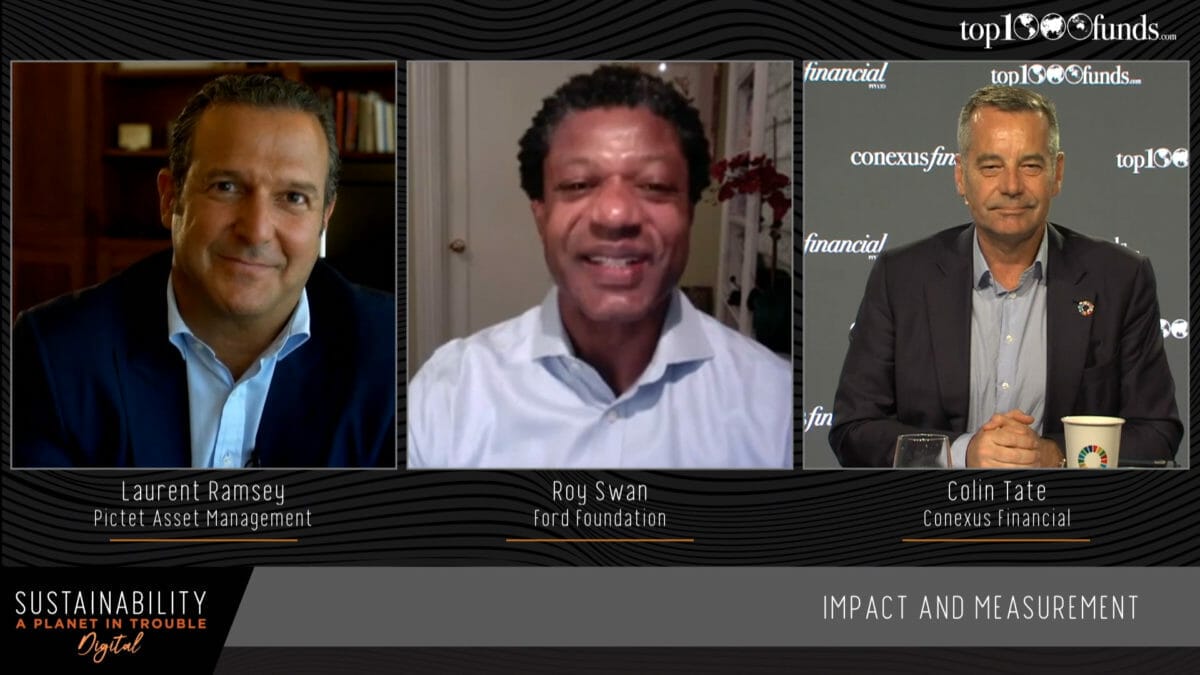

The Ford Foundation outlines its ability to achieve impact and returns and announces plans to invest for impact in public markets in the next 18 months. Elsewhere, renown impact investor Pictet Asset Management explains how impact investment is becoming more mainstream – and should include active engagement.
A key pillar to impact investment at The Ford Foundation includes mandating to diverse fund managers. In what Roy Swan, director, mission investments, at the Foundation called “devastating” statistics, only 1 per cent of the estimated $71 trillion managed by the US investment industry is managed by firms run by women or people of colour. ‘
“Access to capital is access to capitalism,” he told delegates at Sustainability Digital, explaining how the Ford Foundation strives to put more capital into the hands of historically disadvantaged people.
“All those managers will deliver the kinds of financial returns that we believe are important,” he said.
Swan explained that the foundation, America’s largest impact investor, runs a mission-related program that seeks to invest in social problems for a positive impact and appropriate risk-adjusted return. Alongside funding diverse asset managers, investments include social housing as well as investment in financial inclusion and biotech sectors in developing countries. The foundation has exclusively focused on private markets but will expand into public markets in the next 18 months, he said.
Despite measurement being often cited as an obstacle for institutional investors to invest in impact, Swan also explained that the mission investment program avoids sophisticated measurement frameworks because the impact from its investment is clear to see. For example, the shortage of affordable housing in the US means measuring the number of units of housing the foundation can preserve or create is sufficient.
Similarly, the impact of investing in diverse funds managers given the stark lack of investment capital mandated to these managers makes the impact clear. Telling delegates that this “high level approach” would be refined over time, he said the problems the foundation targets loomed large enough to make it possible to “simplistically approach” measuring impact.
Fellow panellist, Laurent Ramsey, managing partner and chief executive of Pictet Asset Management told delegates that there was “no downside” to having an additional impact lens through which to examine factors that could have a material impact on the price of an asset. It helps to mitigate risk and unearth interesting opportunities, he said.
He said that many sustainable strategies had “fared well” through the pandemic. Moreover, public policy and regulation like the EU’s green deal is pushing more capital towards impact investment. Elsewhere, MIFID II regulation will require financial advisors to take account of sustainability risk in their selection of financial products presented to investors in a “structural change that is here to stay.”
Impact is being integrated across asset classes, said Ramsey. It is possible to measure positive impact in private equity and debt and real assets, however he noted that these kinds of investments are difficult to scale. Channelling capital into impact via the public markets is increasing too, he noted.
“It is a pity not to use public markets to drive positive change given the sheer size of public markets,” he said.
He also noted that impact investment in thematic investment and via active ownership – whereby investors not only use their voting rights but engage with companies – had to involve investors ensuring investee companies’ products and services held solutions.
In fixed income he noticed the “acceleration of issuance” in the sustainability space around green bonds linked to impact. For example, Italian energy giant ENEL has issued €1.5 billion bond linked to energy transition targets structured so that failing to meet the targets gives a higher return to investors. At under 1 per cent of outstanding debt, he said it is still “a small space,” but with tailwinds and governments creating incentives, impact in fixed income it also sure to grow.
He said one of the best ways to measure impact in public markets was via engagement.
“Over the years you can push them to divest from activities. When you engage in public markets you have a better sense of that measurability,” he said.
Ramsey told delegates that the fund manager has only recently seen a spike in investor demand for impact. Strategies include investing in a fund to help solve water scarcity, that celebrates its 20 year anniversary, as well as thematic investments that look at mega trends and structural changes in the economy.
Ramsey added that impact differed to mainstream ESG because it involved ensuring the products and services offered by investee companies held solutions. When Pictet created its water strategy the firm had the double benefit of investing in companies generating above average growth rates and good financial returns, alongside allocating capital to companies providing solutions. He also noted that it is now possible to draw on more scientific research to allow more precision in investing for impact, adding that engagement is a crucial piece of the puzzle.
“Even these companies providing solutions have areas of their business they can do better, engaging with management is rewarding in terms of transition and returns,” he said.
Elsewhere Ramsey noted that Pictet’s partnership model has aided and abetted its impact strategy because it lends to the long-term.
“We are a custodian of the company for the future,” he said, adding that by not being listed Pictet can serve all stakeholders and is not trying to satisfy only shareholders. “A partnership structure and sustainability make a good framework,” he said.
He also stressed the close connection between impact and returns. Pictet’s water fund has outperformed world equity markets 17 years of the last 20 years.
“It doesn’t happen every time,” he said. “But there is evidence that the impact lens and identifying themes that benefit from the transition can be rewarding.”
At the Ford Foundation, which has to return 8 per cent a year, returns are clearly superior in some impact areas like affordable housing where Swan noted the gap between actual and perceived risk. “The risk is low versus the returns,” he said.
For the full recording of this session, all the conference sessions, relevant white papers and stories visit the Sustainability content hub here.







Leave a Comment
You must be logged in to post a comment.
Login